
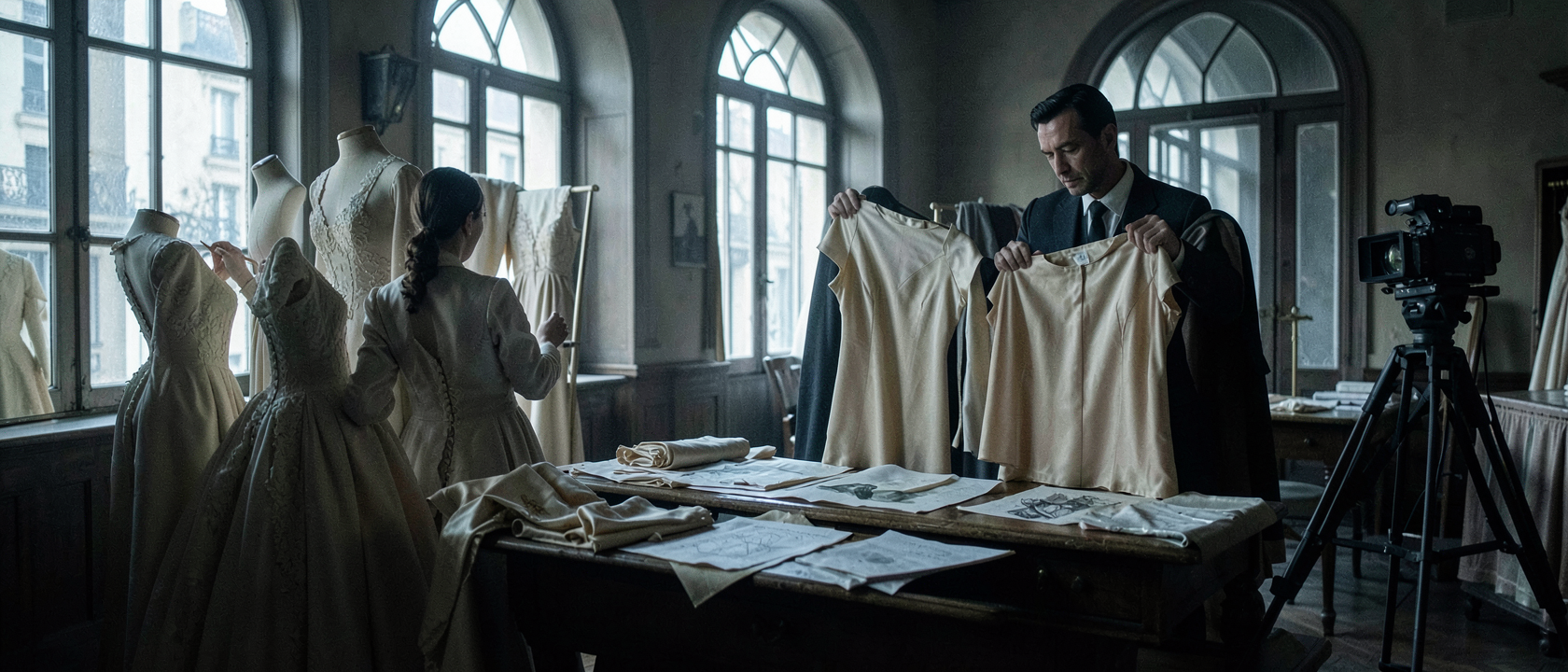
A Vionnet Gown, Cheaply Copied
In the late 1920s, a gown that left Madeleine Vionnet’s workshop in Paris could appear within weeks in an American department store, cut from cheaper fabric and sold for far below its original price. No one had faked a label or a trademark. The design itself, the cut, the drape, the seams, had simply been copied, and American law had nothing to say about it.
The method was simple. A buyer, known in the trade as a “style pirate,” attended a Paris showing or gained access to one, had a copy cut soon after, and shipped it across the Atlantic faster than any French house could respond. Vionnet fought back on her own terms, photographing every model she produced, dating and numbering each photograph, and adding a logo and signature meant to prove which garment was genuinely hers. It rarely stopped a New York shop from selling an identical copy for far less.
Art in Paris, Function in New York
The gap was not an accident of enforcement. It was built into two different legal traditions. French copyright law, in substance since 1902, drew no line between fine art and applied art, so a couture design counted as an authored work, the designer’s property in the same sense as a painting.
American law classified a dress as a useful, functional object, legally no different from a chair or a shoe, and functional objects could not be copyrighted. The only alternative, a design patent, was slow and expensive, built for inventions, not for a trade that moved every few months with the season. This was not an oversight Congress simply forgot to fix. It was a settled legal position that barely moved for the rest of the century.
Suing the Copyists
French houses used the law they had. They filed police complaints and lawsuits against domestic copyists, and the Paris house of Lebrun became a documented target, accused of stitching counterfeit couture labels into cheap reproductions.
None of it reached America. A judgment against a French counterfeiter carried no weight across the Atlantic. In the 1930s, couture houses organized the Protection artistique des industries saisonnières, known as PAIS, to pursue piracy through lawsuits on a collective basis rather than house by house.
FOGA and the Americans Who Wanted In, and the Ones Who Didn’t
On the American side, an answer took shape in 1932, when the Fashion Originators’ Guild of America, FOGA, was incorporated in New York. Members pledged not to deal in copied designs. A Piracy Committee judged which registered designs counted as original, and the Guild enforced its pledge by refusing to sell to any retailer caught stocking a copy, a practice known inside the trade as “red-carding.” By the end of 1935, roughly twelve thousand retailers had signed on, and at its height the Guild was registering about four thousand new designs a month.
It had no shortage of enemies. Manufacturers who had built entire businesses on copying had no reason to join an effort meant to stop them, and piracy was, simply, legal. FOGA was the first real American attempt at industry self-policing without a statute behind it, run entirely on trade pressure rather than law, which made it fragile by design.
The 1939 Agreement, and the War That Ended It
The two sides reached their closest point of cooperation in 1939. PAIS and FOGA agreed to jointly screen shipments suspected of serving “model renters,” the intermediaries who supplied sample garments for copying. It was cross-border enforcement built on cooperation alone, with no treaty behind it, and how far the screening actually went before it mattered is not recorded.
It barely had time to be tested. War broke out in Europe in September 1939, and the ordinary traffic between Paris and New York, buyers, samples, showings, the whole rhythm the arrangement depended on, was cut off almost at once.
The Bill: A Billion Dollars and a Law That Never Came
By one estimate, French couture houses lost the equivalent of roughly a billion U.S. dollars in 2011 terms to piracy in the late 1920s alone. The figure comes from later research, not a contemporary account kept by the houses at the time, and should be read as an estimate rather than an audited sum.
The war did more than pause the PAIS-FOGA arrangement; there is no record it ever resumed on the same terms. FOGA did not last much longer either: in 1941 the Supreme Court ruled its red-card system violated American antitrust law, closing off even the voluntary defense American manufacturers had managed to build.
What never arrived was a statute. Bills to extend copyright-style protection to fashion design have been introduced in Congress repeatedly in the decades since, and have repeatedly stalled. The gap identified in the late 1920s, a dress copied stitch for stitch and sold legally within a season, has never been closed. It still shows up each awards season, when a knockoff of a red-carpet gown reaches stores within days, legally, because the protection Vionnet and her peers wanted was never written into American law. The houses paid in lost sales and in work that went uncredited; once a design left Paris, it belonged to whoever could cut it fastest.
What We Don’t Actually Know
Some things the record does not settle. How effective PAIS’s lawsuits actually were at stopping copyists, rather than punishing a handful of them, is not established. How far PAIS and FOGA’s cooperation went before 1939, beyond the single screening agreement, is not documented either.
The billion-dollar figure needs the same caution: it is a modern calculation, drawn from the research of historian Véronique Pouillard, not a sum anyone totaled up at the time. And Pouillard’s claim that the French press played down the rise of a distinct American fashion identity during the Depression is her own reading of the coverage, not an independently confirmed fact. It belongs in the story as interpretation, not as settled history.