
Sixty Copies
In April 1939, John Steinbeck published The Grapes of Wrath, a novel about an Oklahoma farm family pushed west by drought and debt into California’s fields. It sold fast from the start.
In Kern County, the setting the book described, the county librarian, Gretchen Knief, saw the early notices and expected demand. She ordered 60 copies for the county’s library branches, a routine purchase for a title everyone was talking about. Knief ran a library system. She was not a political figure, and nothing about the order suggested otherwise.
Four months later, that order would sit at the center of a fight she had not asked for.
A County Transformed
Between 1935 and 1940, more than 52,000 migrants arrived in Kern County, an increase of 64 percent in the county’s population. Most had come from the southern plains, driven out by failed farms and pulled in by seasonal agricultural work.
The county’s political structures were dominated by agricultural interests, and those interests had no appetite for relief programs aimed at the new arrivals. The Associated Farmers, an organization formed by the California Farm Bureau Federation and the state Chamber of Commerce to fight organized labor, backed vigilante action against striking farmworkers and fought federal plans to build camps for migrant families.
For growers who depended on cheap, unorganized labor, a bestselling novel describing county officials and farmers as cruel toward the people they employed was not a literary complaint. It was a threat to reputation, and to control over a workforce the county’s economy ran on.
The Kansas City Precedent
By mid-1939, a news report had reached Kern County officials: the Kansas City Board of Education had ordered the book pulled from the city’s public libraries. Kern County did not invent the idea of banning The Grapes of Wrath. It picked one up that was already making headlines elsewhere.
The Kansas City action gave local officials a template, and something to point to if anyone asked why.
The Vote
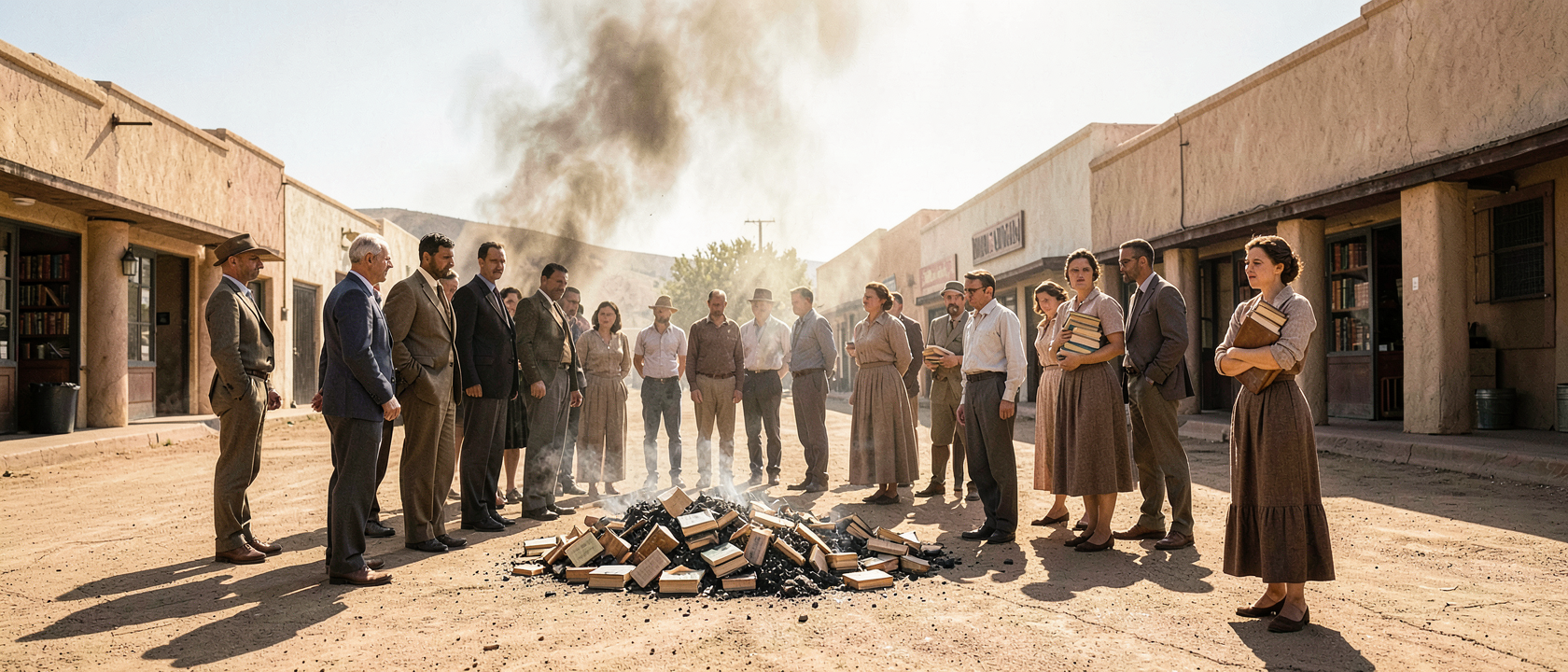
On August 21, 1939, the Kern County Board of Supervisors voted 4 to 1 to ban The Grapes of Wrath from the county’s libraries and schools. Gretchen Knief had no advance warning. The measure was introduced by board member Stanley Abel, a former member of the Ku Klux Klan, acting at the urging of the Associated Farmers.
The resolution accused Steinbeck of presenting county officials, farmers, and citizens as inhumane vigilantes, in its own words, breathing class hatred and stripped of sympathy or decency, while ignoring the aid the county had actually given migrants. It also cited the book’s coarse language as a reason to remove it.
The vote was close, four to one, and it put a board member with a documented past in the Ku Klux Klan at the front of a campaign organized by growers who had spent years fighting labor unions in the same fields Steinbeck wrote about.
Knief’s Quiet Defiance
Knief pulled the book from the shelves, as the board ordered. More than 600 Kern County residents were on waiting lists for it at the time.
She did not destroy the copies she removed. She shipped Kern County’s unused stock to other California library systems seeing demand of their own, and kept doing it until Abel told her to stop.
She also put her objection on the record in a letter to the board, writing that banning books solved nothing, since ideas do not die just because a book is forbidden reading.
At the board’s next meeting, people showed up to say so in person: clergy, county health workers, migrants, union representatives, and the American Civil Liberties Union all spoke against the ban.
A Ban That Didn’t Catch
Within days of the Kern County vote, other local boards across California began weighing bans of their own, encouraged by conservative and pro-business groups watching how the county had handled it. None of them went through with it. By the fall of 1939, Kern County stood alone as the only California county to actually enact a ban.
The Backfire
The ban turned Kern County and the Associated Farmers into a story in newspapers across California and beyond, and not a flattering one. The coverage did not quiet interest in the book. It fed it. Libraries elsewhere in the state reported rising demand for The Grapes of Wrath as the controversy spread, which was the opposite of what the ban had set out to do.
The Rescission and the Spin
In January 1941, roughly a year and five months after the vote, the Kern County Board of Supervisors reversed itself and put the book back on library shelves.
By then, Abel and the Associated Farmers had settled on a new account of their own campaign. They said the ban had never really been about suppressing the book at all, that the whole point had been to draw attention to it and help Steinbeck reach more readers. No independent source confirms this was their actual motive at the time of the vote; it is the explanation they offered once the controversy had already cost them a year and a half of unflattering headlines.
What the Record Doesn’t Settle
Historian Marci Lingo, whose research in Libraries & Culture provides the basis for this account, found no way to confirm whether Abel’s explanation was sincere or an excuse built after the fact to cover an embarrassment. The sources don’t say, and neither do we.
They also don’t give an exact count of how many California boards seriously considered bans of their own, only that several did and backed away, and they don’t put a figure on how much library demand actually rose elsewhere once the controversy spread. The record describes a surge. It does not measure one.
What remains is a sequence of documented facts: a 4-to-1 vote, a resolution citing cruelty and coarse language, a waiting list of more than 600 names, a reversal seventeen months later, and a claim about motive that no one has been able to check. The paper trail runs out exactly where the more interesting question starts, and that gap is part of the record too.