
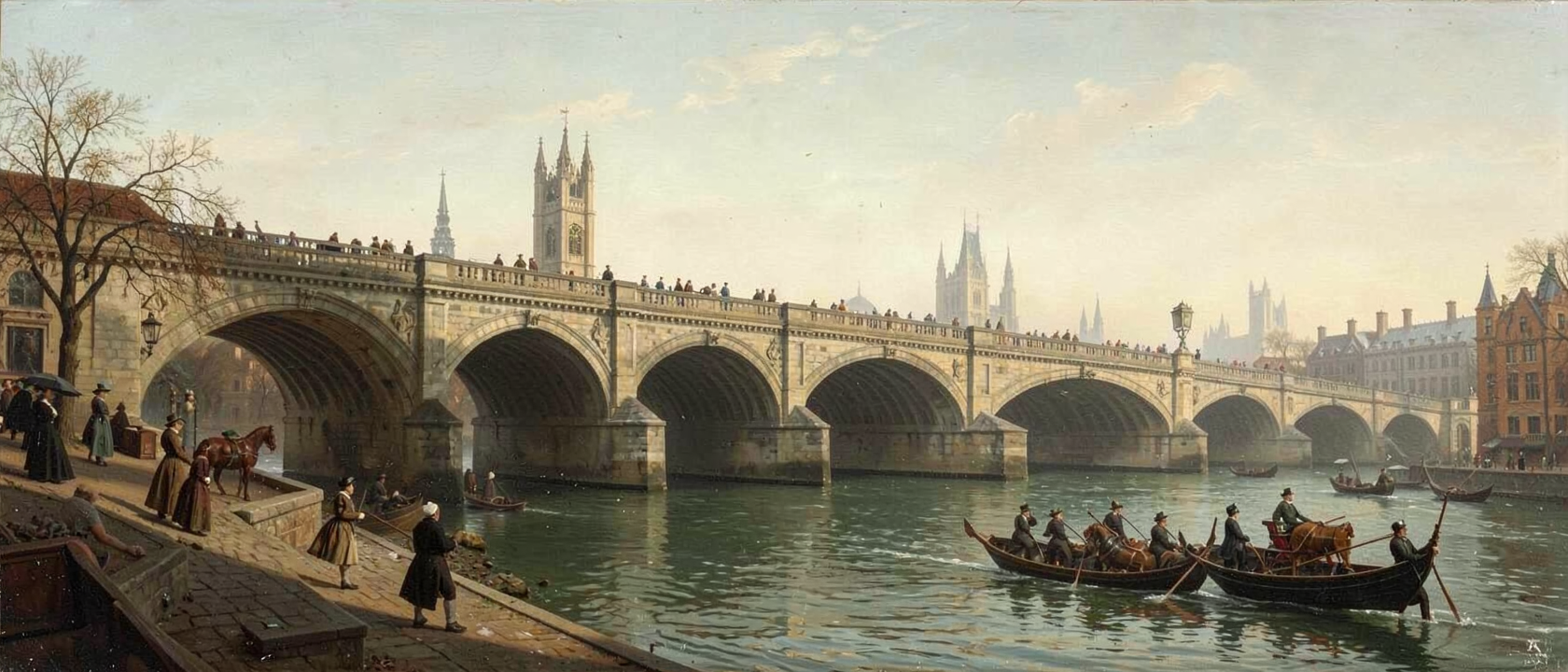
The Only Bridge for Miles
Around 1700, anyone wanting to cross the Thames in London had exactly one option within the built-up city: London Bridge. The crossing was already old by then. Around AD 50 the Romans put up a first bridge on the site; the Saxons replaced it with one in timber, and that wooden structure was rebuilt again and again until the last timber version went up in 1163.
Past that single crossing there was nothing. A traveler heading upstream would find no other bridge until Kingston upon Thames, well outside the built-up city. Below Kingston, the only way over the water was by boat.
That gap kept a trade alive. London’s watermen rowed passengers across the river and along it, filling the space no bridge occupied. They had organized themselves into a City guild back in 1514, regulating who could work the river and training the apprentices who would carry the trade forward. By 1700 that guild, the Company of Watermen, had been running for close to two centuries on one simple fact: London Bridge was the only way across for anyone without a boat of their own.
Two Blows to the City
Within two years, London absorbed two disasters. The Great Plague moved through the city in 1665, killing residents inside the old walls. The Great Fire followed in 1666, burning through much of what the plague had left and destroying large parts of the built-up City of London.
Neither event comes with precise figures in the account behind this piece, but the direction is plain enough: a city that had just lost people to disease then lost buildings to fire. The question left hanging in 1666 was not abstract. Would London shrink to match what remained of it, rebuild to its old limits, or grow past them? Nobody standing in the ashes that year could have answered that.
Faster and Bigger Than Anyone Expected
London did not shrink. Rebuilding after 1666 moved quickly, and it did not stop at replacing what the fire had taken. By 1684, the diarist John Evelyn looked at what the city had become and did not approve of it. He called London’s growth a “mad intemperance,” a judgment made by someone watching it happen, not a later writer’s verdict handed down after the fact.
Evelyn’s complaint only makes sense against what had actually occurred. London’s recovery had gone well past the bounds anyone rebuilding after a fire would normally expect to hold to. The City was not simply restored. It was larger than before.
Gardens Into Streets
The growth Evelyn objected to did not come from a single plan. According to the historian Sir Arthur Bryant, it came from a steady, piecemeal process: the gardens and grounds of large estates ringing the City were built over, year after year, with houses and shops.
This was not confined to the ground the fire had burned. Land with no connection to the 1666 damage was being absorbed into the same pattern. The practical effect was that “London” stopped meaning the area inside the old City walls and came to mean something far larger: the whole built-up region spreading out from it. Nobody voted on that change of meaning. It accumulated, estate by estate, through the final decades of the seventeenth century.
Defoe’s Proposal
By the early 1700s, the gap between London’s formal boundaries and its real extent was wide enough that Daniel Defoe proposed closing it on paper. Among a set of ideas he put forward for improving the city’s appearance, Defoe suggested formally merging the City of London with Southwark, across the river, into a single city under one name: London.
Defoe was not describing something new. He was responding to something that had already happened. The City and Southwark already functioned, for most practical purposes, as one urban mass; his proposal simply asked the law to catch up with the geography on the ground.
Six Bridges by 1800, Against the Odds
The single-crossing arrangement that had defined the Thames around 1700 did not survive the century. By 1800, six new bridges had been built across the river, ending London’s dependence on London Bridge as the only route over the water below Kingston.
None of them went up without a fight. The account behind this piece states plainly that powerful vested interests lobbied against new bridges at every turn, interests whose income depended on there being no alternative to a boat. The watermen, organized since 1514 into their own City guild, had the clearest stake in keeping the river unbridged. What the account does not say is whether they, or anyone else standing to lose from a new bridge, ever received anything for it.
What the Record Leaves Out
The title behind this story promises a fight between watermen and a new bridge. The surviving account does not deliver it. It does not name the six bridges built by 1800, give dates for when each one opened, or describe how the opposition actually played out: what arguments were used, what tactics were tried, who won any concession at all.
Other records fill in part of that gap, though not all of it. A bridge proposed near Westminster in 1664 was stopped after the Archbishop of Canterbury, who profited from the ferry there, and the Mayor of London objected to it; the City of London later thanked King Charles II in writing for preventing a bridge it called “of dangerous consequence to the state of this City.” A second attempt in 1721 drew formal petitions against it from the City, the Company of Watermen, bargemen from the West Country, the borough of Southwark, and the people who actually lived on London Bridge. Three of the eventual six bridges can be named with confidence: Putney Bridge, built in wood and opened in 1729; Westminster Bridge, built in stone and finally opened in 1750 after Parliament overruled the City’s long-standing objections; and Blackfriars Bridge, which followed later in the century. At Westminster, at least, compensation was paid: the bridge’s backers paid off the operators of the old ferry crossing and the local watermen for the business the new bridge would take from them.
The other three bridges, and the full story of how their builders got past the opposition, are not part of the record used here. The guild that fought those bridges is still in existence, still training apprentices for a trade the river no longer requires the way it once did.