
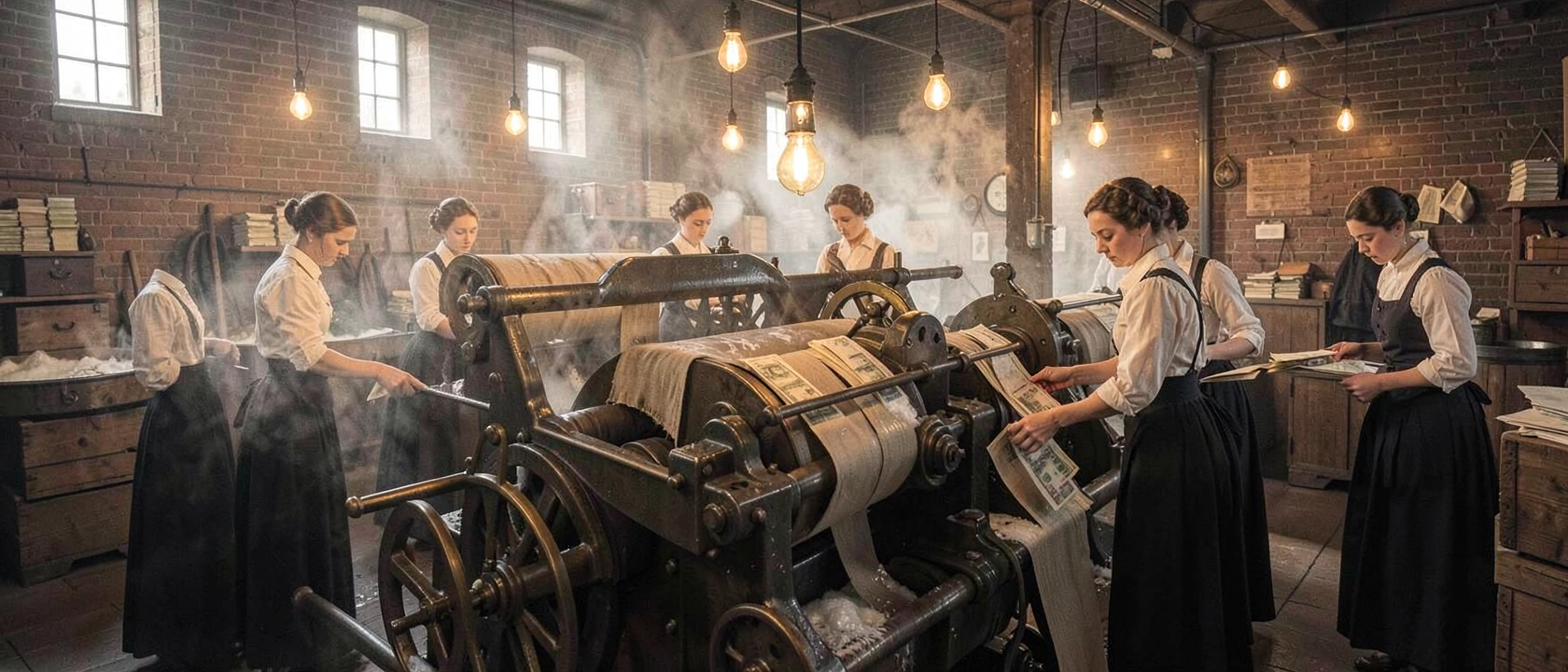
Say “money laundering” and most people picture cartel cash moving through shell companies, not a civil servant ironing dollar bills. But the first recorded use of the phrase, in an official US government document, describes exactly that: a machine in a Treasury basement that washed and pressed dirty money back into circulation.
A Basement in Washington, 1910
In 1910, in the basement of the Bureau of Engraving and Printing in Washington, D.C. the US Treasury put a new piece of equipment to work. It had been built by Burgess Smith, a chemist on the bureau’s staff, to solve a narrow, practical problem: what to do with paper currency too soiled to keep handling. Smith’s device took worn bills, ran them through a washing and disinfecting process, and then pressed them flat and stiff again, so they could go back into circulation looking close to new rather than being thrown away. The process depended on a detail built into the money itself. US bills were printed on a blend of cotton and linen, a fabric that could survive a soaking that ordinary paper could not.
Before the Wash: What a Dirty Dollar Cost
Before Smith’s machine, the Treasury had one response to a worn-out bill: destroy it. A soiled note turned in for redemption went into the macerator, was pulped beyond use, and a fresh one was printed to replace it. Small-denomination bills, handled constantly in shops and across counters, lasted just over a year before they were too grimy or torn to stay in circulation. There was no middle option between “good enough to pass” and “pulp it.” Joseph E. Ralph, director of the Bureau of Engraving and Printing at the time, had been looking for a way to stretch that lifespan, since every replaced bill meant paying twice for the same dollar: once to print it, and again a year or so later to print its successor.
The Numbers: 25,000 Notes a Day
By April 1912, the washing machine had been running long enough for the Treasurer of the United States, Lee McClung, to put figures to it in a report to Secretary of the Treasury Franklin MacVeagh. According to that account, the apparatus could process about 25,000 banknotes a day. Of the bills submitted to the Treasury for redemption, an estimated 60 percent could now be cleaned and restored rather than destroyed and reprinted. A separate contemporary account puts the machine’s capacity far higher, at up to 80,000 notes a day, but that figure has never been checked against a primary Treasury record, so the lower number is the one with a documented paper trail behind it. McClung’s point to MacVeagh was straightforward: the public would get cleaner money, and the government would spend less to provide it.
The Bill, and the Savings
McClung’s report attached a dollar figure to the idea: an estimated $250,000 a year in printing costs avoided, money that would otherwise have gone into pulping usable currency and striking new bills to take its place. One later account converts that into roughly $8.1 million in today’s money, though it does not say what year that conversion was calculated against, so it should be read as a rough sense of scale rather than a precise inflation figure. Looked at plainly, this is an unusual case of government bureaucracy: a program that saved the Treasury money while also making the product better, cleaner bills for anyone who touched them, at a lower cost to the taxpayer. That reading is an observation about the numbers, not a line from McClung’s own report.
Where the Paper Trail Runs Out
One dated document survives from this episode. A Senate record from August 16, 1912, titled “Money-Laundering Machines,” is a letter from the Acting Secretary of the Treasury requesting $60,000 to install, maintain, and run these devices through fiscal year 1913. That is the earliest confirmed appearance of the phrase in an official US government record, written in flat budget language, not coined for effect. Past that document, the record goes quiet. Nothing in the available sources says how long the machine kept running in that basement, when it was taken out of service, or whether it shaped any later method of recycling currency. Whether the phrase moved into wider use directly from this episode, or simply resurfaced decades later carrying a very different meaning, is a question the sources leave open.