
An Amsterdam Estate Draws the World
Gerrit Braamcamp spent his life collecting Dutch paintings in Amsterdam. When he died in 1771, his estate went to auction, and the sale became one of the city’s biggest events of the year. An estimated 20,000 people came to view the collection before it changed hands, and roughly 2,000 copies of the auction catalogue sold out.
Among the bidders were agents acting for Catherine the Great, empress of Russia. She never set foot in the room. From St. Petersburg, she had instructed representatives to buy on her behalf, building a collection meant to announce her court’s standing among Europe’s connoisseurs. It was how she often worked: trust the agents, approve the purchase by report, and wait for the goods to arrive.
What Catherine Bought Sight Unseen
Catherine’s agents came away with twelve paintings from the Braamcamp sale, held on July 31, 1771. Two of them stood above the rest. One was a triptych by Gerard Dou titled “The Nursery.” The other was Paulus Potter’s “Large Drove of Oxen.” Later assessments would rank Dou’s triptych among the finest works of the Dutch Golden Age, on a par with Rembrandt’s “Night Watch.” That comparison belongs to later centuries, not to anyone standing in the auction room in 1771.
Catherine had not seen any of the twelve paintings in person, and she would not see them for some time yet. Getting them from Amsterdam to St. Petersburg meant a sea voyage of weeks, and the entire shipment rode on a single ship.
A Ship Loaded With More Than Art
That ship was the Vrouw Maria, a Dutch two-masted merchant vessel under Captain Raymund Lourens. She left Amsterdam on September 5, 1771, bound for St. Petersburg. The twelve paintings traveled packed in the upper hold, but they were far from the only cargo aboard. The manifest ran to sugar, madder and brazilwood for dye, coffee beans, herring and cheese, clay pipes, and silver. More sugar, fabric, and dye were added at Helsingør, Denmark. The paintings were just one more item on the list, stowed alongside goods bound for ordinary trade.
From Denmark the ship pushed into the Baltic, toward the waters off southwestern Finland, at that time part of the Kingdom of Sweden. For most of a month the voyage gave no sign of trouble.
October 3, 1771: The Storm
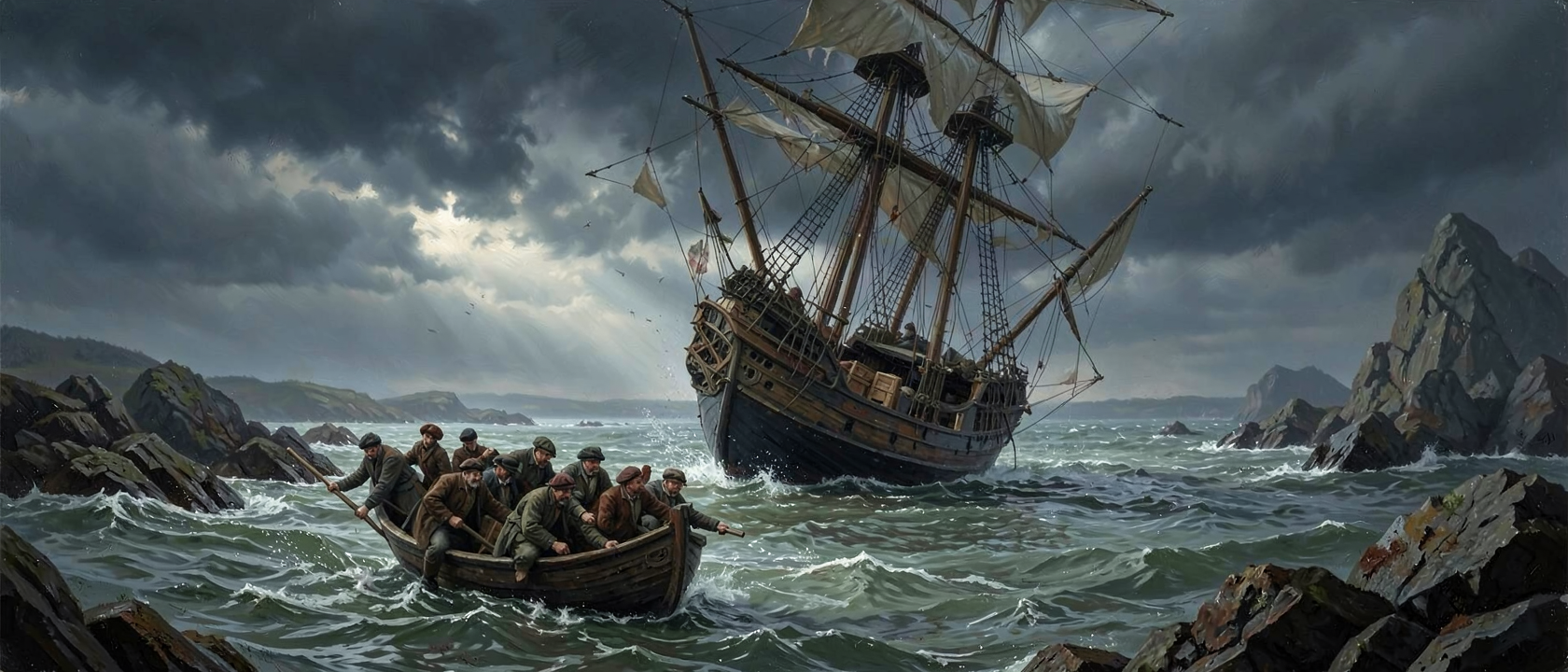
That changed on October 3. A storm caught the Vrouw Maria in the Finnish archipelago near the island of Jurmo. She struck rock and lost her rudder. A wave broke her free, but by then she was taking on water fast. The crew lowered anchor and worked the pumps, only to find them clogged with coffee beans from the hold. At dawn the next morning they gave up on the ship itself, took to the boats, reached nearby rocks, and signaled a passing vessel for help.
Six days of salvage work followed. Survivors brought up what cargo they could reach. The paintings were not among it. Sealed in the upper hold, they stayed out of reach as the ship went down around them. No one drowned. Every member of the crew lived to describe what had happened. What none of them could do was get the art out in time.
The Bill: Two Centuries Underwater
Some of the cargo came off the wreck in those six days, but only a fraction of it. The paintings never did. Catherine the Great had paid for twelve masterworks and would never lay eyes on one of them. Word of the loss even reached the diplomats: Sweden’s ambassador in St. Petersburg, Carl Ribbing, the Finnish county landlord Baron Christopher Rappe, and Russia’s foreign minister, Nikita Panin, all discussed the missing crates of paintings. Nothing came of the discussion. No recovery was attempted.
No lives were lost on the Vrouw Maria. The cost was entirely cultural, and it was total. Twelve paintings, work later judged to rank with the great names of the Dutch Golden Age, dropped out of sight for more than two centuries.
The wreck surfaced again, so to speak, in June 1999, located by the society Pro Vrouw Maria under Rauno Koivusaari using side-scan sonar. It lay roughly 131 feet (40 meters) down, the ship itself described afterward as very well preserved. The hull was still there. Whether the paintings were is a different question.
The Open Questions
Several parts of this story refuse to close neatly. The date the Vrouw Maria finally sank is one of them. The most commonly cited date is October 9, 1771, but at least one detailed account places the actual sinking as early as the morning of October 5, with the crew already ashore. Both versions agree the storm struck on October 3; they disagree on how many days the ship held on afterward.
The price Catherine’s agents paid for the twelve paintings appears in no surviving source reviewed for this account. And it remains genuinely unknown what, if anything, could have survived nearly two and a half centuries in Baltic silt. Since the 1999 discovery, divers have recovered only six objects, all from the open deck. The cargo holds, where the paintings were packed, have never been excavated. What can be seen without digging, zinc ingots, packing cases, something that may be carpet, hundreds of clay pipes, settles nothing about the art beneath them. No one has opened those cases to find out what, if anything, is left to see.