
The Assimilation Years, 1950s to the Late 1960s
In the late 1950s, the actor and singer James Shigeta recorded an album of Tin Pan Alley standards, sung without any of the musical cues studios typically reached for when marketing an Asian face to American listeners. The sociologist Oliver Wang, who studied this period decades later, treats Shigeta’s record as typical of a wider pattern: Chinese, Japanese, and Filipino American performers of the 1950s and 1960s built careers by keeping their ethnicity as quiet as possible, because that quiet was the price of a mainstream career.
The pattern went beyond records. Nightclub acts, film casting, and record promotion followed the same logic: whatever marked a performer as foreign was minimized, and whatever read as all-American was emphasized. It applied across Chinese, Japanese, and Filipino American entertainers alike, and there was no shared public identity for any of them to claim instead. The phrase “Asian American” did not yet exist in common use.
An Identity Without a Common Name
That changed, at least as a political project, during the late 1960s. A new generation of organizers set out to build something that had not existed before: a single “Asian American” identity broad enough to hold Chinese, Japanese, Filipino, and other immigrant communities together, in place of the separate ethnic identities each community had carried on its own. By 1970 the movement had a growing network of organizers and campus groups. What it still lacked was a cultural voice, something that could travel past a meeting room and into daily life.
Chicago, July 1970
On July 18, 1970, an 18-year-old sansei, or third-generation Japanese American, activist named Evelyn Okubo was killed at the national convention of the Japanese American Citizens League, held that year at the Palmer House hotel in Chicago, Illinois. The JACL was, and remains, the oldest and largest Asian American civil rights organization in the United States; its convention was supposed to be a gathering for discussion, not a scene of violence. Okubo’s death reached a small circle of folk musicians in New York who were already active in the Asian American Movement. According to the band’s own later account, they organized a West Coast tour before the year was out, directing the proceeds toward a memorial fund set up in her name.
A Grain of Sand, 1971 to 1973
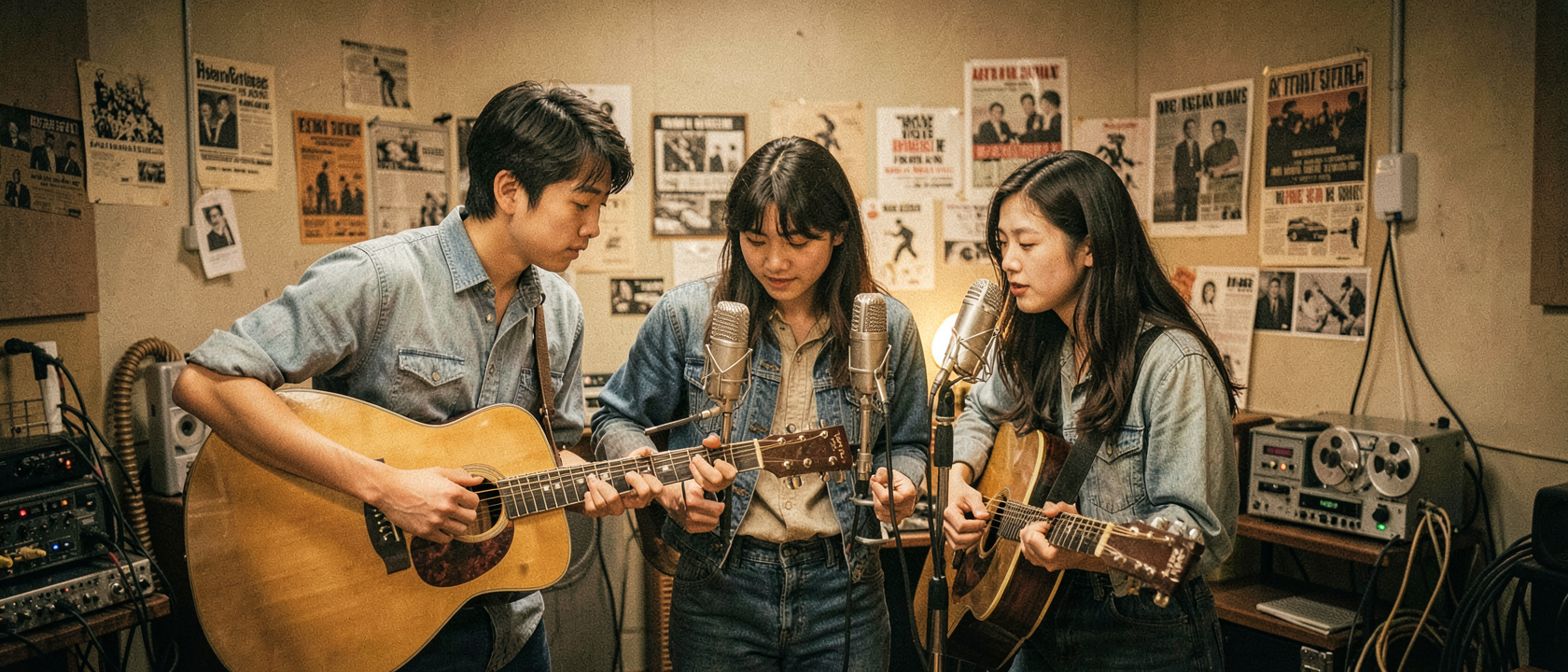
The trio formalized itself in 1971, taking the name A Grain of Sand. Its members were guitarists Chris Kando Iijima and William “Charlie” Chin and singer Nobuko Joanne Miyamoto; some accounts date their first meeting to the previous year, but 1971 is when the group took its lasting shape. All three were then in their twenties or early thirties, based in New York, and already active in the Asian American, Black, and anti-war movements around them.
In 1973, the group released its only studio album, titled A Grain of Sand: Music for the Struggle by Asians in America, through the independent label Paredon Records. Recorded in New York and produced by Barbara Dane, it ran 12 songs across 41 minutes. The songs addressed pan-ethnic Asian American solidarity, alliances with Black and Chicano movements, a class-based reading of racism, opposition to U.S. involvement in Southeast Asia, and affirmations of cultural pride, often within the same song. It is now widely recognized as the first Asian American album, the first time these arguments had been set to music and circulated as songs rather than handed out as speeches or pamphlets.
What the Record Answered
The album did not erase what came before it. Evelyn Okubo was eighteen when she died at a convention meant to bring Japanese Americans together, not to end anyone’s life, and no song changes that fact. Nor does it undo the quieter arithmetic of the two decades before her death, the one Shigeta and performers like him lived inside: careers built and sustained by never letting an audience see them as what they were. A Grain of Sand did not settle either account. It set them to music, three years and one album at a time, and left the record of that cost for listeners who came after.
Oliver Wang’s 2001 Assessment
Wang assessed all of this in 2001, in an essay called “Between the Notes: Finding Asian America in Popular Music,” published in the journal American Music. By then, about three decades after the band formed, younger Asian Americans mostly encountered this material in ethnic studies courses, through reissued recordings, or in archival interviews, not by taking part in the movement itself. Wang’s point was about distance: an identity sung into being in 1971 had, within a single generation, become something people studied more than something people did.
Wang’s Open Question
Wang is careful not to let one trio stand in for an entire era. Plenty of Asian American musicians worked through the 1970s without turning their music into an explicit political statement, and he treats A Grain of Sand as one current inside a wider, more divided scene, not a summary of it. His closing question is one he leaves unresolved: whether the visibility Asian artists have gained since then, including BTS’s invitation to the White House to address anti-Asian hate crimes, reflects real structural change in the industry, or simply a market’s taste for something it finds novel. Wang does not choose an answer.