
A Second King for England
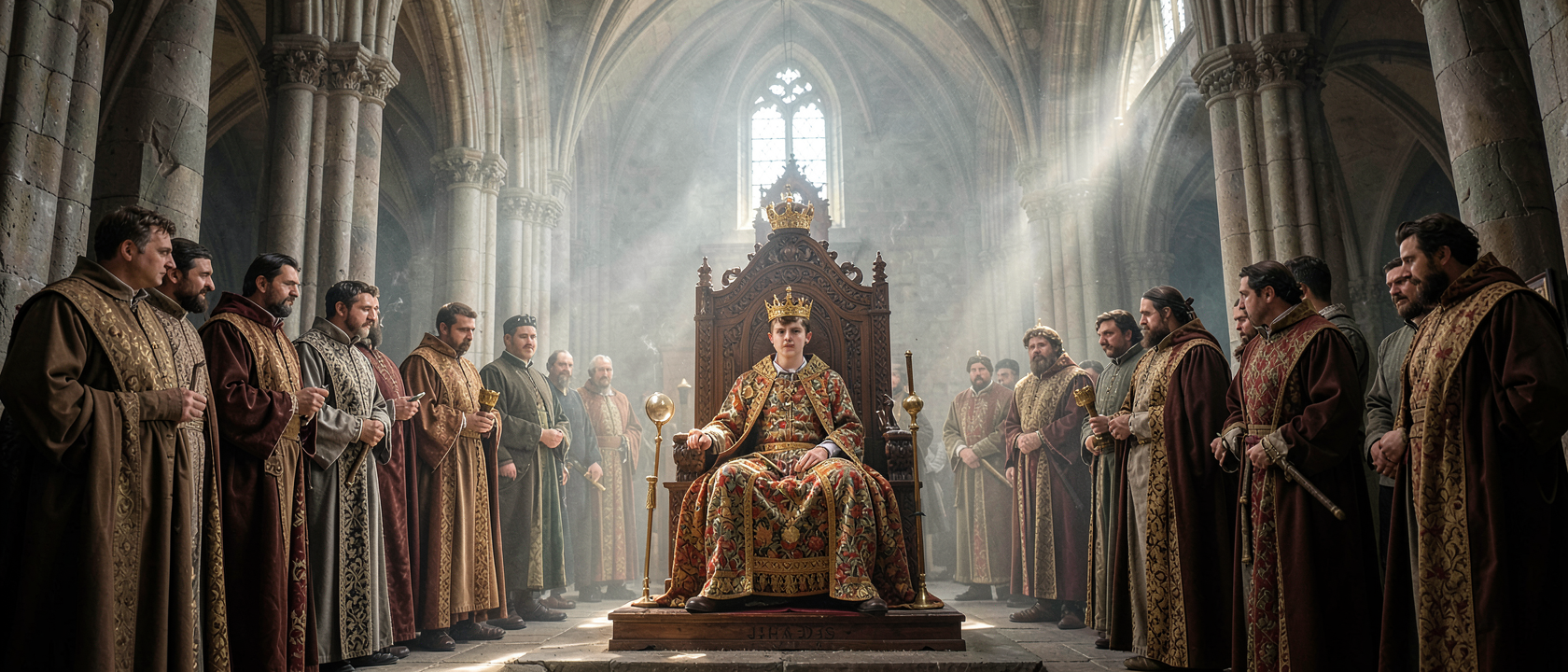
On June 14, 1170, Henry II stood by as his eldest surviving son, also named Henry, was crowned a king of England. The father was 37. The boy was 15. Because Thomas Becket, the Archbishop of Canterbury, was living in exile during a protracted struggle over ecclesiastical rights, the anointing fell to Roger de Pont L’Évêque, the Archbishop of York. Some traditions later placed the ceremony at Westminster Abbey, but surviving records do not confirm the venue.
From that afternoon, England had two living kings sharing a name and a realm. The younger Henry was styled Henry III in the regnal lists. A famous banquet story soon circulated in chronicles: the elder king personally carried the first dish to his son’s table, presenting food to a teenager who suddenly outranked every baron in the realm. Historians treat the moment as anecdote rather than hard fact, but it captured the peculiar illusion created that morning.
The Capetian Guarantee
Associate kingship was an imported safeguard. In France, the Capetian dynasty had practiced it since 987, crowning designated heirs while reigning monarchs still lived to prevent a vacuum at the throne. For nearly two centuries, junior kings in France trained directly for governance by hearing legal pleas, sitting on royal councils, and leading troops in the field.
Henry II had compelling reasons to copy Paris. The fifteen years of civil war known as the Anarchy had erupted after Henry I died and Stephen claimed the throne instead of Matilda. An anointed successor seemed like cheap insurance against another collapse into dynastic war across England and his vast French holdings.
The Crown Without the Purse
Anointing did not bring authority. Henry II retained every lever of state, leaving his son with royal status but withholding any independent territory, revenue, or role in government. When the elder king commissioned an official seal for the boy, Roger of Howden noted its design: the young king sat enthroned holding an orb and a scepter, not a sword. A sword signified military command. Leaving it off signaled that the son’s power remained subordinate to his father’s will, echoing the single-sided seals common among Capetian rulers.
Diplomacy soon compounded the friction. The young king was married to Margaret of France, daughter of King Louis VII, yet she had been entirely excluded from the 1170 rites. To repair the insult to the French crown, both the young king and Margaret were crowned together at Winchester Cathedral on August 27, 1172. The ceremony smoothed diplomatic relations, but it did nothing to change the domestic reality. Despite his status as an anointed monarch, this exclusion from governance and territory drove the young king to rebel repeatedly against his father in the years that followed.
The Reckoning and the Abandoned Ritual
The younger Henry spent the rest of his life challenging the arrangement that had crowned him without giving him a kingdom. He died in the midst of that unresolved struggle on June 11, 1183, at the castle of Martel in Lot, France, at the age of 28. His body was brought to Rouen Cathedral in Normandy for burial. Henry II outlived him by six years, reigning alone until his death in 1189.
Across the Channel, the French model that inspired the experiment was already vanishing. On November 1, 1179, while Louis VII lay gravely ill, his son Philip II Augustus was crowned associate king at Reims Cathedral. When Louis died on September 18, 1180, Philip became sole ruler. Confident in his position, Philip broke with two centuries of Capetian custom and chose not to crown his own heir during his lifetime. In England, the idea was discarded entirely. English monarchs returned to naming heirs who waited for death to bring them both the title and the crown.
The Gaps in the Ledger
Contemporary observers like Roger of Howden and Gerald of Wales recorded the political alignments of the young king’s rebellions, yet the broader human and material balance sheet went unwritten. The chronicles tell us who marched where, but they omit what the campaigns of the 1170s cost the treasury, just as they leave out the numbers of common people displaced or killed in the fighting.
Historians still debate what drove the son. Some portray him as a tool of foreign interests, manipulated by his wife’s Capetian family against the English king. Others see an ambitious prince claiming the dignity promised by his crown. The records confirm the repeated uprisings; the toll exacted on the realm remains lost.