
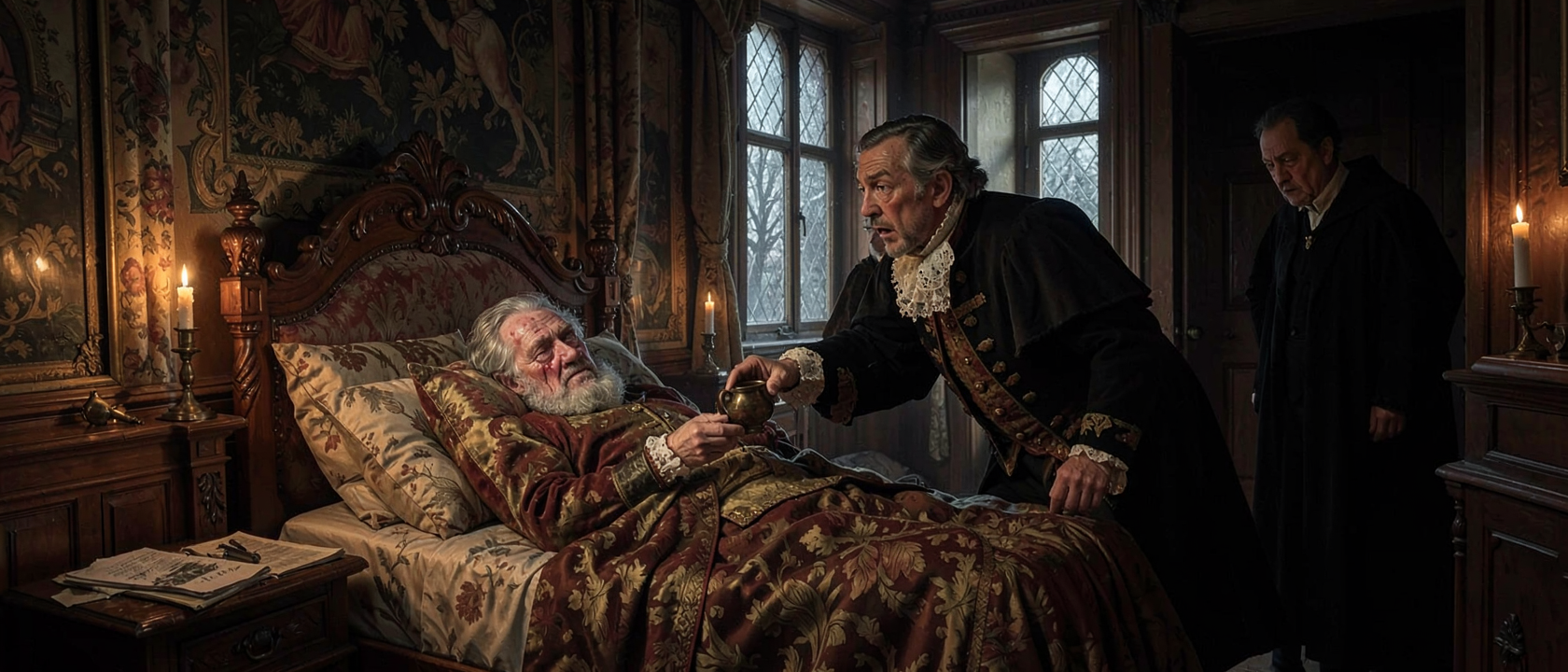
King James VI of Scotland and I of England died on March 27, 1625, at Theobalds House in Hertfordshire, England, of what contemporaries called a violent intermitting fever. Within a year, a Scottish physician in exile turned that death into a murder case against the king’s closest favorite. The charge was almost certainly false. It still took more than two decades, and an English revolution, before a royalist diplomat defending the future king stopped treating it as a live threat to the crown’s standing.
An Exile’s Pamphlet
George Eglisham had once belonged to that same court, having served James himself as a physician. Historians describe him as an embittered Roman Catholic Scot who also worked as a poet and tutor, and perhaps as a forger of coins. He fled to Brussels after coming under suspicion. In 1626, from exile, he published a short tract titled “The Forerunner of Revenge upon the Duke of Buckingham for the Poisoning of the Most Potent King James.” Its title page claimed a Frankfurt printing, though the book was actually produced in Brussels. It appeared in Latin and English that spring, a German edition followed, and copies reached England by April, just as Parliament opened an inquiry into James’s death.
The charge was specific: Buckingham had poisoned both James Hamilton, the second Marquess of Hamilton, and the king himself, in March 1625. Eglisham wrote that one of James’s own physicians, John Craig, protested after Buckingham’s treatments that the king had been poisoned outright. More careful accounts of the same moment have Craig saying only that the treatment did as much harm as poison would, not that Buckingham meant to kill him. Eglisham’s pamphlet left no room for that distinction.
A Favorite Accused
By 1626, George Villiers, Duke of Buckingham, had been the king’s closest favorite for over a decade, and his position rested entirely on that closeness: his offices, his income, and his standing at court all depended on James’s trust and the court’s tolerance of it. An accusation that he had murdered the king he served struck at the idea that the court ran on loyal service rather than self-interest, and so at the legitimacy of the monarchy itself.
Parliament took the charge seriously enough in 1626 to fold it into the articles drawn up for Buckingham’s impeachment. Charles I, who had inherited both the crown and Buckingham’s friendship, dissolved that Parliament before the impeachment could proceed. Whether Buckingham had actually poisoned James mattered less, for the crown’s standing, than how many people believed he had, whether or not the charge was ever tested.
The Libel Takes Hold
Contemporaries called tracts like this one “libels,” and it spread by being read and repeated, not checked. No official account reached the same audience with anything like the same force, and through the late 1620s and the decades that followed, the poisoning story settled into popular memory as part of what people believed about James’s death. Buckingham did not live to see how long it would last. He was assassinated in 1628 by John Felton, a soldier who said he had drawn partial inspiration from Eglisham’s pamphlet, and the tract was reprinted in 1642, this time to damage Charles I rather than Buckingham.
Historians disagree about how much it actually moved events. Alastair Bellany and Thomas Cogswell argue the pamphlet took deep root in popular political thinking and shaped the revolutionary politics of the 1640s. Blair Worden is more skeptical, noting that rising interest in the 1626 impeachment debates may have driven readers to the pamphlet rather than the other way around.
Gerbier’s Reckoning
In June 1648, the diplomat Sir Balthazar Gerbier, once Buckingham’s art agent and later Charles I’s envoy to Brussels, addressed a short treatise to Prince Charles, the future Charles II. Writing amid the English Revolution, he explained why the Stuart dynasty had come to such grief, pointing partly at print: the dynasty, he wrote, had been beset by scandalous tracts penned by “spirits of delusion.” Among those libels, he named one as “more eminent than the rest”: a short tract from 1626, written, in his words, by an “inraged Scotsman, Eglesham, a professor of Phisick,” who had put out “a report of the practice of poisoning in the court of England.”
Gerbier tried to answer the charge rather than dismiss it. He argued that Buckingham’s “sweet nature” made poisoning implausible, and that Buckingham had no real motive to kill James, since he could not have known whether Charles would favor him as James had. Twenty-two years after Eglisham wrote from exile, a diplomat defending the future king still thought the old pamphlet worth answering, point by point, as if it might still do damage.
A Later Reckoning
By later standards, the poisoning charge looks close to impossible to sustain. In 1856, the British physician Norman Chevers reviewed the surviving medical evidence from James’s final illness and found nothing to indicate foul play. Partly as a result, the historian S.R. Gardiner’s later account of the period barely mentions Eglisham’s pamphlet at all.
Bellany and Cogswell’s 2015 study, “The Murder of King James I,” traces the pamphlet’s afterlife across thirty-five years, from 1626 through Buckingham’s assassination in 1628 to the political crisis of the 1640s, arguing it shaped British political culture. What killed James in March 1625 is no longer seriously disputed by historians. What the pamphlet did to the Stuarts afterward is a separate question, and the clearest answer to it is the one Gerbier gave without meaning to: in 1648, defending a king who had not even been born when Eglisham first put his charge into print, he still sat down and argued against it, line by line, as though it could still do harm.