
The Brewer Takes the Chair
In 1682, the East India Company’s directors voted a gift of 10,000 guineas to King Charles II, with a smaller sum set aside for his brother, the Duke of York. The push came from Sir Josiah Child, a London financier trying to overturn a royal veto: in April 1676, Charles had blocked his election as the Company’s governor or sub-governor. The gift succeeded where years of lobbying had not.
Child was born in London around 1630, son of the merchant Richard Child. He rose to mayor of Portsmouth by 1658 and lost the post in 1661 under the Corporation Act; after his wife’s death that year, he moved to London. He remarried in 1663, opened a Southwark brewery supplying the Royal Navy, and entered Parliament for Dartmouth in 1673, joining the Company’s Court of Committees the following year. By December 31, 1675, he was its largest single investor, holding £12,000 of a total £369,891 spread across 554 investors.
Child was a financier, not a soldier, and he had learned that political outcomes could be bought. Accounts of his rise through the Company’s leadership differ: some sources have him becoming Deputy Governor in 1684 and Governor in 1686, others put his governorship as early as 1681. Either way, by the mid-1680s he held the office from which he would overturn seventy years of settled policy.
Seventy Years of Saying No to War
Elizabeth I had chartered the Company on December 31, 1600, to trade, not to fight. Its ships first reached Surat, on India’s west coast, in 1608, and after the Dutch executed English merchants in the 1623 Amboyna Massacre, the Company turned further from the Spice Islands toward Indian ports.
Sir Thomas Roe led an embassy to the Mughal court of Emperor Jahangir from 1615 to 1618. He came back with few trading concessions but a firm argument: trade without territory, trade without war, pointing to Portugal and Holland, whose own wars for trade had drained them rather than enriched them.
The garrisons prove the point. Fort St George, the future Madras (today Chennai), was founded reluctantly on the Coromandel coast in the 1640s and had as few as 25 European defenders by 1655. In December 1667, the garrison at Bombay (now Mumbai) numbered under 300 men in total: 93 English, 42 Portuguese and French, and 150 recruited from the Deccan plateau. This was not a company arming itself for conquest.
Why the Old Caution Stopped Making Sense
By the 1660s, that caution was losing its footing. A Mughal succession war from 1657 to 1660, won by Aurangzeb over his brothers, had already shown how unstable the empire’s center could be. Maratha forces under Sivaji raided Surat in 1664 and 1667; in 1664, Sir George Oxenden, the Company’s man at Surat, helped repel the attack and earned Aurangzeb’s own respect. Sivaji died in 1680, but the pressure he represented outlived him.
Gerald Aungier, who governed Bombay from 1669 to 1677, drew the obvious lesson: a Company surrounded by weakening Mughal authority and rising Maratha power could not keep trading unarmed and hope for the best. He pressed for a more assertive, armed posture, framed as realism about the region, not a taste for conquest, an argument Child would later inherit and carry much further.
The Vote Against Their Own Words
As late as 1681, the Company’s directors put it on the record: war remained against the Company’s interest. In 1682, William Hedges was sent to Shaista Khan, the Mughal governor of Bengal and Aurangzeb’s uncle, to seek a firman, a Mughal trading charter, by peaceful means.
It did not hold. In 1686, Shaista Khan banned the Company from Bengal outright, and the Company answered with force for the first time in its history. By then Child dominated the Court of Committees in London, while his protégé Sir John Child, no relation despite the shared name, governed Bombay from 1681. Together they committed the Company to open war against Mughal authority, a choice made in full knowledge of the directors’ own words from the year before.
What the Record Won’t Say
The surviving account of Child’s War breaks off before it narrates the fighting in full, so parts of what follows rely on scattered later sources that do not always agree. Even the start date is disputed: 1686 by most counts, 1688 by others; the war was over by 1690 either way.
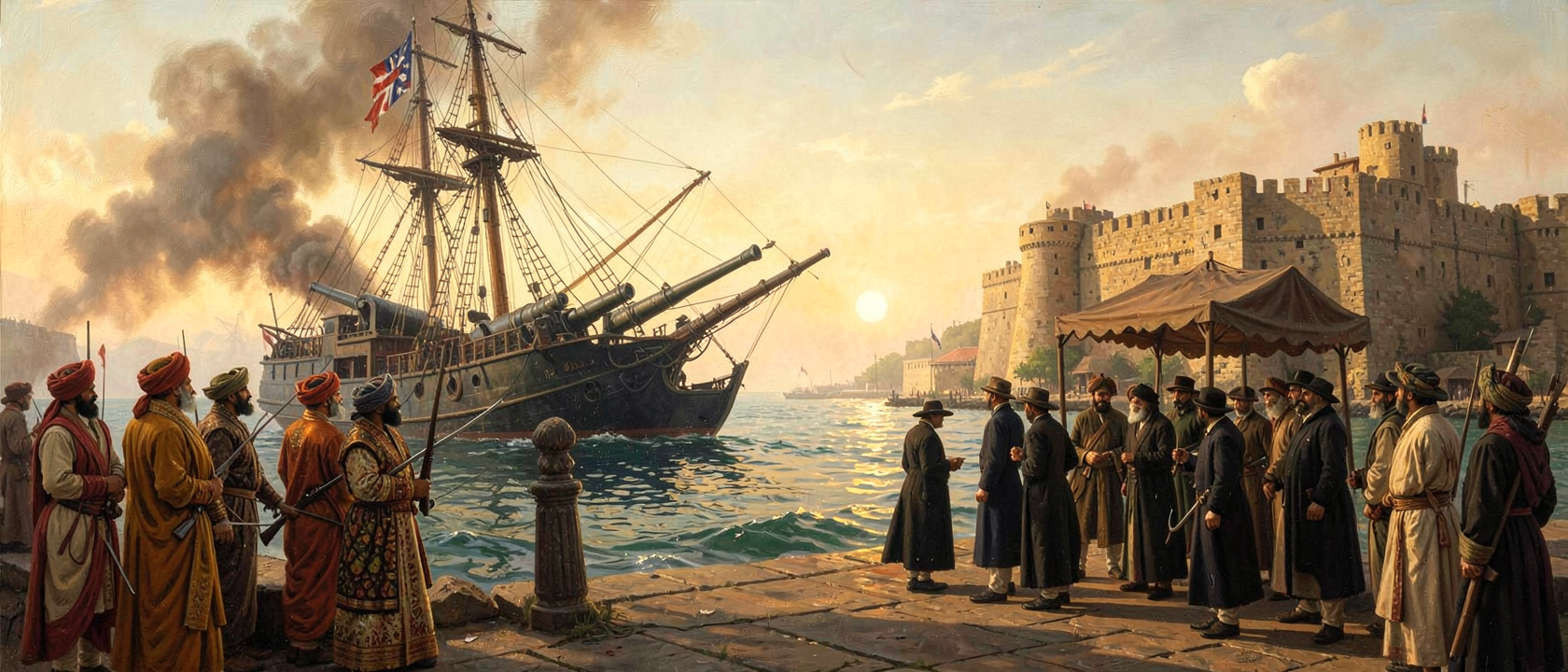
What is known: fighting opened at the Hugli River near Calcutta (Kolkata) and spread to both coasts. The Company’s navy blockaded Mughal ports and seized Mughal trading ships, while Aurangzeb’s forces seized Company factories and arrested its men. In 1689, a Mughal fleet out of Janjira, commanded by Sidi Yaqub, blockaded the Company’s own fort at Bombay. By the end, Company holdings had shrunk to the fortified towns of Madras and Bombay. Its envoys had to prostrate themselves before Aurangzeb, pay a fine, by one account 150,000 rupees though that figure rests on a single source, return what had been seized, and promise better conduct. Aurangzeb did not expel the Company; in 1690 he issued a farman restoring its trading privileges and allowing a fortress at Calcutta. Child had bet on force and lost. The Company survived the war; his gamble did not.
Two Men, Seventy Years, One Method
Most historians place Britain’s real turn toward territorial war in India in the 1740s and 1750s, when French pressure pushed the Company toward outright conquest, culminating at the Battle of Plassey in 1757, when Robert Clive’s victory in Bengal became the foundation of what grew into the British Raj, lasting until 1947.
Child’s War sits almost entirely outside that story, a precursor most accounts leave out: the same institution and the same logic, using force as leverage against Mughal authority, applied seven decades earlier and ending in defeat rather than conquest. The impulse reaches back further still, to 1657, when Cromwell’s government re-chartered the Company as a joint stock with £750,000 subscribed, a commitment of capital that made a more aggressive posture easier to justify long before Charles II’s court politics entered the picture.
Why Child failed where Clive later succeeded is, by most readings, a matter of timing and Mughal strength rather than method: Aurangzeb’s empire in the 1680s still had the resources to blockade a fort and dictate terms; the Mughal power Clive faced in 1757 did not. That is an argument historians make, not a settled fact, but it fits the pattern well enough. Clive is remembered as the founder of an empire. Child only proved, decades before him, that the same gamble could just as easily end in ruin.