
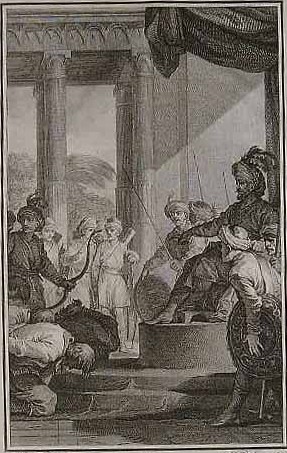
Child’s War, also known as the Anglo-Mughal War, was the first war fought between an English force and an Indian power on the Indian subcontinent, running from January 1686 to April 1690. The East India Company launched the conflict in pursuit of control over Bengal’s profitable trade and empire-wide commercial privileges, dispatching the largest armament England had ever sent eastward. What followed was a comprehensive defeat: the Company’s forces were routed militarily, devastated by disease, and ultimately compelled to submit to Emperor Aurangzeb on his terms. The settlement cost the Company 150,000 rupees, but it also produced one direct and lasting consequence — the founding of Calcutta in 1690.
Key facts
- Type: war
- Start: January 1686
- End: April 1690
- Location: Indian subcontinent
- Participants: East India Company; Mughal Empire
Origins
The war grew out of the East India Company’s ambitions to dominate Bengal’s commerce and secure trading privileges across the Mughal Empire. Diplomatic negotiations were already underway when Sir Josiah Child, the Company’s governor based in London, intervened in the mission being conducted by Hedges, the Company’s envoy. That intervention caused Emperor Aurangzeb to break off talks entirely, removing any remaining possibility of a negotiated outcome and making armed confrontation effectively unavoidable.
Shaista Khan, the Mughal governor of Bengal, was a central figure in bringing matters to a head. He was also the maternal uncle of Aurangzeb himself, meaning that any affront to Mughal authority in Bengal was a matter that reached the imperial family directly.
The fighting
In 1686 the Company dispatched twelve warships loaded with troops. The war was fought across both coasts of the subcontinent: it began at the Hugli River at Calcutta in the east and extended to Bombay in the west. During the fighting, the city of Balasore was bombarded and Bombay Harbour came under siege.
On 20 December 1686, English commander Job Charnock withdrew his forces from Hooghly to the hamlet of Chuttanutty, approximately twenty-six miles down the river, and then further to the island of Ingelee at the mouth of the Hooghly River. That island proved lethal. It was a low swamp covered with long grass and had no fresh water whatsoever. Within three months, half of the English troops quartered there had died from disease, before any major land engagement had been fought.
Aurangzeb was simultaneously prosecuting his Deccan campaign during these years, having taken Bijapur in 1686 and Golconda in 1687. The Mughal Empire was at its widest territorial extent, stretched across the subcontinent, yet still handled the English challenge without suspending its other operations.
Submission and settlement
The Company sent two envoys from Bombay to Aurangzeb’s camp in the Deccan to deliver its submission: the factor George Weldon and the interpreter Abraham Navarro. The Emperor formally settled the war in February 1690. The peace terms required the Company to pay 150,000 rupees, to restore all property seized during the conflict, and to accept the expulsion of Sir John Child from India.
Aurangzeb’s decision to readmit the Company, despite its humiliation on the battlefield, was driven partly by economic calculation. Surat’s customs revenues were a significant source of imperial income, and the Company’s silver kept the weavers of Gujarat and Bengal in work. Punishing the English permanently would have cost the Mughal treasury more than it was worth.
Aftermath
Following the settlement, Aurangzeb permitted the East India Company to re-establish itself in Bombay and to open a new trading base in Calcutta. Job Charnock established that base in 1690 on the very site, twenty-six miles downstream of Hooghly, where his forces had retreated during the fighting. That settlement became the city of Calcutta, which would later serve as the capital of British India.
Child’s War is classified as the earliest entry in the sequence of Anglo-Indian wars that shaped the subsequent history of the subcontinent. Yet it largely disappeared from British public memory. As later Company victories accumulated and were celebrated, this opening and unsuccessful episode was set aside and became one of the least taught chapters of early Anglo-Indian history.
Did you know
- After the English encamped on the island of Ingelee — a low, freshwater-free swamp at the mouth of the Hooghly River — within three months half of all the English troops stationed there had died from disease, before a single major land battle had been fought. (historic-uk.com)
- The Company sent the largest armament that had ever been dispatched from England to the East for the war, yet it was decisively defeated by the Mughal Empire, widely considered the world’s largest economy at the time. (justworldnews.org)
- The Calcutta that later became the capital of British India was founded in 1690 directly as a consequence of the war’s settlement, when Job Charnock established a base on the very site, twenty-six miles downstream of Hooghly, where the English had retreated during the fighting. (justworldnews.org)
- Shaista Khan, the Mughal governor of Bengal who was a central figure in triggering the war, was the maternal uncle of Emperor Aurangzeb himself, making the conflict a matter that reached the highest levels of the Mughal dynasty. (livehistoryindia.com)
- Portugal had attempted to impose conditions on the Mughals in Bengal 54 years before Child’s War and had been decisively repelled, yet Josiah Child proceeded with an even greater challenge to Mughal sovereignty and achieved the same outcome. (justworldnews.org)
Data sources
- Wikidata
- historic-uk.com
- worldhistory.org
- justworldnews.org
- kbssidhu.substack.com
- livehistoryindia.com
Where it appears
- Josiah Child’s War on the Mughal Empire Ended in Surrender November 6, 2026
Data updated: 2026-11-02