
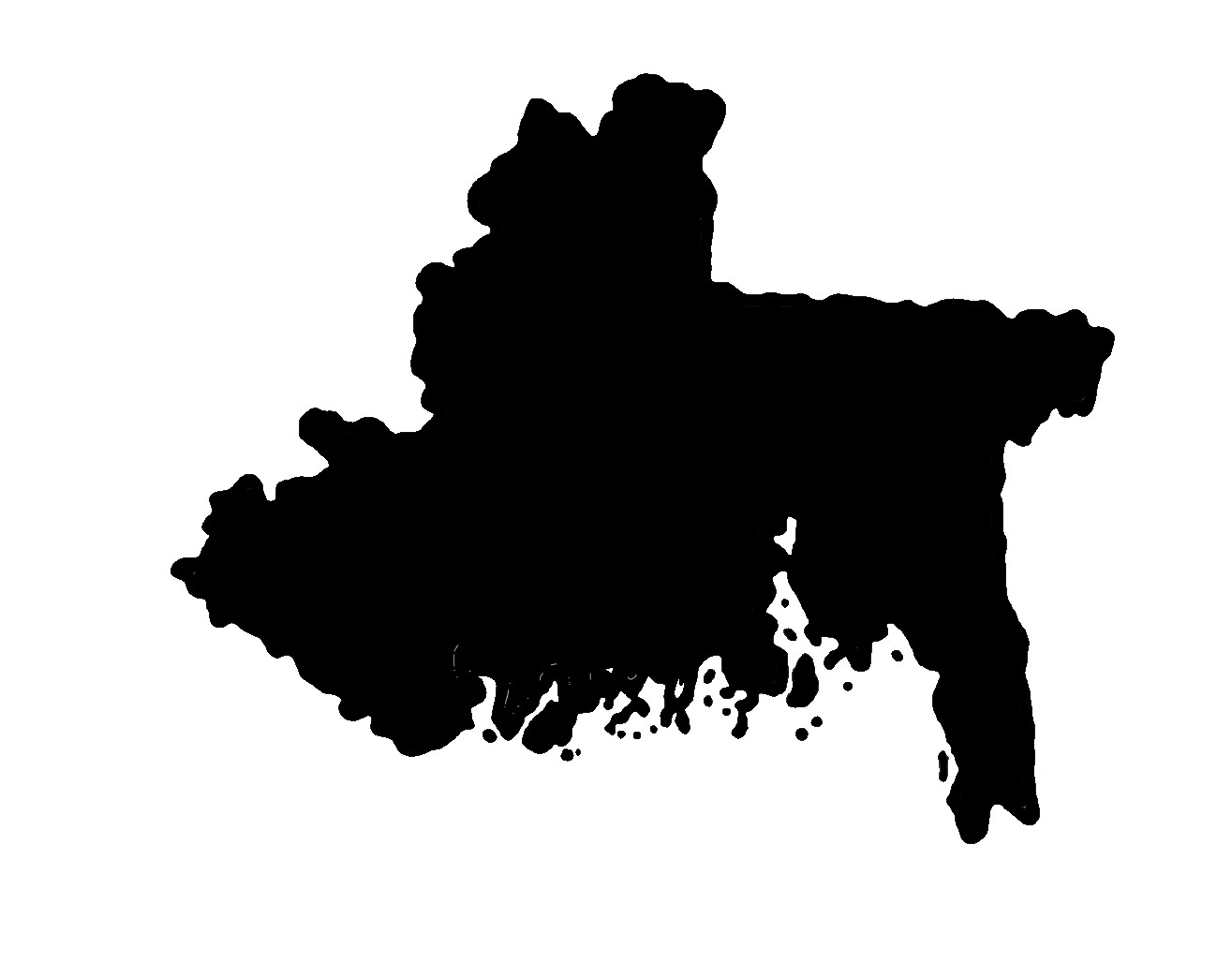
Bengal is a historical and geographical region occupying the eastern edge of the Indian subcontinent, spanning an area of 236,322 km² across what is now India and Bangladesh. Its territory encompasses West Bengal, Bangladesh, Tripura, and the Barak Valley. The region produced Rabindranath Tagore, the first non-European to receive the Nobel Prize in Literature, and gave rise to a language movement whose legacy is marked by an international day recognised by the United Nations. The second and permanent partition on 15 August 1947 drew its modern political boundaries.
Key facts
- Country: India; Bangladesh
- Type: historical region; region
- Located in: West Bengal; Bangladesh; Tripura; Barak Valley
- Coordinates: 23.9888, 88.7311
- Area: 236,322 km²
Geography and Extent
The region covers 236,322 km² and straddles the borders of two sovereign states: India and Bangladesh. Within India, Bengal’s territory is distributed across the state of West Bengal, the state of Tripura, and the Barak Valley. The bulk of the population and land area that was historically called East Bengal now forms the independent nation of Bangladesh.
Historical Divisions
Bengal’s internal geography was formalised administratively during the Sena dynasty, which succeeded the Pala dynasty in the 12th century. The Sena rulers consolidated the region into five recognised divisions: Radh, Varendra, Vanga, Bagri, and Mithila.
Partition
Bengal was partitioned more than once. The second and permanent partition took place on 15 August 1947, when the British Indian province of Bengal was divided under the Indian Independence Act 1947. The division followed religious majority lines: Hindu-majority West Bengal joined India, while Muslim-majority East Bengal joined Pakistan.
One complicating element of the 1947 settlement was the status of Sylhet. On 7 July 1947, a referendum in Sylhet returned a majority in favour of joining the Dominion of Pakistan. The Barak Valley of Sylhet, however, remained in India when partition was implemented.
Rabindranath Tagore
Rabindranath Tagore was born in Calcutta in 1861. In 1913 he was awarded the Nobel Prize in Literature for his poetry collection Gitanjali, becoming the first non-European to receive that honour.
Population
As of 1 July 2026, the population of West Bengal alone was projected at 100,631,000, representing approximately 7.04 percent of India’s total population, according to a National Commission Technical Group report. That figure covers only the Indian portion of the historical Bengal region; the population of Bangladesh, which occupies the greater part of historical East Bengal, is not included in that projection.
Did you know
- The Sundarbans is the only mangrove forest in the world inhabited by tigers. It supports one of the subcontinent’s largest populations of the Bengal tiger (Panthera tigris tigris), a species known notably for its ability to swim. (world-heritage-datasheets.unep-wcmc.org)
- The Bengali Language Movement of 21 February 1952 is the only language movement in history to have produced a UN-recognised international day. UNESCO declared 21 February as International Mother Language Day on 17 November 1999. (metaphrase.uk)
Data sources
- Wikidata
- en.banglapedia.org
- learn.culturalindia.net
- ebsco.com
- statisticstimes.com
- modernhistoryblog.com
Where it appears
- Josiah Child’s War on the Mughal Empire Ended in Surrender November 6, 2026
Data updated: 2026-11-02