
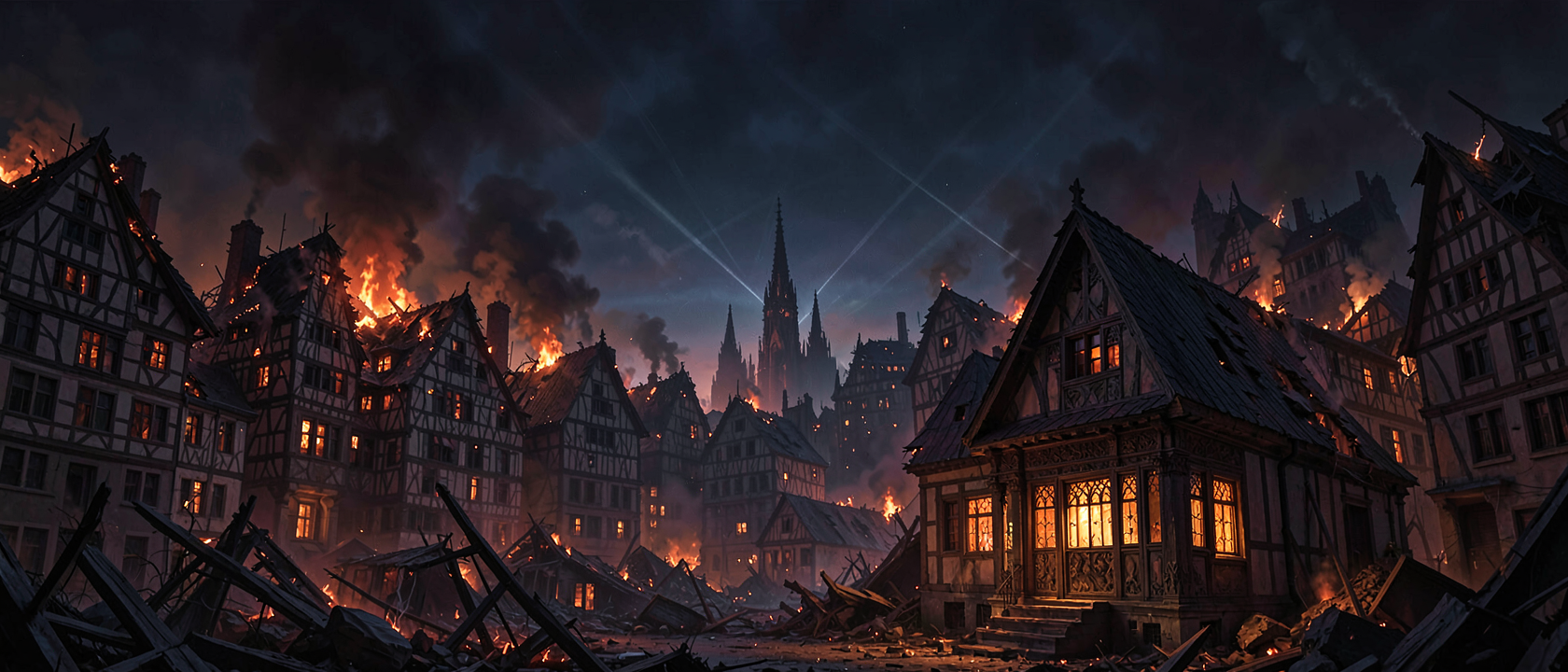
Night of March 22, 1944
The alert over Frankfurt am Main came after dark. Within the hour, 816 Royal Air Force bombers crossed the city and released their loads: more than 3,000 heavy high-explosive bombs and about 1.2 million incendiary devices, the whole weight of it dropped in under sixty minutes. Frankfurt had already been hit twice that winter. A raid on October 5, 1943, had damaged the interiors of the Römer, the city’s medieval town hall, and on March 18, 1944, roughly 750 aircraft had burned the area around the Paulskirche, Frankfurt’s old parliament church. March 22 was built on a different scale. Concentrating that many explosives and incendiaries into less than an hour was the point: a core built largely of timber-framed houses, their wooden frames filled with plaster and brick, could not survive fire on that scale no matter how it was defended.
What Stood Below
The Altstadt, Frankfurt’s Old Town, held one of the densest concentrations of historic building anywhere in Germany: close to 2,000 half-timbered houses, many of them centuries old, grouped around parish churches and civic halls that had anchored the district since the medieval and early modern periods. Among them, at 23 Großer Hirschgraben, stood the house where the writer Johann Wolfgang von Goethe was born in 1749. Frankfurt’s Altstadt is remembered as the largest half-timbered historic city center that existed in Germany. The city was not undefended that spring. Anti-aircraft batteries ringed Frankfurt as part of a standing air-defense network built up over years of Allied raids.
The Defenses That Failed
The guns fired. The stream of 816 bombers came through anyway and, in under an hour, did what it had come to do. Nothing in the record of that night describes the anti-aircraft fire breaking up the formation or keeping the bomb loads from reaching the Altstadt. Frankfurt had defenses in place. On the night of March 22, 1944, they were not enough to stop what followed.
The Old Town, Gone by Morning
The heaviest damage fell on the Old Town itself. Its churches were reduced to rubble in the same hour that leveled the streets around them. By the time the bombers turned for home, almost the entire quarter, the half-timbered heart of Frankfurt, built up over centuries, had been destroyed. Of the roughly 2,000 historic timber-framed buildings standing there that evening, only one came through unscathed. The rest were destroyed or damaged beyond saving.
Nearly Everything Lost, and a Past in Question
The toll was close to total: by one account, virtually every one of the roughly 2,000 historic structures in the Altstadt was lost that night, with only one left standing unharmed. Frankfurt’s wartime bombing as a whole is estimated to have killed around 5,500 residents and to have destroyed the largest half-timbered historic city center in Germany, though that estimate covers the whole war, not this one raid. Clearing the debris from the Altstadt alone took years: work began in 1946 and was not finished until 1950.
Rebuilding proved harder to settle than the clearing itself. It meant deciding whether Frankfurt’s medieval and early modern past was something to restore or something to set aside. In 1947, a survey of architects and art historians working through the German Werkbund Hessen argued that the lost buildings should not be reconstructed as they had stood, but reimagined in new form. Others took the opposite view: the writer Hermann Hesse, the philosopher Karl Jaspers, and the industrialist Richard Merton, recently returned from exile, all argued for rebuilding the old structures faithfully. The question came to a head over Goethe’s birthplace. Some wanted the ruin fenced and marked with a plaque, arguing that rebuilding a writer’s house made little sense while many Frankfurt residents were still living in inadequate postwar housing. The Freies Deutsches Hochstift, the foundation that ran the house as a museum, pushed for an exact reconstruction instead. The city agreed, and the architect Theo Kellner rebuilt it starting in 1947. The Paulskirche, rebuilt that same year, was the first Altstadt building restored; the Römer town hall and several neighboring structures did not follow until after 1952. By 1947, calling that German past “glorious” was no longer something anyone could do without a second thought, and the rebuilding decisions, made one structure at a time, show it.
What the Record Doesn’t Say
No casualty figure survives for the March 22 raid specifically; the estimated 5,500 wartime dead in Frankfurt covers years of bombing, not one night. No Royal Air Force commander, no German civil defense official, and no Frankfurt planner from that period is named in the account this piece draws on. Even the building count carries a caveat: other tallies of the same raid put the number of structures destroyed or badly damaged above 7,000, a figure that likely counts every kind of building hit, not only the half-timbered houses that defined the Old Town. The two counts have never been reconciled. What is certain is plainer than either number: a city center that had stood for centuries was destroyed within an hour, and a fuller attempt to recover its old street pattern, the Dom-Römer quarter built between the cathedral and the Römerberg, did not open to the public until May 9, 2018.