
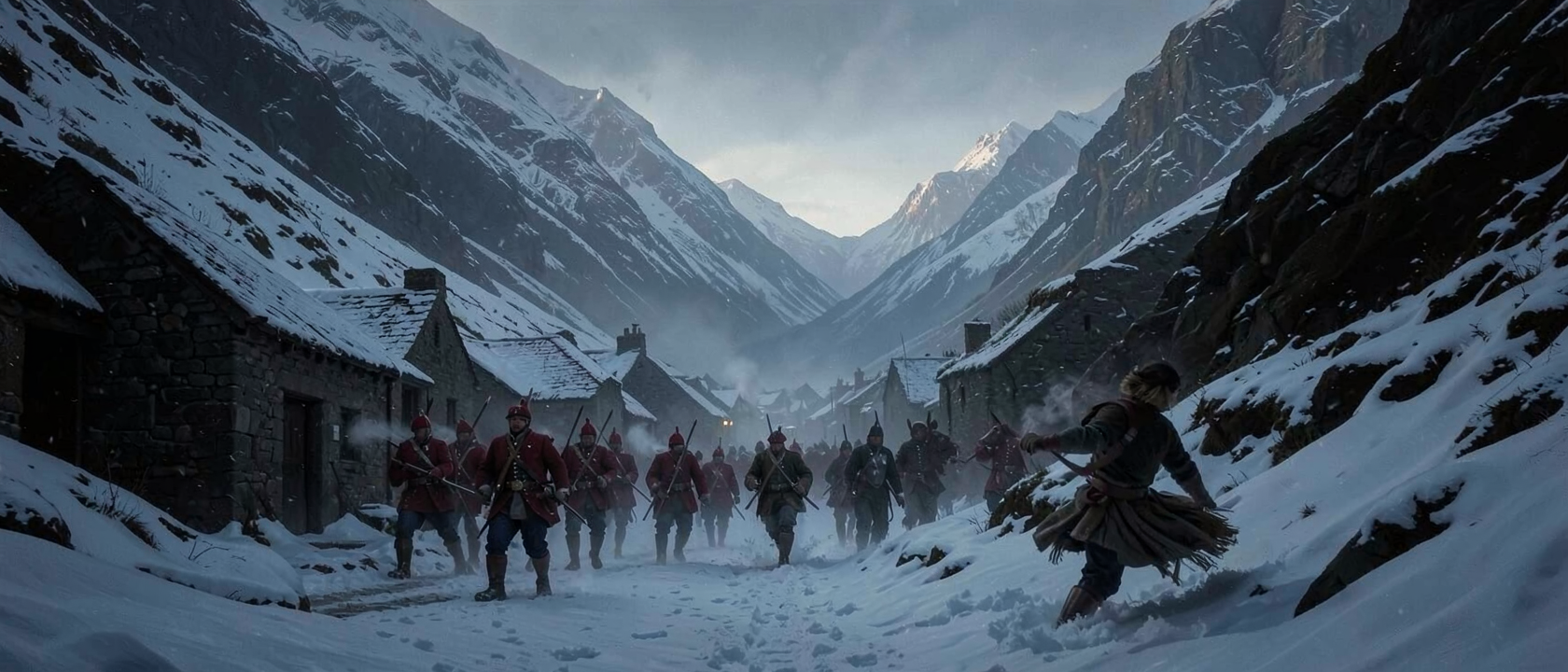
Before Dawn in Glen Coe
On February 13, 1692, in the Highland valley of Glen Coe (Glencoe), in Argyll, Scotland, soldiers who had spent two weeks eating at the tables of the Macdonalds rose before daylight and turned on their hosts. They were acting on written government orders, and for most of the people in the glen the attack came from men they had sheltered under the oldest rule in the Highlands: a guest fed at your fire did not raise a hand against you.
The Oath That Came Late
Alasdair MacIain, the elderly chief of the Macdonalds of Glencoe, left for Fort William around December 31, 1691, walking through snow to swear the oath of allegiance the government required of Highland chiefs. When he arrived, Lieutenant-Colonel John Hill, the officer in command, told him he had no authority to receive it, and sent him on to Inveraray with a letter for the local magistrate, Sir Colin Campbell. MacIain did not get his oath formally recorded until January 6, 1692, reportedly pleading, in tears by some accounts, to be allowed to submit. The delay was not defiance. It was an old man following instructions to an office that could not do what he needed when he reached it.
A Deadline With Teeth
The deadline came from a royal proclamation of August 26, 1691: Highland clans who had supported the deposed King James, the Jacobite cause, were offered pardon if they swore allegiance to William and Mary before January 1, 1692. Those who did not would face, in the proclamation’s own words, “fire and sword.” William III had held the throne barely three years, and his government wanted the Highlands settled. A chief who missed the deadline by six days, for reasons outside his control, left room for officials to treat his clan as fair game under the letter of the order. The Macdonalds of Glencoe also carried a long-standing reputation as a “nest of thieves” and cattle raiders, a name that made them an easy clan to single out even among officials not looking hard for a reason.
Billeted Among Their Hosts
On February 1, 1692, a detachment of the Earl of Argyll’s Regiment of Foot, somewhere between 120 and 130 men under Captain Robert Campbell of Glenlyon, arrived in Glencoe. Their stated purpose was to collect unpaid taxes, and under the old rule of Highland hospitality they were quartered inside Macdonald homes rather than camped outside them. For twelve days the soldiers ate at Macdonald tables, and Glenlyon himself dined and drank with MacIain. Despite the welcome, MacIain was wary enough to send the clan’s unmarried young women away and have its weapons hidden elsewhere. A government unit housed on these terms, inside the homes of the people it was meant to watch, gave no outward sign of what was coming.
The Order and the Dawn
On February 12, 1692, Glenlyon received written orders, carried by Captain Thomas Drummond from his superior, Major Robert Duncanson: at five in the morning on February 13, he was to “fall upon the rebels” and “put all to the sword under seventy.”
The killing began at dawn. MacIain was shot in the back while dressing. His wife was stripped, had rings torn from her fingers, and died of exposure shortly after. Nine men who had already been bound were shot one at a time, Glenlyon finishing each with a bayonet. Many Macdonalds escaped into the hills in winter weather, and the operation is generally described as botched, slowed by soldiers unwilling to turn on people who had fed them for two weeks. Estimates of the dead vary: a commission that investigated three years later put the number at around 30, including the nine bound men, while other accounts run as high as 38 to 44. The exact figure is disputed and likely always will be.
A Commission Without a Punishment
News of the killings produced public outrage, and by 1695 William III had appointed a commission of inquiry, with the Scottish Parliament conducting its own investigation that summer. The commission called the massacre “murder under trust” and confirmed that the king had signed an order to “extirpate” the Macdonalds. It concluded, however, that he had meant only for them to be “proceeded against in the way of public justice,” and placed the blame for how the order was carried out on John Dalrymple, Secretary of State for Scotland. Dalrymple was forced from office in 1695. William pardoned him anyway, reasoning that a man many hundreds of miles from Glencoe could not be held responsible for the method of execution. Glenlyon returned to active service, was posted to Flanders with his regiment, and died there, at Bruges, on August 2, 1696. The captain who delivered the bayonet thrusts, the secretary who signed the orders, and the king who signed the warrant were never punished.
What the Order Actually Meant
Two questions about Glencoe have never been fully settled. One is what William III meant by ordering the Macdonalds “extirpated”: the 1695 commission read it as license for lawful punishment within the rough norms of the day, while the word itself, and the manner of the killing that followed, have led other historians to read it as sanction for something closer to a massacre. The other is whether the clan’s name as cattle raiders and a “nest of thieves” reflected a genuine government assessment of a security risk or simply inherited Lowland prejudice against Highlanders, used afterward to justify what had already been decided. Neither question has a documented answer. What is not in dispute is the outcome: a chief, his wife, and an estimated 30 to 44 of their people dead in the snow, and three years later, a report that named a culprit and punished no one.