
The Order at Lahore
In late 1585, Emperor Akbar moved his court to Lahore, partly to escape water shortages that had made his former capital, Fatehpur-Sikri, hard to sustain. He was already building a large library there, according to Ruby Lal‘s account, one holding more than 24,000 books and manuscripts on subjects ranging from astronomy to religious commentary. Akbar could not read any of it himself. He was unlettered, what the sources call “ummi,” and had reciters read to him aloud every night. Even without that skill, he drove an unusually ambitious record-keeping project.
In about 1587, Akbar issued a hukm, a royal order, asking those who had known his father, Humayun, and his grandfather, Babur, to write down whatever they remembered. The material was meant to feed Abul Fazl, the historian Akbar had assigned to compile the Akbarnama, the empire’s official chronicle. Among those asked were Bayazid Bayat, who had once overseen the imperial kitchen, and Jawhar, a former water carrier in Humayun’s household, both men with some footing in the habits of court record-keeping. The same order reached Gulbadan Begum, Babur’s daughter and Akbar’s aunt, who was living in the Lahore harem.
A Woman With No Training and No Precedent
Gulbadan was 63 when the order reached her. She had returned from a pilgrimage to Mecca only a few years earlier, a journey of roughly 3,000 miles (4,828 km) each way that had kept her away, by most accounts, for about seven years. Local authorities eventually judged the Mughal women’s extended stay in Mecca improper, and the group was forced to leave; the trip home included a year stranded in Surat waiting for travel passes from Portuguese traders and a shipwreck off Aden.
Unlike Bayazid Bayat and Jawhar, she had no training in court historiography and no precedent to draw on. No Mughal woman had ever been asked to produce a historical text for the dynasty. Her only material was her own memory, reaching back more than fifty years, and the memories of the women still living around her in the harem. Nothing in Akbar’s order promised that her account would be read, kept, or treated as equal in weight to the men’s.
The Storytelling Circle
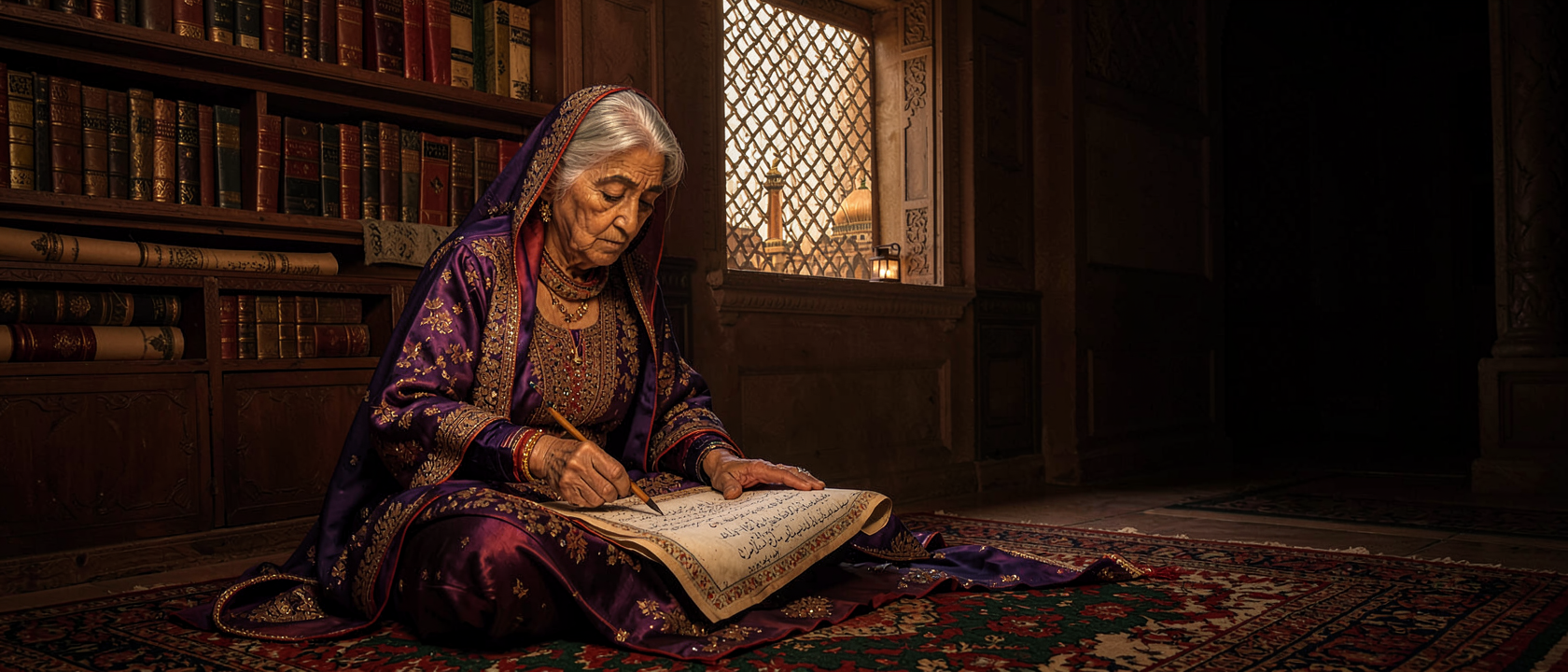
She did not work alone. Gulbadan brought together women of the Lahore harem, among them Hamida Banu Begum, Akbar’s own mother, into gatherings where they checked each other’s memories against one another out loud before anything was set down. In the finished text she sometimes names exactly whose memory lies behind a passage, crediting Hamida Banu by name within the sentence itself, a habit no male chronicler of the period used; Abul Fazl’s Akbarnama speaks throughout in a single authorial voice. Gulbadan then wrote the material down herself, in a plain, conversational Persian mixed with Turkic and Hindavi words, rather than the polished literary Persian expected of a formal history.
What the Book Looks Like
The result became known as the Ahval-i Humayun Badshah (also called the Humayun-nama). It falls into two parts. The first covers Babur’s unsettled early years in Hindustan and is the only fully autobiographical section, drawn from Gulbadan’s own childhood in Kabul. She admits plainly that she was only eight years old when Babur died in 1530, so she might not remember much of his reign firsthand. The second part covers Humayun’s exile: his wedding to Hamida Banu in the desert, his defeat by Sher Shah Suri at Chausa (dated to 1539, though some accounts place the final collapse the following year), and Akbar’s own birth during that same exile.
The book does not move in a straight line the way a formal tarikh, or chronicle, would. It jumps between episodes, closer to a cluster of remembered scenes than a structured record. It includes childbirth, marriage negotiations, and grief, material almost entirely absent from Abul Fazl’s chronicle and the other male-authored accounts of the same years. It is now counted among the earliest known prose works by a woman, and the only surviving text written by a woman of Mughal royalty in the sixteenth century.
No Mandate, No Pay, No Guarantee
Abul Fazl’s Akbarnama was a state project. It had imperial backing, trained scribes, and a built-in audience at court. Gulbadan’s book had none of that beyond Akbar’s original request. No one assigned her scribes. No court status attached itself to the finished pages. The work of recovering fifty years of lived history fell to her and to the aging women who sat with her, unpaid and never credited as historians in their own right.
Nothing in the surviving record says whether Akbar ever read what his aunt produced, or whether the manuscript circulated at court during her lifetime at all.
What We Still Don’t Know
No date survives for when Gulbadan finished writing. It is also impossible, from the text alone, to separate what she remembered directly from what was dictated to her inside the storytelling circle; she credits Hamida Banu by name but leaves the exact division of testimony unsettled. Scholars are not agreed on who else sat in those gatherings beyond Hamida Banu, and the question remains open.
What happened to the manuscript after Gulbadan’s death in 1603 is not recorded either. Only one copy is known to survive. It is incomplete, breaking off in the middle of a sentence, and the section describing her own years away on pilgrimage is missing entirely. That single, unfinished copy, now held in the British Museum, is all that survives of a project Akbar never backed with the same resources he gave Abul Fazl.