
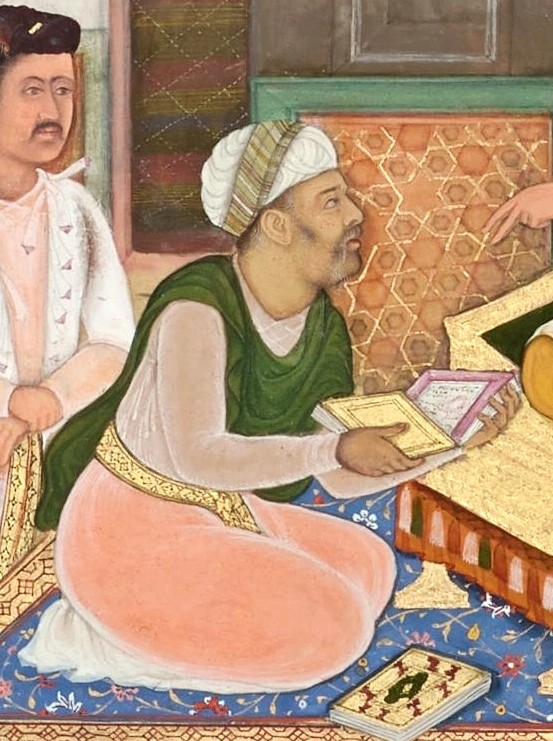
Born in Agra on 14 January 1551, he rose from a family that had suffered religious persecution to become one of the most prominent intellectuals at one of the most powerful courts of the sixteenth-century world. His three-volume chronicle, the Akbarnama, together with its administrative compendium the Ain-i-Akbari, remains the single most detailed record of Mughal governance and culture from that period.
Key facts
- Born: 14 January 1551
- Birthplace: Agra
- Died: 12 August 1602
- Place of death: Lahore
- Country: Mughal Empire
- Occupation: translator; poet; historian; politician
Early life and formation
Abu’l-Fazl was born in Agra on 14 January 1551. His father, Shaikh Mubarak Nagori, faced repeated accusations of being a Mahdawi and a Shia, charges that forced the family to move repeatedly in search of refuge, spending a period in Delhi. Those years of displacement and harassment against his father gave Abu’l-Fazl a lasting hostility toward orthodox religious authority, a disposition that would later find expression in his political writing and in the policies he helped Akbar shape.
At the age of 23, Abu’l-Fazl was introduced to Akbar’s court by his older brother Abu’l-Faizi, who would go on to become the court’s poet laureate. The introduction proved consequential: Abu’l-Fazl entered imperial service and never left it, eventually serving as grand vizier from 1579 onward.
The Akbarnama and the Ain-i-Akbari
The Akbarnama is structured in three volumes. The first traces Akbar’s ancestry back to Timur. The second covers Akbar’s reign up to 1602. The third, the Ain-i-Akbari, documents the administration and culture of the empire and has functioned ever since as a reference for scholars of Mughal institutional history.
Illustrated manuscripts of the Akbarnama survive in more than one form. A second illustrated copy is divided between the British Library in London, which holds Volume I with 163 folios and 39 paintings, and the Chester Beatty Library in Dublin, which holds Volume II and part of Volume III comprising 256 folios and 61 paintings. The manuscript now at the Victoria and Albert Museum has its own documented provenance: the museum acquired it in 1896 from a widow, Mrs Frances Clarke, whose husband, British Major General John Clarke, had obtained it while serving as Commissioner of Oudh between 1858 and 1862.
Abu’l-Fazl’s approach to source material attracted notice well beyond his own century. One scholar has argued that his unusually systematic use of original sources and his critical scrutiny of evidence make him a precursor of Leopold von Ranke, the nineteenth-century Prussian historian regarded as the father of modern history-writing, at a time when no comparable method existed in Indian historiography. That assessment sits alongside a well-documented counter-charge: his veneration of Akbar periodically tipped into outright panegyric, and modern historians treat his works with considerable caution because of this bias.
Political thought and Sulh-i-kul
Abu’l-Fazl is credited with formulating the doctrine of Sulh-i-kul, meaning universal or absolute peace. The principle held that the state should promote harmony among all religious communities rather than privilege any single orthodoxy. Akbar adopted it as state policy, and it became the philosophical foundation of his approach to governing a religiously diverse empire.
This stance made Abu’l-Fazl a target for orthodox religious circles throughout his career. The author of the Maasir ul-Umara recorded the charge directly: ‘Abul Fazl was an infidel.’ The accusation reflected the sustained hostility of those who saw his influence over Akbar as corrosive to established religious order.
Death
The purpose was to help Akbar manage the rebellion of Prince Salim, Akbar’s son and heir. On the road back, he was ambushed at Sarai Vir near Narwar, in the territory that is now Madhya Pradesh. The killing was carried out by Vir Singh Bundela, also known as Bir Singh Deo.
Prince Salim had ordered the ambush. In his own memoirs, written after he had become the emperor Jahangir, he openly admitted to orchestrating the murder.
Place at court
He and his older brother Faizi were both counted among Akbar’s Navaratnas, the nine jewels of the court. They are the only pair of siblings recorded as having held that collective distinction at the Mughal court at the same time.
Did you know
- The Akbarnama manuscript held at the Victoria and Albert Museum was acquired in 1896 from a widow, Mrs Frances Clarke, whose husband British Major General John Clarke had picked it up while serving as Commissioner of Oudh between 1858 and 1862. (hkeshani.github.io)
- Both Abu’l-Fazl and his older brother Faizi were among Akbar’s nine jewels (Navaratnas), making them the only pair of siblings ever to hold that collective distinction simultaneously at the Mughal court. (worldatlas.com)
- One scholar has argued that Abu’l-Fazl can be considered a precursor of Leopold von Ranke, the nineteenth-century Prussian historian celebrated as the father of modern history-writing, because of his unusually systematic use of original sources and critical scrutiny at a time when no comparable approach existed in Indian historiography. (thekashmirmonitor.net)
Data sources
- Wikidata
- polsci.institute
- ethicsofsuicide.lib.utah.edu
- sothebys.com
- notesonindianhistory.com
- banotes.org
- historymarg.com
Data updated: 2026-10-30