
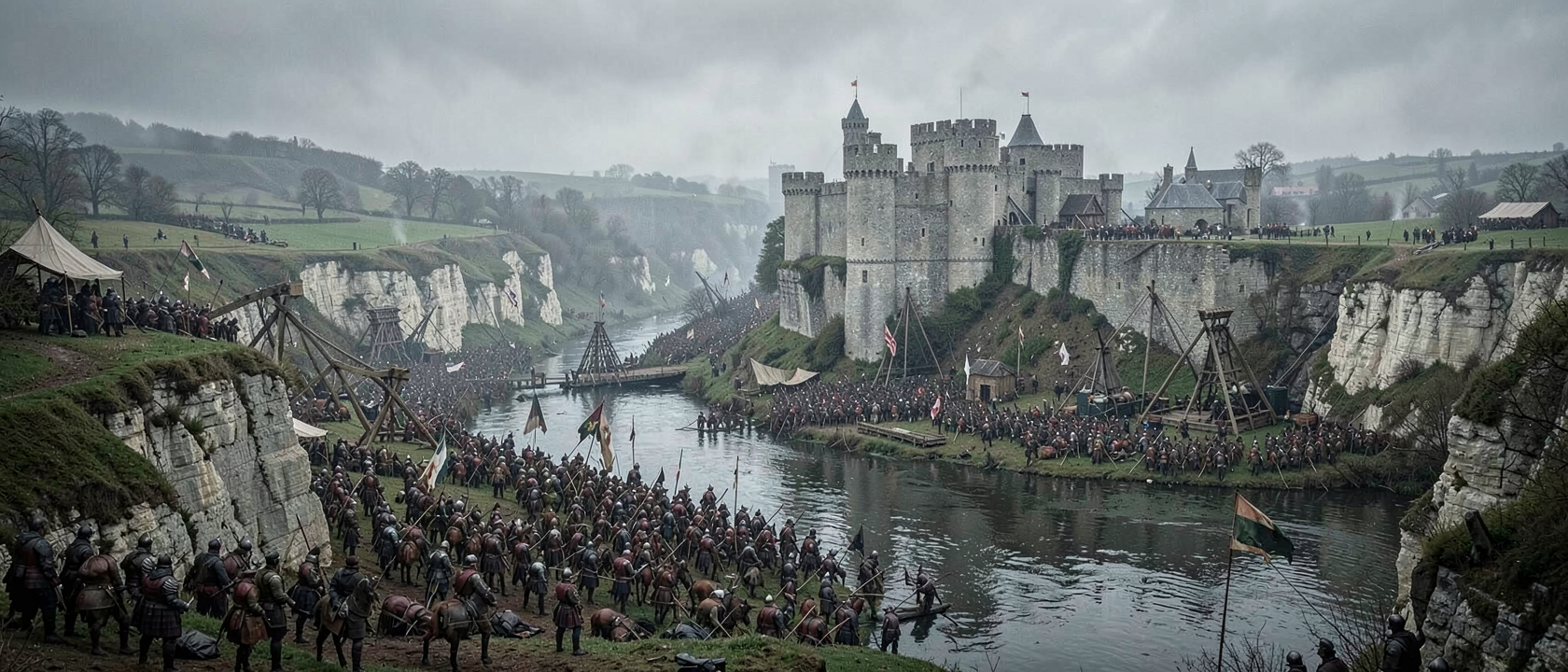
The siege of Château Gaillard
On March 6, 1204, or March 8, by some accounts, French sappers working under King Philip Augustus breached the inner defenses of Château Gaillard. Richard the Lionheart had ordered the fortress raised on the chalk bluffs above Les Andelys, along the Seine, as the anchor of the Norman frontier. Philip’s siege had opened in August 1203, though chroniclers measure its duration anywhere between five and eight months depending on whether they date the investment from August or September. Roger de Lacy of Chester directed the defense with an estimated garrison of around 300 knights and men-at-arms. Tradition claims Richard once remarked the castle could hold even if constructed of butter, a line remembered as legend rather than a documented statement. Yet the butter melted. Normandy’s principal gatehouse fell, leaving the road to Rouen exposed.
The feudal knot
Château Gaillard existed to protect a composite realm. Henry II had been invested as Duke of Normandy between November 1149 and March 1150, inherited Anjou upon the death of his father Geoffrey in 1151, and acquired Aquitaine through his 1152 marriage to Eleanor of Aquitaine. By the time he secured the English crown in 1154, Henry commanded a continuous sweep of territory from the Scottish border to the Pyrenees. He later added the lordship of Brittany in 1158 and claimed lordship over Ireland after invading in 1171.
This empire contained an intractable legal contradiction. In England, the Plantagenets answered to nobody. Across the Channel, they held their ancestral lands as vassals of the French king.
John had already demonstrated how fragile that structure was during Richard’s captivity between 1193 and 1194, when he allied with Philip Augustus and yielded Norman border strongholds, including Évreux, to undermine his brother.
The crisis over Isabella and Arthur
John took the throne in 1199 following Richard’s death. In 1200, he married Isabella of Angoulême, who was already betrothed to Hugh le Brun, Lord of Lusignan. Denied satisfaction, the Lusignans appealed to Philip Augustus as their common feudal superior. A French royal court heard the case in 1202, declared John in default of his vassal duties, and ruled his continental holdings outside Normandy forfeit. Philip promptly assigned those lands to John’s nephew and rival, Arthur of Brittany.
John struck back rapidly. On July 31, 1202, or August 1, in other accounts, he surprised and captured Arthur at Mirebeau.
The captive was taken to Falaise and then transferred in 1203 to Rouen Castle under the custody of William de Braose. Arthur was last accounted for alive around April 3, 1203, though some records cite April 4. No body was ever recovered. The Margam Abbey annals asserted that John killed the young prince with his own hands and cast the weighted corpse into the Seine, an accusation echoed by chroniclers Matthew Paris and Thomas Wykes. Official rolls simply went silent. Whatever the true circumstance of Arthur’s death, local barons abandoned the Plantagenet cause, unwilling to fight for a lord suspected of murdering his own kin.
The surrender of Rouen
John abandoned the duchy for England on December 5, 1203, or December 6, according to other records. De Lacy remained trapped inside Château Gaillard without hope of relief. After the fortress yielded in March 1204, Philip drove into western and southern Normandy, taking Falaise and Caen before marching on the ducal capital. French divisions reached Rouen in May 1204. On June 24, 1204, the city opened its gates, terminating cross-Channel rule that had persisted since the aftermath of the Norman Conquest.
The cost of the collapse
The settlement dismantled the core of the Angevin world. Philip absorbed Maine and Anjou alongside large swaths of Aquitaine, tearing out what historians later identified as the heart of the empire. Landowners who had held manors on both sides of the sea were forced to surrender one half of their patrimony, choosing whether to serve a monarch in London or one in Paris. John returned to an island kingdom where his authority had been permanently shaken, leading directly into an ecclesiastical interdict imposed by the Pope between 1208 and roughly 1213 or 1214.