
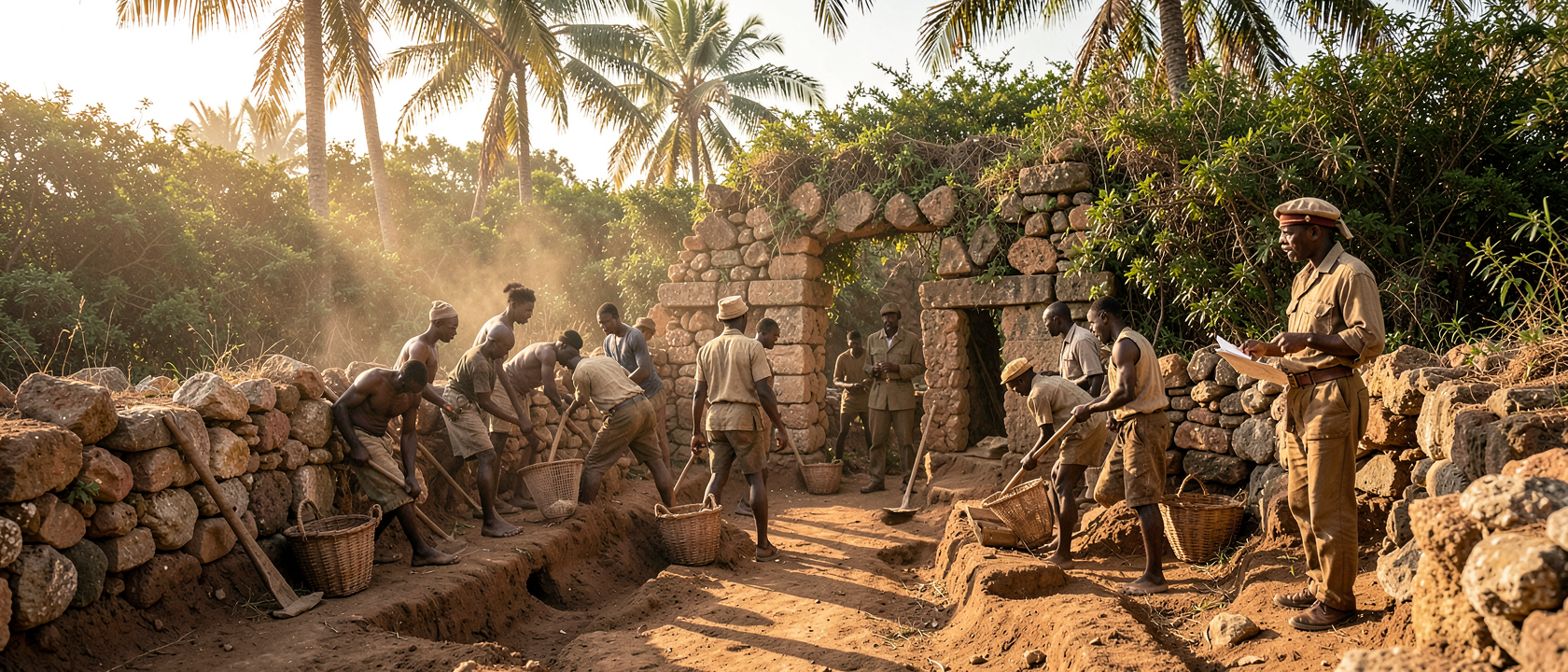
Fort Jesus, 1959
A camera at Fort Jesus in Mombasa caught Karisa Ndurya standing at the edge of a trench in 1959, directing a crew of Kenyan laborers at work. Three frames survive from that session. The fort itself was new to this kind of attention: it had served as a prison for sixty years before the Kenyan government declared it a historical monument in 1958 and asked James Kirkman, the British archaeologist who had been directing the dig at Gedi since 1948, to oversee its conversion into a museum. By 1959, Kirkman held the title of director at both sites. Ndurya ran the crews that made the digging possible, and for decades the three photographs sat in storage, uncaptioned, with no name attached to the man giving the orders.
A System Built on Unnamed Labor
Before the 1970s, almost no Kenyan had the chance to study archaeology formally. Foremen like Ndurya supplied the practical skill behind a dig: how to manage a crew and where to look. Directors depended on that site knowledge for the reports they published, and none of it carried over into the credit line. Site plaques, published excavation reports, and museum records across Kenya carried only the European name attached to a dig. The same pattern sits in London: the Horniman Museum’s collection of Kenyan archaeology, including material excavated from Gamble’s Cave in the Rift Valley in 1931, is listed under Louis Leakey’s name alone. Formal training for Kenyan archaeologists only opened up in any numbers around the 1970s, close to when Kirkman himself retired from Fort Jesus in June 1972.
Twenty Years, Then Silence
Ndurya’s working life ran across both digs through the 1950s and 1960s, supervising the Kenyan teams that excavated Gedi and Fort Jesus for more than two decades. He died in 1988, at the age of 80. He left no diary, no personal papers, and no account of the work from his side of the trench. What survived instead were photographs nobody had labeled, filed away in an archive, and the fading memories of the few workers from those decades who were still alive by the time anyone came looking.
A Granddaughter Returns to the Walls
In 2018, Ndurya’s granddaughter Sherry Davis, a musician, filmmaker, and curator born in London to a Kenyan mother and a Jamaican father, traveled to Kenya to learn about her grandfather’s work. She sought out surviving workers from the old excavation crews while there were still people left to ask. At Gedi and Fort Jesus she found Kirkman’s name on the walls and in the museum’s own records, with none of the Kenyan crew anywhere in sight. Davis had previously worked at the Horniman Museum as a Community Action Researcher, and she brought the idea for an exhibition correcting the record to both the Horniman and the National Museums of Kenya. Which institution she approached first, and how long it took to become a firm commitment, is not part of the record.
Five Hundred Photographs in a Box
Davis began working with Ashikoye Okoko, a researcher at the National Museums of Kenya, and with George Abungu, a Kenyan archaeologist and former director of the National Museums of Kenya, to track down images of the Kenyan crews. Much of what they found was unusable: material never digitized, photographs too deteriorated to read, or collections dated after the colonial period and outside the years they needed. Most of the excavation photographs that had survived at all showed only empty trenches, not the men who had dug them.
Then Ashikoye Okoko found an unsorted box of roughly 500 photographs from the 1940s and 1950s in the Fort Jesus archives. Among them were the three 1959 images of Ndurya overseeing his crew. Abungu has suggested that the original archaeologists simply did not see themselves as taking something that belonged to someone else. That is his own reading of their intentions, not something documented in anything Kirkman or Leakey wrote.
What Came Back
Some of what was lost cannot be recovered. Ndurya left no papers of his own. The handful of surviving workers who could still speak to what the digs had been like were already elderly by 2018, and an unknown number of other men from those crews never appear in any record at all, named or otherwise. What came back was partial. Word of the project spread, and other names surfaced: Wazwa Mwadime, a trainee conservator who had worked on the Santo Antonio de Tanna, the Portuguese shipwreck of 1697 off Mombasa, and Omar Bwana, who had curated the Lamu Museum in the 1970s. Neither is a substitute for the crews at Gedi and Fort Jesus in the 1950s. They show that once people started asking, more names turned out to be there.
December 8, 2022
“Ode to the Ancestors: Kenyan Archaeology” opened at the Horniman Museum in London on December 8, 2022, built from the recovered photographs and new artwork made by young people of African and Caribbean descent responding to them. A sister exhibition opened at Fort Jesus, organized by the National Museums of Kenya, the institution that had helped recover the photographs from its own archives. Among the images on display were the three photographs of Karisa Ndurya from 1959, now identified by name after more than sixty years.
What the Archive Doesn’t Say
The project produced no final count. How many Kenyan workers beyond Ndurya were ultimately identified by name is not stated, only that more kept surfacing as word spread. The order of events, whether Davis approached the Horniman or the Kenyan museum first, when Abungu and Ashikoye Okoko began searching, when community members started coming forward, is not recorded either. Abungu’s comment about the archaeologists’ state of mind remains his own reading; nothing from Kirkman or Leakey confirms or denies it.
Three photographs survive from 1959, out of an archive of roughly 500 images recovered from Fort Jesus. They show a Kenyan foreman running a dig that the historical record credited to someone else. There were more men on that crew than three photographs can hold, and most of them left nothing behind at all.