
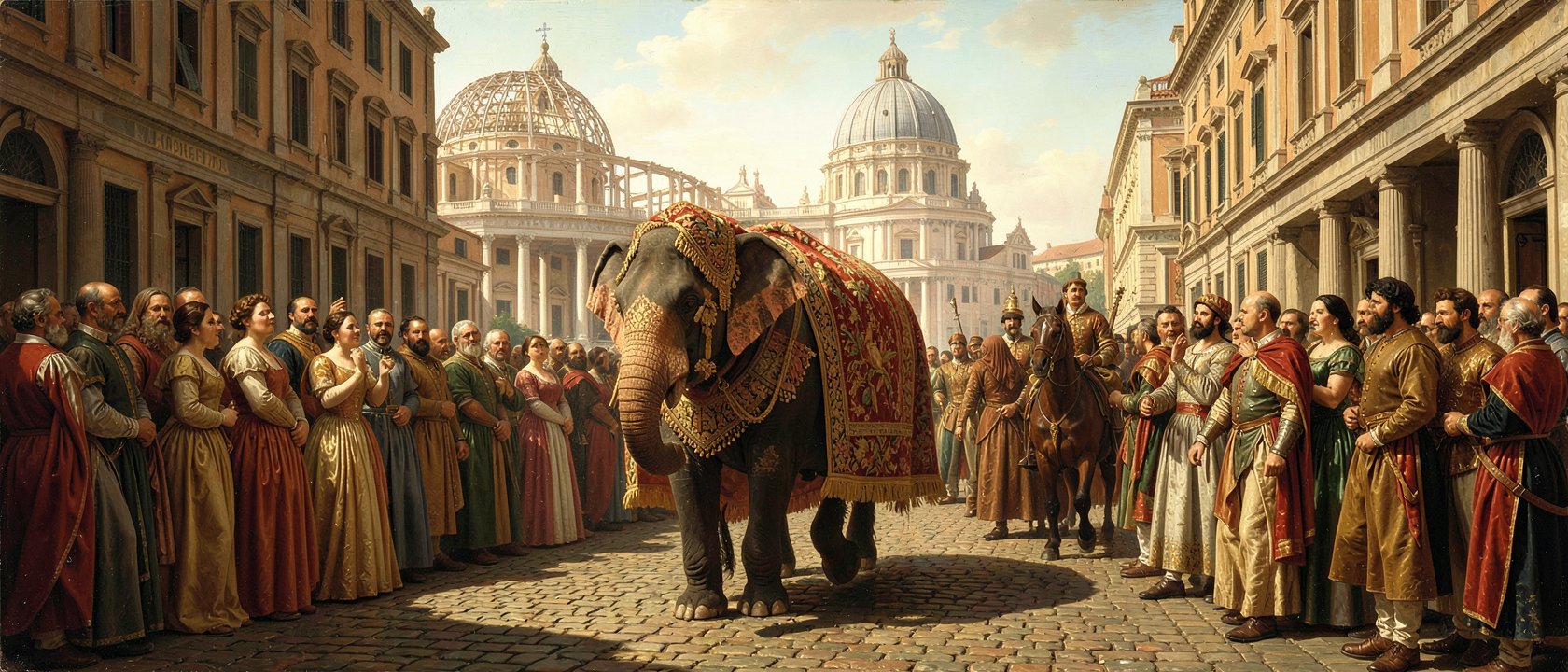
A Silver Castle Enters Rome
By one account, on March 19, 1514, a four-year-old elephant walked into Rome carrying a structure built like a small silver castle on his back. Other sources place the procession through the city a week earlier, on March 12, 1514; the exact date of his public entry is not settled across accounts. The structure was a howdah, the raised platform used across Asia to carry riders or cargo. As he passed, the elephant raised his trunk toward the crowd, and the crowd pressed closer to watch him do it.
His name was Hanno. The papal court and the Portuguese embassy that brought him, led by ambassador Tristão da Cunha, had arranged the entry together. It was the public unveiling of a gift three years in the making, sent by King Manuel I of Portugal to the newly elected Pope Leo X.
Why an Elephant, Why Now
Leo X, a Medici, had become pope on March 9, 1513. Custom required every Catholic monarch to greet a new pope with a formal embassy, known as a mission of obedience, and Manuel meant his to be remembered. Exotic animals ranked above almost any other royal gift of the age: ahead of parrots, cheetahs, and leopards, all of which Portugal also sent to Rome that year. A living elephant was something almost no one in Europe had seen.
Manuel had something concrete to protect, too. Portugal’s new sea route to India threatened the old overland spice trade, and by one contemporary account Egypt’s Mamluk Sultanate was pressing the new pope against Portuguese interests. Manuel answered with an embassy of roughly 140 people, led by da Cunha with Garcia de Resende as secretary, carrying manuscripts, pearls, a Persian horse, and a gold chalice alongside the animals. The elephant was the centerpiece, and also the risk: a living creature had to survive two sea voyages and an overland march, by sail and cart, with no established way to keep one alive that far from home.
Six Months on an Open Deck
Hanno’s journey had begun three years earlier, in Portuguese India. He was born around 1510, likely near Kochi, called Cochin by the Portuguese, and raised from infancy by mahouts, the region’s traditional elephant handlers. Exactly how Manuel I acquired him is unsettled: some accounts call him a gift from the Raja of Kochi, others a purchase arranged by Afonso de Albuquerque, Portugal’s viceroy in India. One surviving record credits Albuquerque with written orders, dated January 12 and 19, 1511, setting out rations of rice, butter, and oil for the animal.
In early 1511, Hanno was loaded onto a ship at Kochi with his mahouts, bound for Lisbon, a straight-line distance of about 4,400 miles (7,080 km); the actual route around the Cape of Good Hope ran longer. He spent roughly six months on an open deck, tied down through storms, with no precedent for keeping an elephant alive at sea that long. He survived it, and by the time he reached Lisbon in the summer of 1511 he was already a valuable asset, years before Manuel decided to send him on to Rome.
The Crowds That Wore Him Down
That decision came in 1514, when Manuel folded Hanno into the embassy bound for Leo X. He sailed again, now alongside the parrots, the cheetah, the leopards, and the rest of the gifts, under the Portuguese equerry Nicolau de Faria. At every stop, Alicante, Ibiza, Palma de Mallorca, crowds gathered in numbers large enough that Faria began skipping ports rather than manage them.
The overland leg to Rome was harder on the elephant. The group stopped often because the hard road was wearing down Hanno’s feet, a serious problem for an animal whose whole frame depends on healthy feet. A stay arranged at a cardinal’s villa outside the city was abandoned after crowds broke through its walls and trampled the vineyards. At one stop, an inn roof gave way under people who had climbed onto it for a better look. Faria turned down nobles who wanted Hanno routed through their estates; there was already barely any way to manage the people who found him uninvited. By the time he reached Rome in March 1514, under his silver howdah, Hanno had already been marched and mobbed across two countries.
Two Years as a Favorite
Hanno spent the next two years as one of Leo X’s prized possessions, kept first in the Vatican’s Belvedere Courtyard, then in a building put up specially for him near St. Peter’s Basilica and the papal palace. Leo X reportedly opened the enclosure to visitors every weekend, turning the elephant into a standing Vatican attraction, an extension of the role he had been shipped around the world to play.
The Bill
In early June 1516, Hanno fell ill with what was read at the time as constipation. Leo X’s own physicians treated him as they would any Renaissance patient: they examined his urine, bled him, and dosed him with a purgative laced with gold. No one in Rome had treated an elephant before, because Rome had never had one to treat. On June 8, 1516, Hanno died.
He was about six years old. A wild Asian elephant can live to around 60. The fame that had carried him across oceans and mobbed Italian towns also meant that, once sick, he was handled by men trained in human medicine, not animal care. The writer Pietro Aretino marked the death with a mock last will and testament mocking Rome’s leading political and religious figures, Leo X included; its success launched his career as a satirist. A drawing of Hanno made that same year, often attributed to Raphael’s workshop, survives in Berlin.
What the Record Doesn’t Say
Several parts of this story are not pinned down. Hanno’s exact birth date and birthplace are given only as likely, sometime around 1510 near Kochi. The date Manuel I acquired him is not recorded, nor is which account, gift or purchase, is correct. Even the date of his formal entry into Rome is disputed between sources, a reminder of how much of this story rests on scattered Renaissance accounts rather than a single clean record. No source puts a price on the elephant or on the embassy that carried him to Rome. The size of the crowds is known only through what they did: roofs gave way, walls came down, vineyards were trampled. No one counted the people.
What survives instead is physical. In 1962, maintenance workers inside the Vatican’s Belvedere Courtyard found a large tooth and fragments of jawbone, mistaken at first for the remains of a dinosaur. They belonged to Hanno, confirming, more than four centuries later, that an elephant really had lived and died exactly where the written record said he had.