
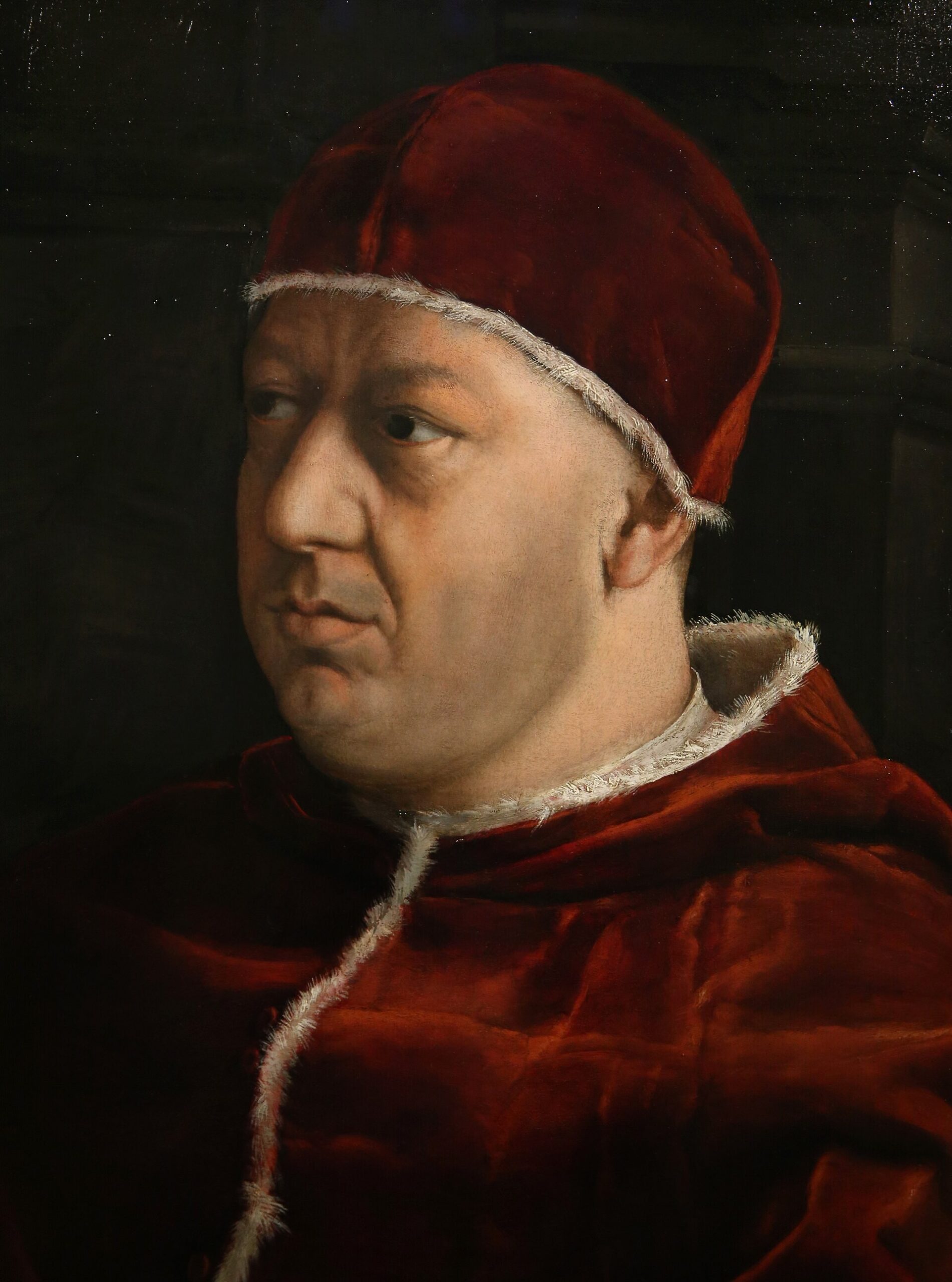
Giovanni di Lorenzo de’ Medici, who took the name Leo X upon his election in 1513, was pope of the Catholic Church until his death on 1 December 1521. His pontificate witnessed the opening of the Protestant Reformation, the excommunication of Martin Luther, and a level of artistic and humanist patronage so concentrated that later writers gave the period its own name: the Leonine Age.
Key facts
- Born: 11 December 1475
- Birthplace: Florence
- Died: 1 December 1521
- Place of death: Rome
- Country: Papal States
- Occupation: Latin Catholic priest; Catholic priest
- Field: administration and management of the church
- Education: University of Pisa
Early life and education
Giovanni was born on 11 December 1475 in Florence, the second son of Lorenzo de’ Medici, ruler of the Florentine Republic, and Clarice Orsini. His path into the church was fixed almost from birth.
The education provided at his father’s court was thorough and humanist in character, directed by tutors who included Angelo Poliziano, Marsilio Ficino, and Bernardo Dovizi, who later became Cardinal Bibbiena. From 1489 to 1491 Giovanni supplemented that grounding with formal study of theology and canon law at the University of Pisa under Filippo Decio and Bartolomeo Sozzini.
Pope Innocent VIII created the thirteen-year-old Giovanni a cardinal on 9 March 1489, with the condition that he should refrain from exercising the insignia and privileges of that office for three years. The appointment reflected both the political weight of the Medici family and the pope’s willingness to use church offices as instruments of alliance.
Years in exile and return to prominence
The Medici were expelled from Florence in 1494, and Giovanni spent the following years travelling across Europe, passing through France, Holland, and Germany between 1494 and 1500. The journey brought him into contact with Renaissance humanism as it had developed outside Italy, an exposure that likely deepened the cultural interests he would later direct toward Rome.
When his brother Pietro died in 1503, Giovanni became head of the Medici family and moved into a more active role in Italian politics. His ecclesiastical standing grew alongside his political profile. In October 1511 he was named legate of Bologna and Romagna, placing him in command of papal forces in the region. French forces captured him at Ravenna in 1512, though he managed to escape.
Election as pope and the character of his pontificate
Elected pope in 1513, Leo X inherited a papacy at the centre of Italian politics and European culture. His court in Rome attracted writers, artists, and musicians, and the period of his reign came to be called the Leonine Age for the density of cultural patronage he sustained.
The financial cost of that patronage was severe. Within two years of taking office he had exhausted the entire treasury left by his predecessor Julius II. To raise funds he resorted to selling Vatican palace furniture, dishes, jewels, and statues of the apostles.
In 1517 an internal threat emerged when Cardinal Alfonso Petrucci’s conspiracy to poison the pope was uncovered. Petrucci was executed. Several other cardinals were imprisoned and subjected to heavy fines. Leo then appointed 31 new cardinals in rapid succession, reshaping the College in a way that secured his hold over it.
The Reformation and the excommunication of Luther
The challenge Martin Luther posed to Rome reached a formal breaking point in 1520 and 1521. On 10 December 1520, Luther burned a copy of the papal bull Exsurge Domine at the Elster Gate in Wittenberg. Leo’s response was the bull Decet Romanum Pontificem, issued on 3 January 1521, which formally excommunicated Luther from the Catholic Church. The original manuscript of that bull is preserved in the Vatican Library.
Leo also engaged the wider European politics of the Reformation. On 11 October 1521, he conferred on King Henry VIII of England the title Fidei Defensor, meaning Defender of the Faith, in recognition of Henry’s treatise Assertio Septem Sacramentorum, which defended the Catholic Church against Luther’s arguments. The original bull recording that grant survives as Cotton MS Vitellius B IV/1 in the British Library, though it was significantly damaged in the Cotton Fire of 1731.
Religious policy and the church
Beyond the conflict with Luther, Leo’s pontificate included decisions that shaped Catholic institutional life. He approved the formation of the Oratory of Divine Love, a group of pious men at Rome that later developed into the Theatine Order. He also canonized Francis of Paola.
Death and burial
Leo X died on 1 December 1521 in Rome. The cause of his death has been given variously as sudden malignant malaria, bronchitis, or pneumonia; accusations of poisoning made by his enemies have not been substantiated.
The circumstances of his funeral reflected the state of the papal finances he left behind. The candles used at his funeral rites were leftovers from a previous funeral, and no monument was erected to his memory until the reign of Pope Paul III. He is buried in the basilica of Santa Maria sopra Minerva in Rome, where his tomb was eventually designed by Antonio da Sangallo the Younger.
Did you know
- Leo X is the only pope known to have kept a pet elephant. In 1514, King Manuel I of Portugal sent him a young Asian elephant named Hanno, which became the darling of the papal court and lived in an enclosure in the Vatican’s Belvedere Courtyard. (theconversation.com)
- Within two years of taking office, Leo X had completely drained the treasury left by Julius II. To raise funds he began selling off pieces of Vatican palace furniture, dishes, jewels, and statues of the apostles. (content.time.com)
- The original papal bull of 11 October 1521 conferring the title “Defender of the Faith” on Henry VIII survives as Cotton MS Vitellius B IV/1 in the British Library, though it was significantly damaged in the Cotton Fire of 1731. (bl.uk)
- The original manuscript of the papal bull Decet Romanum Pontificem of 3 January 1521, excommunicating Martin Luther, is preserved in the Vatican Library. (historyofinformation.com)
Data sources
- Wikidata
- newadvent.org
- ebsco.com
- reformation500.csl.edu
- historyofinformation.com
- bl.uk
- thegeographicalcure.com
- newworldencyclopedia.org
Data updated: 2026-10-28