
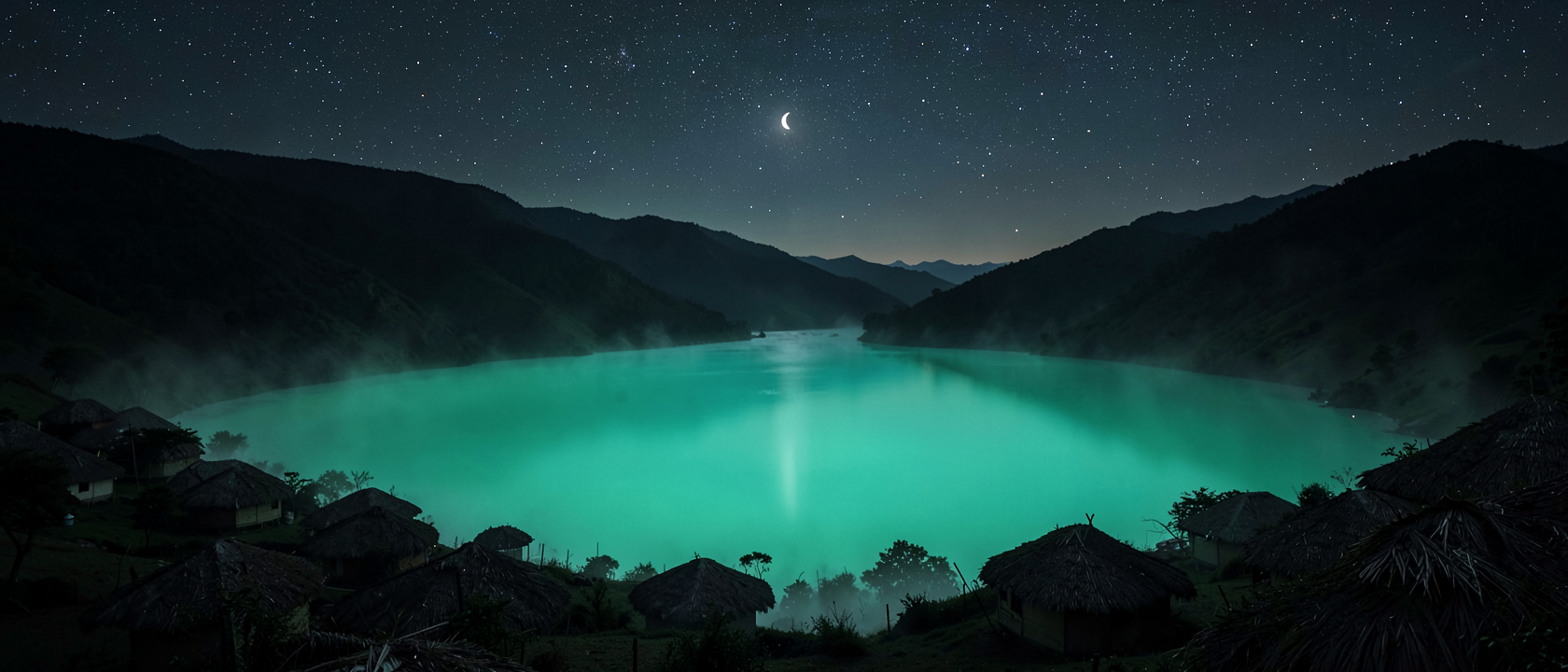
The Waking
Some people near Lake Nyos, in Cameroon‘s Northwest Province (today’s Northwest Region), did not regain consciousness until two days after the night of August 21, 1986. When they came to, they found their families, their cattle, and even the insects around them dead. There were no burns on anyone, no wreckage, no sign that anything had caught fire.
The village of Nyos sat closest to the water and took the worst of it, but the strangeness reached well beyond the shoreline. Survivors stepped outside into a silence that made no sense: livestock lying still in the grass, birds dropped where they stood, nothing scorched, nothing broken. Whatever had come through had left no mark at all beyond the bodies.
That absence was the puzzle investigators would spend the following days trying to solve. What kills without leaving a trace?
A Lake Built to Kill
Lake Nyos fills the crater of a dormant volcano. Beneath the lakebed sits a pocket of magma that has been leaking carbon dioxide into the water for what geologists estimate to be roughly a century. The gas settles into the lake’s deepest layer, 682 feet (208 m) down, where water pressure runs about 20 times what it is at the surface. At that pressure, the water holds about 20 times more dissolved CO2 than it could near the top. Nyos is one of only three lakes on Earth known to be saturated with gas this way.
None of it showed from above. Nyos looked like any other crater lake, calm and unremarkable, with no instrument anywhere measuring what was building in its depths.
A warning had already come. On August 15, 1984, a similar release at Lake Monoun, a shallower crater lake about 62 miles (100 km) away and 315 feet (96 m) deep, killed 37 people after a landslide disturbed its deep water. It was treated as an isolated accident. Nyos held far more water, at far greater depth, and no one had measured how much gas it carried.
The Release
At around 9:30 p.m. on August 21, 1986, people near the lake heard a rumble that lasted some 15 to 20 seconds, then felt a gust of foul-smelling air roll past. Something had disturbed the lake’s lowest layer. Four explanations have been proposed: a tremor, a wind-driven sloshing of the surface, a steam explosion, or an underwater landslide. Which one actually triggered the release has never been confirmed.
Whichever it was, the effect worked like a shaken bottle of soda. Water pulled up from the depths lost pressure, and the carbon dioxide locked inside it broke out as bubbles. Those bubbles dragged more deep water up behind them, which degassed in turn, so the reaction fed itself and grew. In a matter of minutes, the lake vented an estimated quarter of a cubic mile of gas (close to 1 cubic kilometer, with some estimates running as high as 1.2 cubic kilometers). The cloud, heavier than air, rolled downhill at close to 45 mph (72 km/h), by some estimates nearer 50 mph (80 km/h).
Government officials and outside visitors who reached the area in the days that followed were unaffected by whatever had happened, which led them to suspect an epidemic at first. There was no blast damage anywhere to point to anything else. Only after studying the pattern of deaths and testing the water did they identify carbon dioxide as the cause. At a concentration of about 10 percent, the gas brings on unconsciousness within minutes and death within fifteen; at 40 percent, it kills almost on contact.
How Far It Reached
The cloud did not rise and thin out like smoke. It behaved like a fluid, pouring downhill and settling into the low ground. Bodies turned up in villages as far as 12 miles (19 km) from the lake, by other estimates around 10 kilometers (6.2 mi); either distance means the gas traveled for miles while staying low enough to the ground to kill anyone in its path. Dead cattle were found at elevations up to 330 feet (100 m) above the crater rim, where the gas had climbed high enough to spill over before pouring down the far slope.
For several days afterward, no insects stirred near the lake and no vultures touched the carcasses scattered across the hillsides. That absence became evidence in itself. A gas that suffocates everything down to the smallest insect, and that lingers long enough to keep scavengers away, pointed investigators toward carbon dioxide rather than toward any airborne disease.
The Count
By the United Nations’ count, 1,746 people died that night, at least 300 more were hospitalized, and about 3,000 people were displaced from the villages around the lake. Roughly 3,500 cattle died with them. These are the totals as reported, not figures claimed to be exact to the last person, but they describe a night that emptied an entire district.
In Nyos itself, the town closest to the water, only four people are reported to have survived; one account narrows that further, to a woman and a child who lived through the night in Lower Nyos. Whichever number is closer to the truth, the town was effectively gone by morning.
What Still Isn’t Known
Four decades later, three questions remain open. What exactly destabilized the lake that night, tremor, wind, steam, or landslide, has never been pinned down. Why the four people in Nyos survived is just as unsettled; researchers have pointed to wind patterns that may have steered the cloud away from certain spots, to buildings whose poor ventilation might have kept the gas from reaching inside, or to pockets of slightly higher ground, but none of it is proven.
Cameroon’s Northwest Province holds an estimated 44 other crater lakes, and no one knows for certain which of them, if any, are accumulating gas the way Nyos did. Lake Kivu, between Rwanda and the Democratic Republic of the Congo, is one of only two other lakes in the world known to carry the same kind of saturation, with dissolved methane sitting on top of the carbon dioxide. What would happen if it ever vented the way Nyos did is, in the scientists’ own words, unclear.
At Nyos, engineers eventually ran degassing pipes into the lake to bleed off the gas gradually instead of letting it build. Lake Monoun received one in 2003. Both lakes are still being monitored, because a body of water that can kill without fire, without wreckage, and almost without sound is not a problem anyone considers closed.