
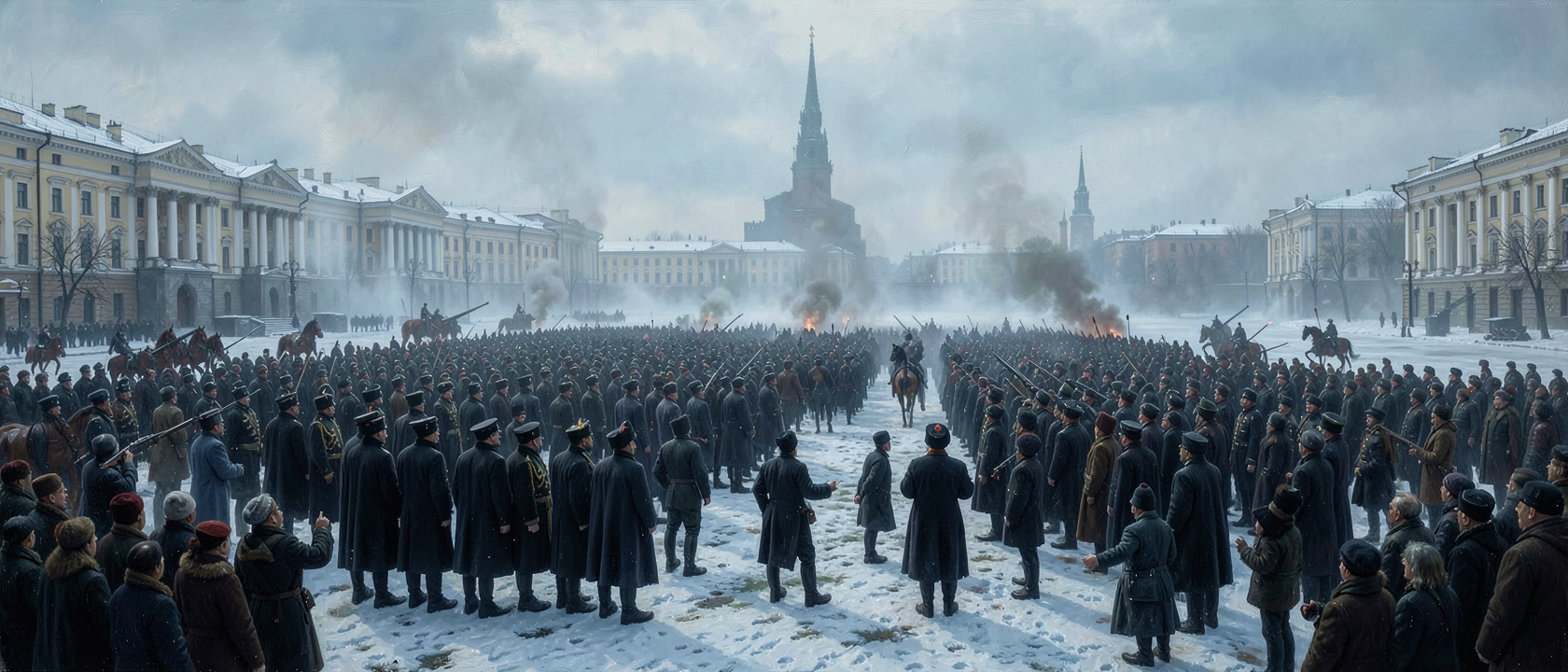
On December 14, 1825, by the calendar then in use in Russia (December 26 in Western Europe), close to 3,000 soldiers stood for hours in Senate Square in St. Petersburg in winter weather. Russian army officers, not the crown, had brought them there. The men came to be known afterward as the Decembrists, for the month of their action. By evening the square had been cleared by artillery fire ordered by the tsar they had gathered to keep from the throne.
The Soldiers Who Waited
Nicholas I had been tsar for less than two weeks. His elder brother, Alexander I, had died on December 1, 1825. The throne should then have passed to another brother, Grand Duke Constantine Pavlovich, and many soldiers, including some standing in the square that day, had already sworn loyalty to him. When Constantine’s earlier renunciation of his claim became public, Nicholas stepped forward to take the crown. Officers of a secret society saw the gap between those two oaths as their opening.
The man appointed to lead the rising, Colonel Prince Sergei Trubetskoy, never reached the square. He went instead to the office of the army’s chief of staff to swear his own oath to Nicholas, then took refuge at the Austrian embassy. Command passed raggedly among the other officers while the troops held their ground. For six hours, negotiation and threat passed between the square and the palace, and neither side gave way.
The Manifesto That Lied
The soldiers in the square were following a secret society, not a single commander. The Northern Society had been organizing in St. Petersburg since 1821. A parallel group, the Southern Society, led by Pavel Pestel, had organized the same year in Tulchin, in present-day Ukraine. Both aimed at the same target: autocratic rule itself.
The manifesto the officers wanted the Senate to read stated that Nicholas had renounced the throne and that the government had fallen. Neither claim was true. The lie was meant as a lever: if the Senate believed the old order gone, it might proclaim the program the rebels actually wanted, a constitution, the end of serfdom, and civil rights. The timing was not an accident. A succession already clouded by two changes of oath in two weeks was the one moment an autocrat’s authority could be made to look provisional.
The Order to Fire
Nicholas tried persuasion before force. He sent Mikhail Miloradovich, the Governor-General of St. Petersburg and a war hero from the campaigns against Napoleon, to talk the soldiers into dispersing. A retired lieutenant among the rebels, Pyotr Kakhovsky, shot him, and the wound proved fatal. Only after that, with six hours gone and the square still held, did Nicholas order artillery brought up and fired on the troops.
The square emptied quickly once the guns opened. Most of the rebels were arrested on the spot or within days and marched to the Peter and Paul Fortress. No reliable count of the dead from the shooting has survived. It is one of the clearest gaps in the record of that day, and it is better left marked as unknown than filled with a guess.
The Uprising in Ukraine
The conspiracy was not confined to the capital. On December 29, 1825, officers of the Second Army’s Chernigov Regiment, stationed in Ukraine and tied to the Southern Society, raised their own revolt under Sergey Muravyov-Apostol and Mikhail Bestuzhev-Ryumin. Government troops moved against them within days. On January 8, 1826, Muravyov-Apostol was critically wounded by canister shot and captured, and the uprising collapsed with him. It showed that the plot had reached well beyond St. Petersburg, into the ranks of the army far from the throne it had tried to shake.
The Investigation and the Sentence
A Secret Investigative Committee was formed to look into the conspiracy, and Nicholas took part in the interrogations himself. The committee’s exact methods and the full detail of the charges against each man are not well documented in the record available, but its work ran on for months before the sentences were set.
By July 1826, the sentences were set. A total of 121 men were condemned to hard labor and exile in Siberia. Five of the leaders were sentenced to death by hanging: Pavel Pestel, the poet Kondraty Ryleyev, Sergey Muravyov-Apostol, Mikhail Bestuzhev-Ryumin, and Pyotr Kakhovsky, the same man who had shot Miloradovich in the square. They were executed at the Peter and Paul Fortress on July 13, 1826.
More Than Romantics
It has become common to describe the Decembrists as romantic idealists, men swept up in borrowed ideas about liberty with little sense of what they were risking. The timeline invites a second look. The Northern and Southern Societies had been organizing since 1821, four years before they acted. Their manifesto targeted the exact seam in a succession crisis where an emperor’s authority was weakest. When the plan in St. Petersburg failed, officers in Ukraine raised a second revolt rather than let it drop. Five of them went to the gallows rather than recant. Historians still debate how coherent their program really was and how far it could have succeeded, but the years of planning behind it, and the price five men paid for it, sit uneasily with the word “naive.”
The consequences outlasted the men who were hanged. Nicholas I turned toward a more conservative and watchful style of rule, and some historians trace the start of Russia’s revolutionary tradition back to this failed uprising. In 1925, on the hundredth anniversary of the revolt, Senate Square was renamed Decembrist Square, after the men who had once stood there waiting for an answer that never came.