
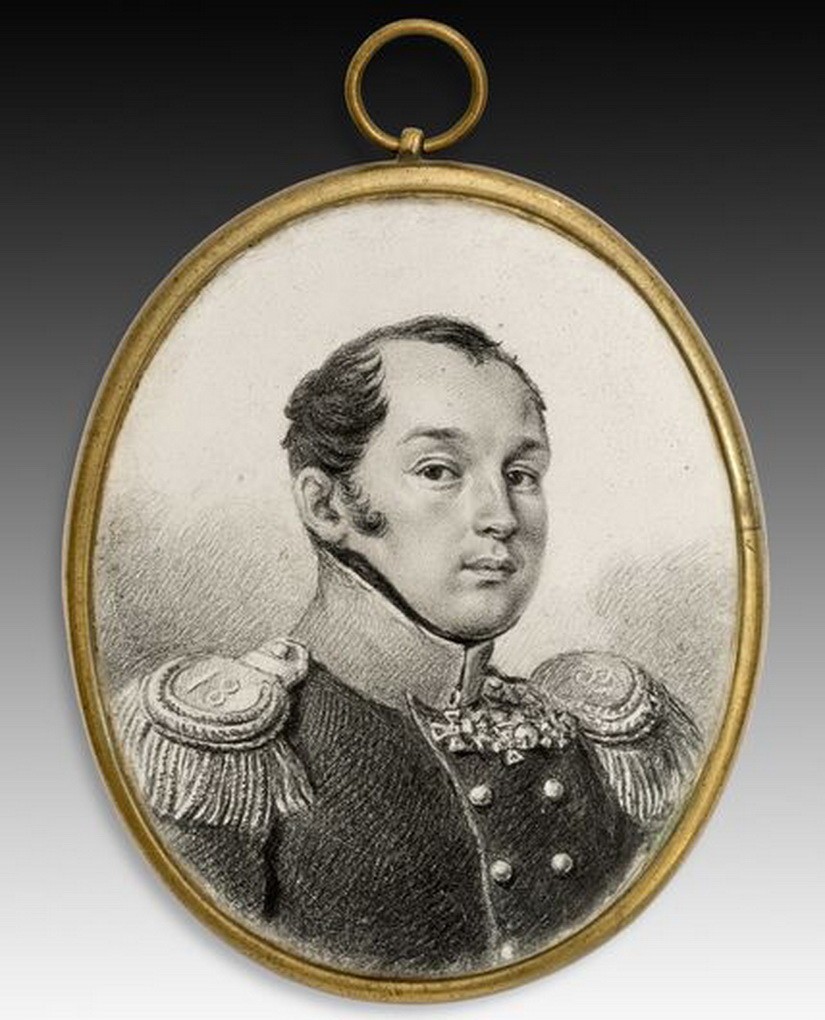
Pavel Pestel (1793–1826) was a colonel in the Russian Imperial Army, a leader of the Decembrist movement, and the principal architect of its most ambitious republican programme. Born in Moscow on 24 June 1793, he served with distinction in the Patriotic War of 1812 before turning his energies to clandestine political organisation. The constitutional document he drafted, Russkaya Pravda, called for the abolition of the tsarist autocracy and the establishment of a republic modelled in part on that of the United States, making Pestel the figure who introduced a systematic republican programme into Russian opposition politics. He was executed on 13 July 1826 at the Peter and Paul Fortress.
Key facts
- Born: 24 June 1793
- Birthplace: Moscow
- Died: 13 July 1826
- Place of death: Peter and Paul Fortress
- Country: Russian Empire
- Occupation: military personnel; revolutionary; Decembrists; colonel
- Education: Page Corps
- Awards: Order of Saint Anna, 2nd class; Order of St. Vladimir, 4th class; Gold Sword for Bravery; Knight of the Order of Leopold (Austria)
Early Life and Military Career
Pestel was born in Moscow on 24 June 1793 and educated at the Page Corps, the elite institution that prepared young men of the Russian nobility for military and court service. He entered the army in time to fight in the Patriotic War of 1812, seeing action at the Battle of Borodino, and continued in the field during the foreign campaigns of 1813 and 1814 as Russian forces pursued Napoleon’s army across Europe. His military record earned him the Order of Saint Anna (2nd class), the Order of St. Vladimir (4th class), a Gold Sword for Bravery, and the Austrian Knight of the Order of Leopold, a list of decorations that reflects active combat rather than ceremonial service.
By the time the campaigns ended, Pestel held the rank of colonel. The experience of fighting alongside allied European armies shaped his political thinking over the years that followed.
Entry into Conspiracy: The Union of Salvation
In 1816 Pestel joined the Union of Salvation, which had been founded in St. Petersburg in February of that year. He became the principal author of its statutes and pressed the society’s members to commit to a republican rather than merely a constitutional-monarchist programme. That push established the republican strand within the Russian liberation movement as an organised, documented position rather than a vague aspiration.
The Union of Salvation was a small, secretive circle, but Pestel’s intervention gave it an ideological direction that persisted into the larger organisations that followed.
Russkaya Pravda and the Southern Society
From 1821 onward Pestel worked on a full constitutional programme for Russia. He gave it the name Russkaya Pravda (Russian Truth) in 1824, and it was formally adopted as the political programme of the Southern Society at a congress the same year. An earlier version had been accepted at a secret meeting in Kyiv in 1823. The document called for the abolition of the monarchy and the creation of a republic explicitly compared to that of the United States.
The constitutional structure Pestel outlined in a synopsis titled ‘Constitution: A State Covenant’ divided power among three bodies. A unicameral Popular Veche would hold legislative authority. Executive power would belong to the Duma of the State. Supervisory power would rest with a Supreme Assembly. The arrangement was intended to prevent the reconcentration of authority in any single office or person.
Pestel’s land reform scheme was among the most striking elements of the programme. He proposed dividing all arable land into two equal sectors: one held communally and redistributed annually among all citizens who wished to farm, the other available as private property. On the question of nationality, however, his programme was restrictive: he did not recognise the right to self-determination for the empire’s non-Russian peoples, with the Poles as the sole exception. He opposed a federal structure and was consequently hostile to the separatist Little Russian Secret Society.
Negotiations and Arrest
In 1825 Pestel conducted negotiations with representatives of the Polish Patriotic Society on the possibility of coordinated revolutionary action between the two organisations. The talks reflected his willingness to seek allies outside Russia, even as his constitutional vision left little room for the autonomy those same allies sought.
He was tried and condemned to death. On 13 July 1826 he was hanged at the Peter and Paul Fortress in St. Petersburg.
Legacy and Historical Assessment
One modern commentator described Pestel as ‘the most impressive Russian revolutionary before Lenin,’ a characterisation that points to both the scope of his programme and the controversy it has generated. Soviet historiography valued him highly for a specific reason: rather than proposing the convening of a constituent assembly after a successful uprising, he called for replacing the tsar with a provisional revolutionary dictatorship. Soviet scholars saw that stance as anticipating the Bolshevik approach to power.
The assessment cuts both ways. The same feature that made him attractive to later Soviet commentators is the one that separated his programme most sharply from liberal constitutionalism: the dictatorship would precede, and could delay indefinitely, any popular ratification of the new order. What Pestel actually proposed, what followed from it, and what was merely retrospectively attributed to him remained points of debate across the twentieth century.
Did you know
- Pestel’s land reform proposal divided all arable land into two equal sectors: one held communally and redistributed annually among all citizens who wished to farm, the other available as private property. Scholars have described it as one of the most radical land-reform schemes put forward in European constitutional thought in the early 19th century. (cambridge.org)
- In 1826, musicians serving in Pestel’s old Vyatka Regiment were reported to have expressed sorrow at his arrest and spoken in his praise, recalling his alleged dying words that ‘what he had sown would necessarily sprout.’ (pages.uoregon.edu)
Data sources
- Wikidata
- encyclopedia2.thefreedictionary.com
- encyclopediaofukraine.com
- link.springer.com
- pages.uoregon.edu
Data updated: 2026-10-30