
A Club, Sometime Between 1938 and 1940
In a London club, at some point between 1938 and 1940, a sitting Member of Parliament walked up to Sir Horace Wilson and told him, to his face, that he had betrayed his country. Wilson was then Permanent Secretary to the Treasury and Head of the Civil Service, the senior administrative officer in the British government. Civil servants of that era were expected to carry out their work without a public name attached to it; an elected politician accusing one of treason, in person and in a social setting, had no real precedent in Whitehall’s culture of anonymity. The story survives in a single account, later recorded by the historian Martin Gilbert, and neither the MP’s identity nor the exact date of the encounter has been confirmed elsewhere.
How One Man Held Three Jobs
Wilson’s path to that confrontation ran through an unusual concentration of office. From 1930 he served as the government’s chief industrial adviser, shaping economic and industrial policy from inside Whitehall. In 1937 he became personal adviser to the new Prime Minister, Neville Chamberlain, having already advised Chamberlain’s predecessor, Stanley Baldwin, since 1935. By 1939 he also took the post of Permanent Secretary to the Treasury and Head of the Civil Service, running the administration of government, advising the Prime Minister directly, and still shaping industrial policy, all at once. He had started in the civil service decades earlier as a boy clerk without formal qualifications and later earned only a B.Sc., a background that made his rise to the top of Whitehall unusual in the eyes of contemporaries. In the summer of 1939, the Conservative politician R.A. Butler called him “the Burleigh of the present age,” likening Wilson to Elizabeth I’s chief minister. Lord Woolton, for his part, judged that Wilson’s influence over government business went beyond that of most members of the Cabinet.
1938: The Year Wilson Became Visible
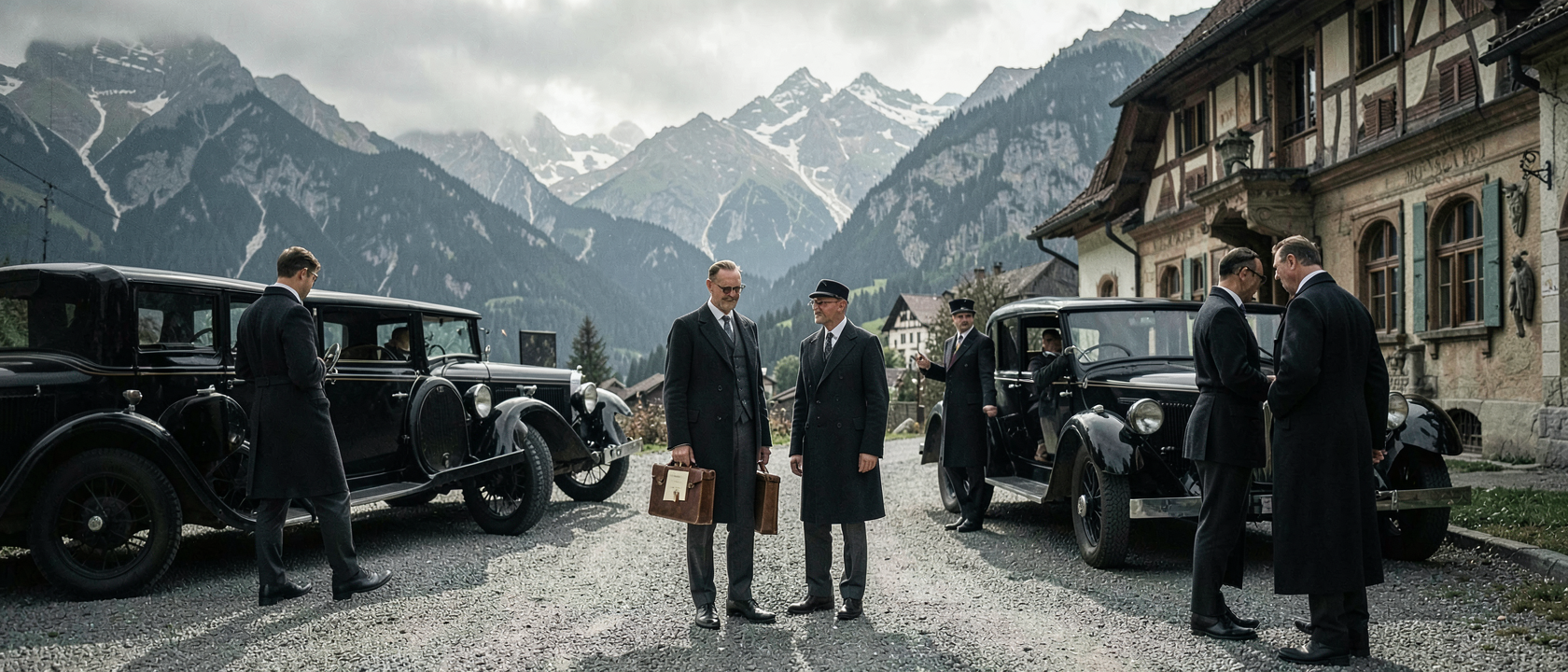
The Munich crisis of September 1938 was what made Wilson visible outside Whitehall. On March 10, 1938, two days before German troops entered Austria, he had already met with German intermediaries to discuss Anglo-German relations. By September he was traveling with the Prime Minister himself. When Chamberlain flew to Berchtesgaden on September 15, 1938, to negotiate directly with Hitler over the disputed Sudeten territory of Czechoslovakia, Wilson went with him, in what was his first diplomatic mission. The diplomat and writer Harold Nicolson likened the two men, as he put it, to “the bright faithfulness of two curates entering a pub for the first time.” Newspapers named Wilson and pictured him beside the Prime Minister, breaking a working convention under which senior officials gave their advice unseen and took no public credit, or blame, for it.
An Unverified Scene From Woolton’s Memoirs
Lord Woolton recorded, in his memoirs, an evening when Wilson cut short a dinner engagement with him and returned to 10 Downing Street. His explanation, as Woolton set it down years later, was that he “must go and look after my master.” This account rests on Woolton’s memory alone; it has not been confirmed in any other source. Even so, it points to an influence that rested on personal attachment to Chamberlain as much as on any formal office.
No Hearing, No Charge, Only a Reputation
Wilson was never put through a disciplinary hearing, a parliamentary censure, or a resignation forced by his record on appeasement. Winston Churchill, who replaced Chamberlain as Prime Minister in 1940, thought Wilson an appeaser who should have no further say over foreign policy, but even that judgment stopped short of a formal charge. The lasting verdict came from print instead. The 1940 polemic Guilty Men, written by a group of left-wing journalists, argued that Wilson had built an ascendancy over Chamberlain and had supplied the policy and the philosophy behind his decisions. Wilson kept the post of Permanent Secretary to the Treasury and Head of the Civil Service until 1942, his career on paper undisturbed, while his name hardened in public memory into that of a man who had betrayed his country. That reputation outlasted the career itself, and it is the reason his name is still remembered at all.
What Historians Still Argue About
Some details never surfaced. No source names the MP who confronted Wilson in his club, and no record fixes the date beyond the general years of the crisis. Historians also disagree about a larger question: whether Wilson’s power came from his formal titles or simply from standing closer to an isolated Prime Minister than anyone else in government. David Reynolds has argued that Wilson’s role in the September 1938 negotiations with Hitler made him more than a subordinate carrying out orders, while other historians maintain that this is exactly what he was, a capable civil servant doing as he was told. Martin Gilbert, writing in History Today in 1982, went further, framing Wilson as a man working within the limits of his system rather than the author of its policy.
Wilson died in 1972. The man who called him a traitor in his own club was never identified, and the disagreement among historians has never been settled either. Both gaps are part of the record now, as much as any date or title in his file.