
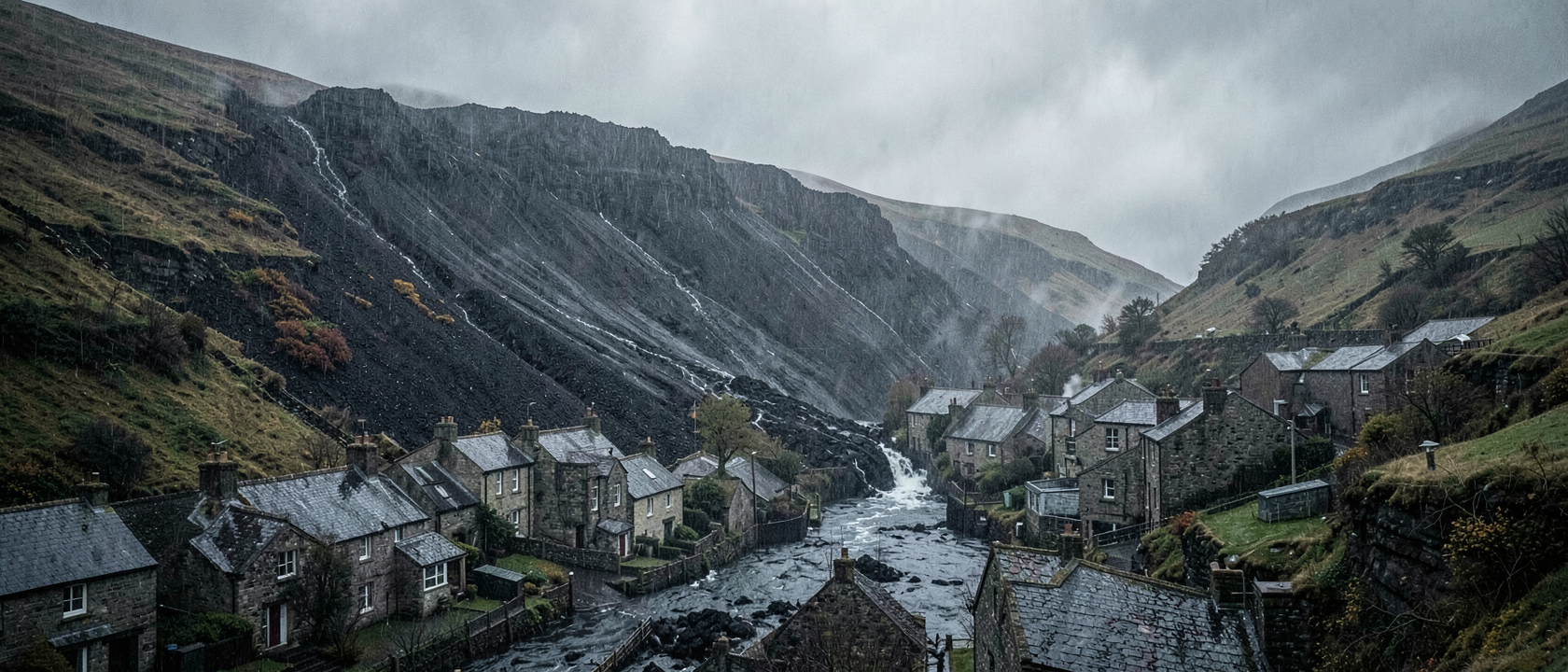
The slag heap gives way
On October 21, 1966, three weeks of heavy rain finally did what engineers at the National Coal Board had not expected. Above the Welsh village of Aberfan, near Merthyr Tydfil in Glamorgan, a colliery waste tip known as Tip 7 had been growing since 1958, reaching 111 feet (34 m) by that morning. The rain had soaked into it until the whole mass gave way, sliding downhill as slurry. Estimates of how much debris moved vary: one figure puts it at roughly 140,000 cubic yards (110,000 m3), another at just over 40,000 cubic meters moving as a slurry about 39 feet (12 m) deep. The exact volume is disputed, but every account agrees the slide buried the lower end of the village.
Survivors described a fast-moving wall of slurry coming down the slope, loud enough that people heard it before they saw it. It struck Pantglas Junior School and a row of houses shortly after nine in the morning, while lessons were under way.
What it cost
The toll came to 144 people: 28 adults and 116 children. It is the one figure in this entire story that nobody disputes. A single school, in a single village, lost most of a generation in minutes. Rescue crews worked through the morning; no survivors were found after eleven o’clock.
The search that followed was not only for bodies. It was for an explanation, and almost immediately, for anyone who might have known it was coming. A tribunal was appointed within days and later placed blame squarely on the National Coal Board. But a stranger question was already circulating: had anyone sensed the disaster beforehand, in a dream or a feeling, and failed to act on it?
Two men and an idea
That question found its champions soon after. John Barker, a psychiatrist with a long-standing interest in the paranormal through the Society for Psychical Research, and Peter Fairley, the science correspondent of the Evening Standard, decided to test it properly. Later in 1966 they set up what they called the Premonitions Bureau.
The method was simple on paper. Fairley asked Evening Standard readers to write in if they believed they had experienced a genuine premonition of a coming disaster, Aberfan included. The first appeal drew 76 responses; Fairley judged 22 worth taking seriously as possible evidence of real foresight. The Bureau logged every submission and waited to see what happened next. When Robert Kennedy was assassinated, his death became one of the cases checked against the file.
The warning about Barker himself
Sam Knight‘s 2022 book on the Bureau treats one episode as the hinge of the whole story: a correspondent wrote in to warn Barker that his own death had been foreseen. The book presents this as the moment the project stopped being an academic exercise and became something closer to home.
What the book does not supply is an ending. It gives no date for the warning and no account of what happened to Barker in its aftermath. For a story built on gaps in the record, this is the widest one, and it is worth saying so plainly rather than filling it in.
The unpaid bill
Across the roughly eighteen months it stayed open, the Bureau collected nearly 1,000 reports of premonitions. More than 90 percent predicted nothing that ever happened. A handful seemed, after the fact, to line up with real events; the book credits about 3 percent of the total as plausibly linked to something that later occurred. None of them, plausible or not, prevented a single disaster. That was the Bureau’s founding purpose, and it did not happen.
A Wikipedia record lists the project’s closure in 1968, but neither the book nor the record built around it explains why it ended, who had been paying for it, or what became of Barker once it did. The 144 dead at Aberfan remain the only cost in this story that can be counted. Everything after that is undocumented: no funding figures, no closing date backed by more than a single source, no confirmed successful prediction anywhere in the record.
What the book admits it doesn’t know
Knight’s book, published by Faber in 2022 at 256 pages, does not resolve the central question it raises: whether any premonition sent to the Bureau was ever conclusively validated, or by what standard a “hit” was even judged. It does not say why the project folded or trace what became of Barker afterward.
The book also wanders off into related but separate territory, among them “nocebos” (harm brought on by negative expectation) and the long-running story of “lost cosmonauts.” Darran Anderson, reviewing the book for History Today, treats these detours as loosely tied to the main story rather than essential to it.
The reviewer’s verdict
Anderson’s review, published by History Today on August 5, 2022, praises Knight’s eye for period detail, down to a psychiatric hospital’s daily milk consumption, used to recreate the texture of 1960s Britain. The criticism runs alongside the praise: the material, Anderson argues, reads like a long magazine piece stretched to fill a book, and the author never lands on a clear answer to the question the whole project was built to settle, whether premonitions are real or just coincidence noticed after the fact.
What survives from Aberfan is not an answer. It is 144 names, a tribunal report, and a short-lived newspaper experiment that never stopped anything from happening. The wish to have seen it coming turned out to be its own kind of historical fact, even where the seeing never did.