
The Coin
Elizabeth Justice was born Elizabeth Surby in 1703. At sixteen she married a lawyer named Henry Justice, and nothing about the marriage survives in any outside record except what she herself later chose to put in print: that he struck her hard enough to raise a swelling on her head. No court filing, parish note, or witness statement backs this up. It is documented only because Justice wrote it down herself, years afterward.
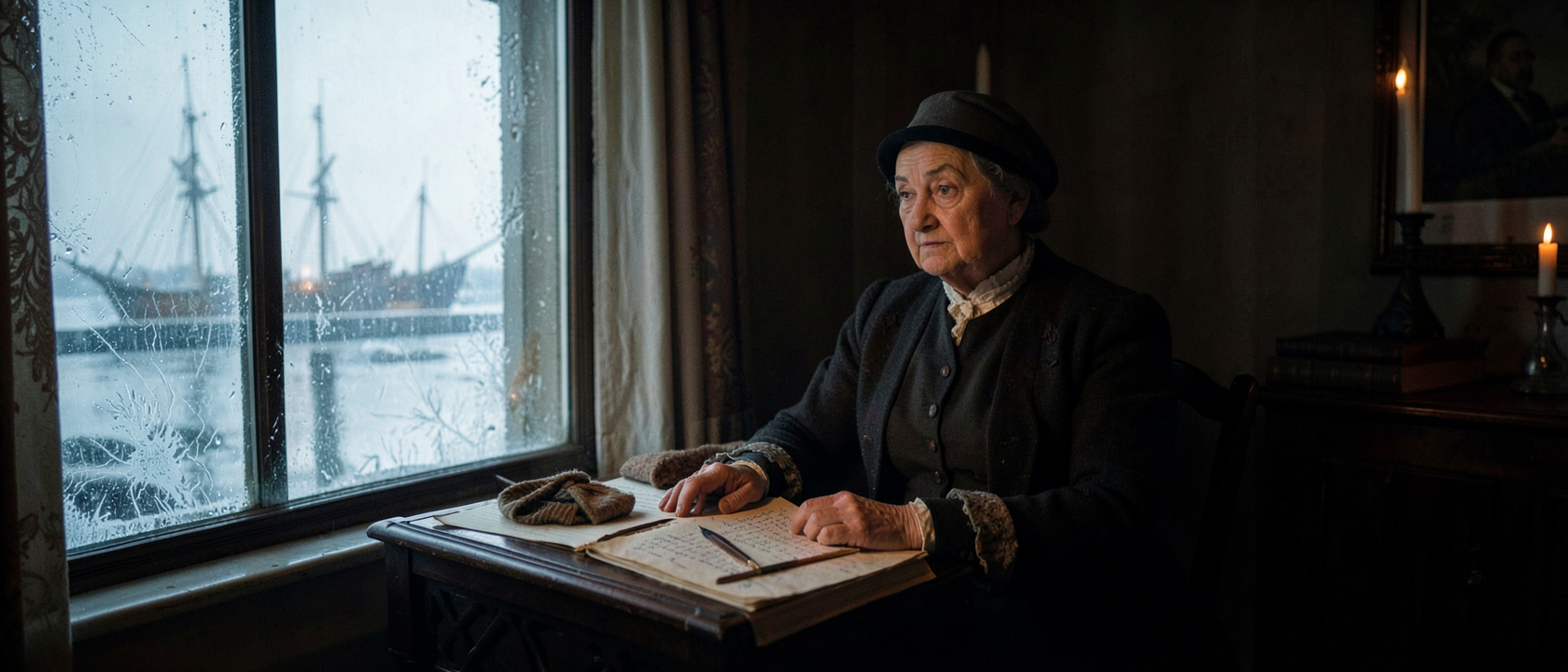
She insisted on separating from him after that blow. Sometime in 1734, carrying a single coin, a shilling, she set out for St. Petersburg, roughly 3,000 miles (4,800 km) away. No diplomatic post or scientific commission justified the trip, the usual credentials for an English traveler abroad at the time; she was an ordinary woman whose husband had stopped supporting her, which is what makes the destination she chose so unusual. She later wrote to a friend that she had left England to sail those three thousand miles “with only a splendid-shilling in my pocket,” adding that she had done it “without the least anxiety.”
Three Thousand Miles, Alone
Justice had no husband’s protection to travel under, no family waiting at the other end, and no institution standing behind the trip. She needed the income because Henry Justice had stopped paying the annuity the two of them had agreed when she left him; by one account, she had already sued him over it and still come away with nothing. Paying her own way across that distance was what remained.
Her only arranged security was a post as governess to the three daughters of an English merchant working in St. Petersburg, a man identified in the record only by his first name, Hill, with his surname given as either Green or Evans depending on the source. If that post had fallen through, or if the family had changed its mind before she arrived, Justice would have reached a foreign capital with one coin in her pocket and no one who owed her anything. The whole plan rested on a job she had not yet started, for a family she had never met.
A City Changing Shape
Justice reached the naval port of Kronstadt, spelled “Cronstadt” in the records of the time, on August 30, 1734, and left it again on August 12, 1737, just under three years later, almost to the day. She spent that stretch as governess to the merchant’s daughters during the reign of Empress Anna Ivanovna, from 1730 to 1740, in a city still being remade along Western European lines, a push that had begun under Peter the Great. The gowns she saw were cut in the French style. Italian opera played twice a week. Dutch theater turned up on occasion too, though she was not won over: “I think nobody would choose to see them twice,” she wrote of the plays.
She paid close attention to the ordinary workings of a foreign household: what people ate and drank, how houses were heated against the cold, which customs were kept and which were not. Winter gave her one of her sharper images. Looking at frost-covered trees, she wrote that they put her in mind of the sprigs of rosemary laid on cakes at twelfth-tide, the English feast marking the close of the Christmas season. These were among the details she later built into a book, published two years after she sailed home.
The First Book
That book appeared in 1739, printed in York by Thomas Gent, under a title that ran for several lines: it promised an account of Russian law, manners, and customs, “several entertaining adventures” from the journey by land and sea, and, tacked on at the end, a translated description of relics kept in the cathedral at Oviedo, in Spain. Justice said later that she wrote it partly to help clear her debts and partly to put down talk that she had never actually gone to Russia. A second, expanded edition followed in 1746, adding material that made clear she had not warmed to every part of Russian life.
Historians now call it the earliest known English-language travel book written by a woman. A separate academic account describes it instead as the first English book on the Russian Empire since John Perry’s The State of Russia under the Present Czar, published in 1716. The two claims count different things, but both rest on the same underlying fact: almost nothing in English had described Russia before Justice did.
Twelve years later, in May 1751, she published a second book, Amelia, or The Distress’d Wife: A History, anonymously, credited only to “a Private Gentlewoman,” through the booksellers Robert and James Dodsley. Its title page announced that it was “Founded on Real Circumstances.” The disguise was thin: her own father, Dorset Surby, appears in it as Amelia’s father, Dorset Sanby. That December, Henry Fielding published a novel of his own, also titled Amelia, also about a distressed wife, a coincidence of timing and title that had no connection to Justice’s book. In hers, Amelia writes to a friend that everybody loves her, “but he that should.”
What It Cost, What Remains
Outside her own two books, there is almost no record of this woman at all. Neither volume names her husband outright; what identifies him today as Henry Justice, a lawyer, comes from a separate source, the same kind that shows he was later convicted of stealing books and sentenced to transportation. The merchant family she served for three years is little clearer: his first name was Hill, his surname Green in one account and Evans in another. What day she left England, and what day she came home, were never written down at all, only the span between them and the date the book appeared.
She died on March 15, 1752, at the age of 49, worn down, the record says, by poor health and money troubles that had never really let up. Two books outlasted her. One put Russia on the English page for the first time in decades; the other took a marriage no court ever ruled on and gave it the only verdict that survived: her own.