
On the evening of April 21, 1975, Nguyen Van Thieu stood before television cameras inside Independence Palace in Saigon and told his country, and anyone else watching, that he was stepping down. He had led South Vietnam for eight years. He used his last address in office not to call for unity or resolve, but to accuse the United States, South Vietnam’s own ally, of walking away from the war.
A President Resigns on Camera
Thieu had been in power a long time by the standards of South Vietnamese politics. He took part in the 1963 coup that removed President Ngo Dinh Diem, became head of state in 1965, and was elected president in 1967. By 1975 he was the republic’s longest-serving leader, and he gave his resignation address from the palace’s state reception room, facing Vietnamese officials and the cameras of national television.
He was not forced from office. He chose to leave it on air, in front of an audience that included members of his own government, and he timed the broadcast for early evening, shortly before the city’s nightly curfew, to hold down panic. According to the record, he had delivered much the same accusation privately to American representatives in Saigon before he ever faced a camera, which makes the speech look less like an outburst than a decision made in advance. He handed the presidency to his vice president, Tran Van Huong, as the constitution required.
The Supplies That Stopped Coming
South Vietnam’s army had never fought this war alone. American money bought its weapons and ammunition; American helicopters moved its troops; American aircraft, including B-52 bombers, struck targets its own air force could not reach. By the spring of 1975, that backing had thinned out sharply. US ground combat units had already left the country more than two years earlier and were in no position to help defend Saigon or evacuate it. In Washington, after Richard Nixon’s resignation, Congress had cut military and economic aid to South Vietnam by roughly 30 percent by the second half of 1974.
Thieu’s forces were still holding ground that spring, but holding it on credit. An army built around American fuel, shells, and air cover was being asked to keep fighting once the fuel, shells, and air cover stopped arriving in the quantities it had relied on for years.
An Honorable Way Out, for Themselves
In the speech itself, Thieu did not simply announce his departure. He laid out an argument. The United States, he said, had sent half a million of its own troops to Vietnam and spent close to $300 billion over six years, and had still not finished the war; now, with his own army short of weapons, ammunition, helicopters, aircraft, and B-52 bombing support, he said Washington expected South Vietnam to succeed where American power had not, a task he likened to trying to fill the ocean with stones. He went further, calling the withdrawal of support an inhumane act, and the United States, in that act, an inhumane ally.
This is Thieu’s framing, delivered to a national audience on the day he left office. The record does not settle whether the charge against US policy is fair; it tells us only that this is what the outgoing president said, and that excerpts of the speech were already appearing in American newspapers the next day.
Nine Days on the Calendar
Between that broadcast and the fall of the city lay nine days, from April 21 to April 30, 1975. North Vietnamese forces kept advancing on Saigon through that interval, and by April 27 an estimated 100,000 of them had encircled the city. What exactly happened inside the South Vietnamese government in those nine days, and what became of Thieu personally once he left the palace, is not something this record can lay out in detail; accounts of when he actually left the country even disagree with one another. What is documented plainly is the date the speech was given and the date the city fell, and the fact that the collapse arrived on almost the exact timeline Thieu had warned of.
Who Was Left Behind
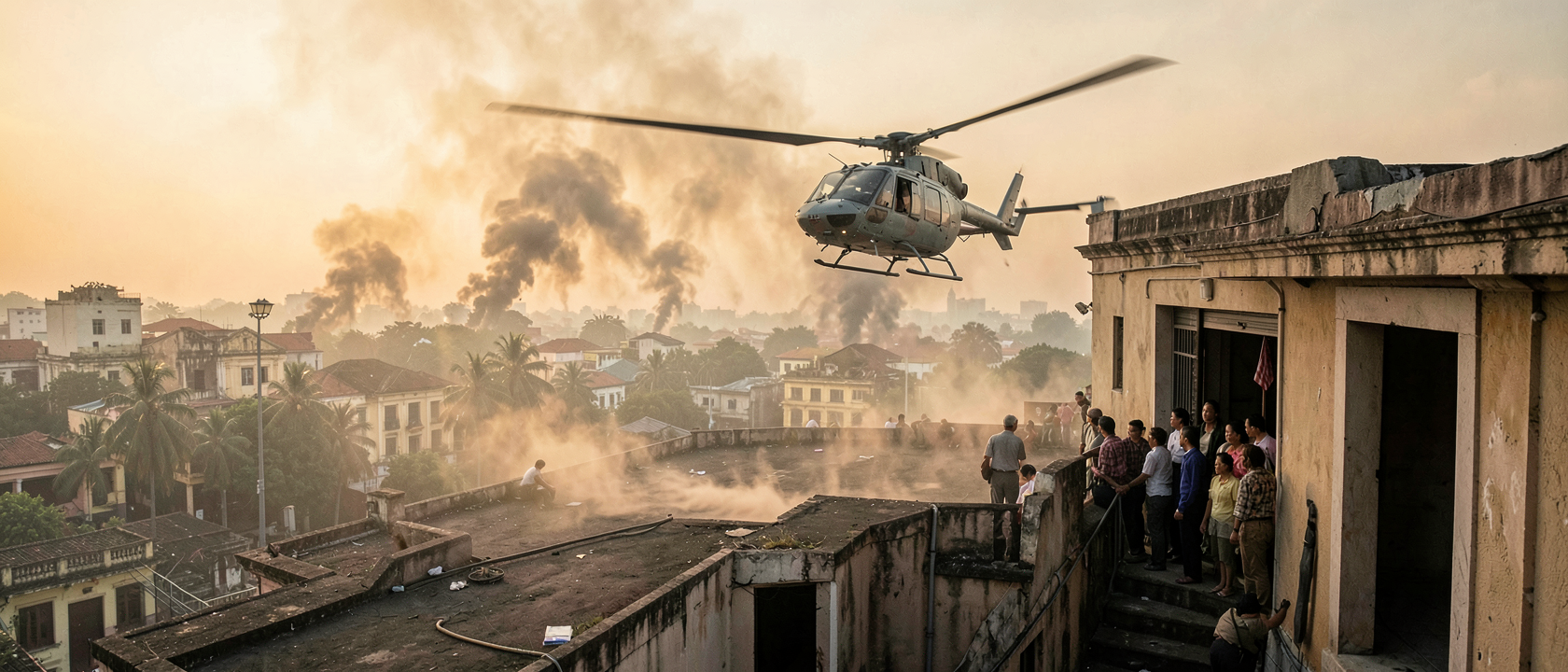
On April 30, 1975, North Vietnamese troops entered Saigon, and the Republic of Vietnam ceased to exist as a government. The presidency Thieu had held for eight years, through coup, military rule, and election, ended with it. Some residents of Saigon managed to leave the city as it fell, carried out by a helicopter evacuation and a wider refugee effort whose full scale is still argued over in the sources. The record does not give a single settled count of how many got out and how many did not, on either side of the war, and this account will not manufacture one just to round the story off. That gap in the record is itself part of what the history shows: a government fell in nine days, and no one has ever managed to put a final number on what it cost the people still inside the city.