
The Fields in Sacramento and Imperial Valley
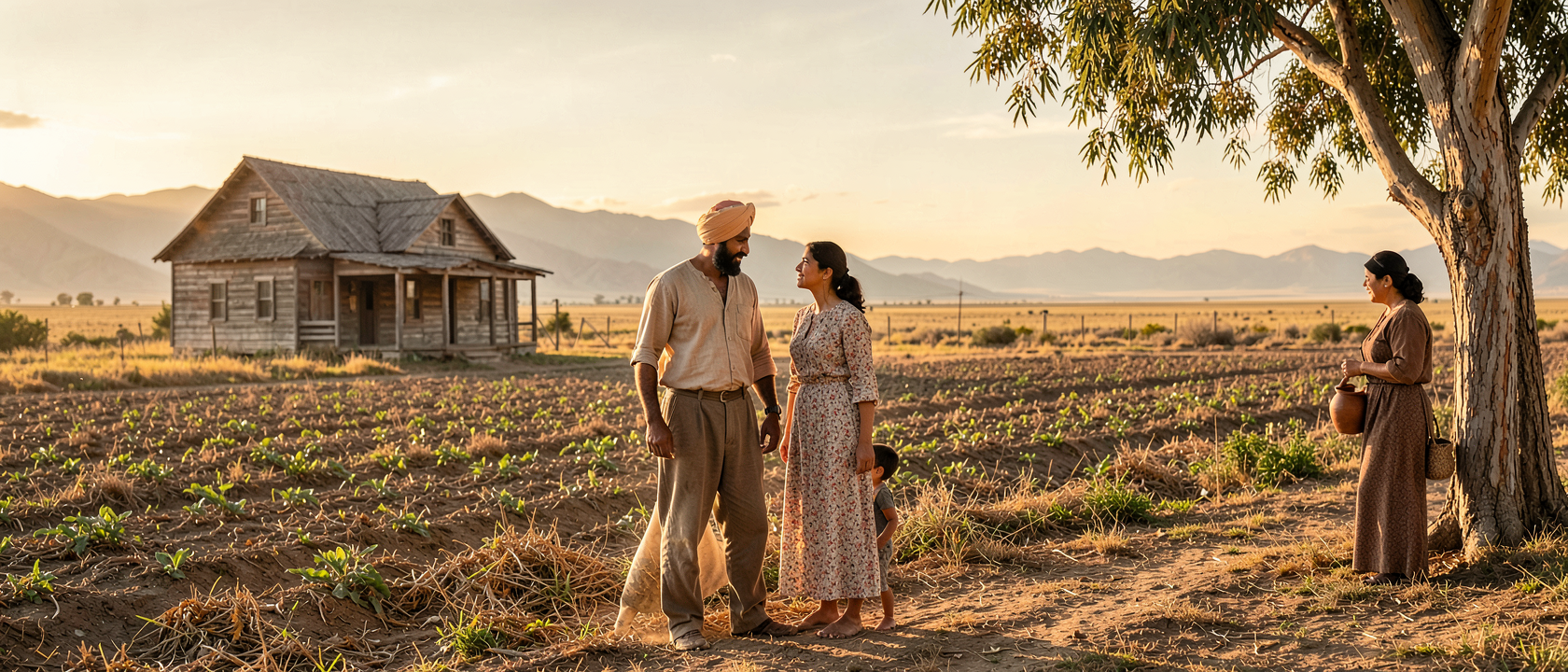
The record begins in the 1910s, in California’s Imperial Valley near the Mexican border and in the Sacramento Valley to the north, around what would become Yuba City. Punjabi men, most already in their thirties and forties, arrived to work cotton, melon, and rice fields. Nearly 85 percent were Sikh, by historian Karen Leonard‘s count, with smaller numbers of Muslims and Hindus among them, though growers and local papers called every one of them a “Hindu” regardless of what he actually believed. Decades later, historians would give the community that grew out of these fields the same mismatched name: “Mexican-Hindu.” They worked in small partnerships alongside Mexican and Mexican American families doing the same harvest labor, some up from Mexico for the season, others already settled for good. Day after day, the two groups shared the same rows.
A Law Built to Keep Them Alone
Before 1946, no one born in India could become a US citizen, which closed off nearly every legal path to bringing a wife from Punjab: there was no citizenship to petition family through. California’s anti-miscegenation law closed a second door, barring marriage across recognized racial lines and requiring both parties on a marriage certificate to be recorded under the same race. Neither law was an accident; both were built, like the exclusion rules around them, to keep migrant laborers single. The one opening left to a Punjabi man was a woman the county clerk would record under his own racial category, and clerks were not consistent about it. Some offices recorded both the groom and his Mexican or Mexican American bride as “brown,” a category the law never defined, and the marriage went through. Historians have pointed to that clerical inconsistency as the loophole through which much of the community’s marriages passed; no one clerk left behind a record of why he made that call, so the reasoning itself is lost to us.
Marrying In, Marrying Sisters
The women these men married were mostly Spanish-speaking Catholics, about half born in Mexico and half born in the US to Mexican parents, often daughters or sisters in households with no adult man present. Leonard counts 378 such marriages between 1913 and 1949; a separate estimate, counting men rather than unions, puts the figure near 500. In the Sacramento Valley the brides were not only Mexican: roughly half were, with the rest white, African American, Indian, and Native American women in smaller shares.
The marriages tended to run in clusters. Partners who had farmed together for years would marry sisters, or a mother and her daughters, from one family, so a labor partnership doubled as a marriage partnership. Catholic priests accepted the Punjabi fathers as godparents under the compadrazgo system, the Hispanic Catholic practice of binding godparents into the family as kin, which had no real equivalent in Punjabi custom. Sikh men stood godfather to Muslim men’s children, and Muslim men to Sikh men’s, a crossing of faith lines from Punjab that the record shows happening inside a single California parish.
1946 and 1947: Two Dates, Two Pulls
On July 2, 1946, President Truman signed the Luce-Celler Act, setting a yearly immigration quota of 100 each for Filipinos and Indians and, for the first time, letting people born in India naturalize as US citizens. Dalip Singh Saund, who had come to California in 1920 and farmed in the Imperial Valley, had lobbied for the law; he became a citizen in 1949. Citizenship meant Punjabi men could now own the land they had farmed for decades, hold a passport, and petition to bring family to join them. The next year, 1947, India became independent and split along religious lines into India and the new state of Pakistan. Punjab was suddenly reachable after three decades away. Some fathers turned back toward those ties, sometimes at the cost of the households they had built in California, just as their own children were reaching adulthood and, almost entirely, marrying outside the community.
Yuba City’s New Arrivals, and Two Ways of Answering
In 1965, the Immigration and Nationality Act scrapped the national-origin quotas the Luce-Celler Act had only loosened, and a new wave of Indian immigrants arrived, this time as families rather than single laborers, many settling around Yuba City. Friction grew with the older community already there. Around Yuba City, some established Mexican-Hindu families leaned harder into their Mexican side, a few even adopting more Hispanic-sounding names to put distance between themselves and the newcomers. In the Imperial Valley, spared a comparable wave of new arrivals, descendants kept calling themselves “Hindu” without the same pressure. One word, carried with pride in one valley and quietly set aside in the other, depending on who had moved in next door.
What the Record Doesn’t Say
Nearly all of this comes from one body of work: fieldwork Karen Leonard and Bruce LaBrack carried out among the community’s descendants, published jointly in 1984 and later expanded into Leonard’s book, Making Ethnic Choices, generally dated to 1992 (library catalogs also list 1989, and a paperback edition appeared in 1994). There is no reliable population count for how many such households ever existed. Leonard’s own figures, 378 marriages against a separate estimate of roughly 500 men, do not quite square with each other, and few events in this story carry a precise date or location beyond the two valleys and Yuba City. Leonard and LaBrack’s conclusions, carefully gathered as they were, now get repeated as settled fact more often than as one team’s reading of interviews taken decades after the fact, with a generation that had already scattered. The story holds up. It is also, by its nature, thinner than it looks. That gap between how solid a story feels and how thin its footing actually is may be the part worth carrying away.