
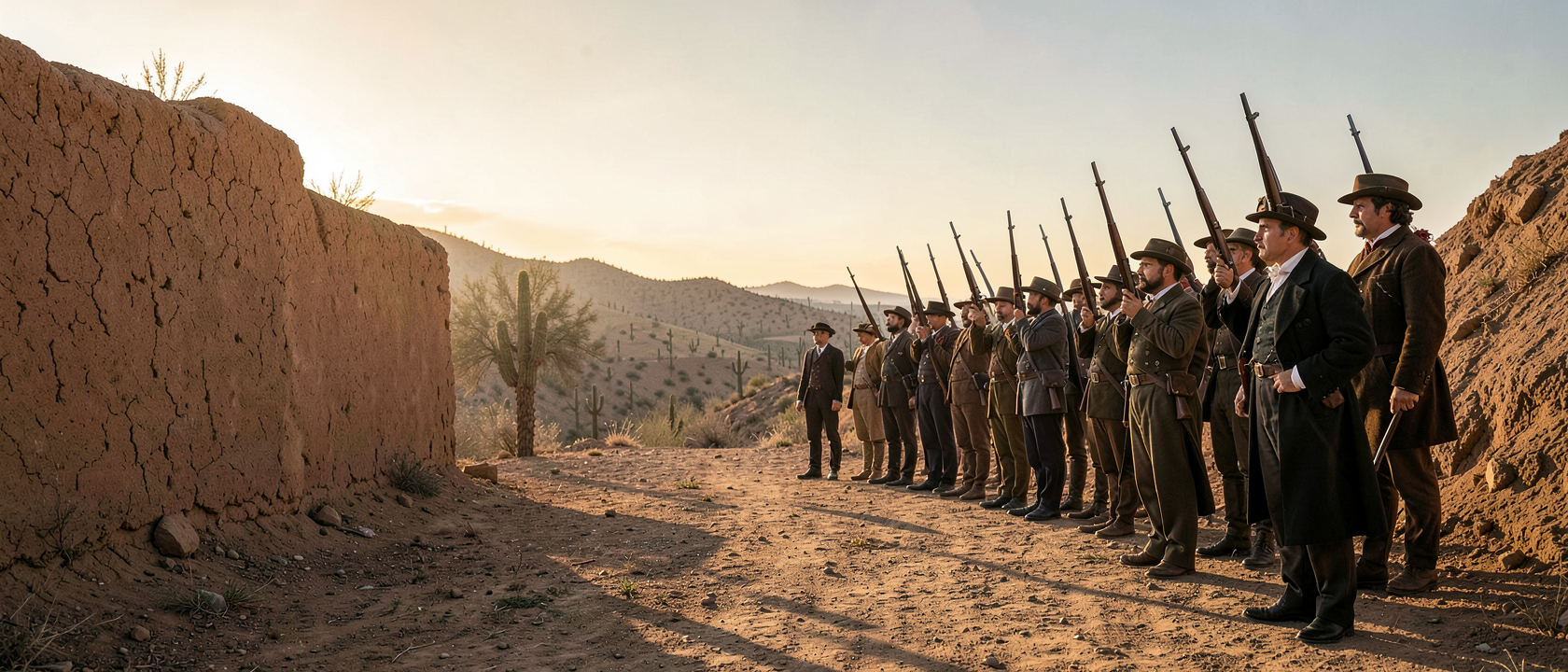
Dawn at the Cerro de las Campanas
On June 19, 1867, Ferdinand Maximilian died by firing squad outside Querétaro, the city then recorded as Santiago de Querétaro and known today as Querétaro City. He had been a prisoner since his surrender on May 15, and he was thirty-four years old. According to one near-contemporary account, not corroborated elsewhere, he heard Mass and ate breakfast that morning before being taken out of the city.
Two generals who had fought for his empire, Miguel Miramón and Tomás Mejía, were held with him and would die within the hour. The same account describes carriages taking the three men to a low rise called the Cerro de las Campanas, the Hill of the Bells, where a firing squad waited near an adobe wall, said to have stood only a few paces off, under a sky recorded in that same source as clear and cloudless. These details come from a single popular history source and could not be confirmed elsewhere, but the outcome is not in doubt.
Napoleon III’s Mexican Project
The story behind that morning starts five years earlier, in 1862, when Napoleon III of France began maneuvering to set up a client state in Mexico. The United States, consumed by its own civil war, had no way to object to a European throne rising in its hemisphere. Ferdinand Maximilian, chosen to fill that throne, was an Austrian archduke, born at Schönbrunn Palace in Vienna in 1832, the younger brother of the reigning Emperor Franz Joseph.
A French expeditionary force did the work of installing him. Maximilian accepted the crown it offered, was proclaimed emperor on April 10, 1864, landed at Veracruz on May 28, and was crowned on June 10. The arrangement rested on two conditions holding at once: that French troops would stay long enough to secure the new empire, and that the Mexican conservatives who had wanted a monarchy would hold together behind the man France had sent them. It was a gamble on Napoleon’s part. Within a few years, both conditions gave way.
The Siege of Querétaro
French troops began leaving Mexico in 1866, and Napoleon III cut off the money that had kept Maximilian’s government running. Without that backing, the empire’s hold on the country grew difficult to defend. Maximilian refused to abdicate and stayed in the country after the last French units left. Stiff Mexican resistance, together with pressure from a United States now free of its own civil war, pushed Napoleon to order a full withdrawal in 1867.
Maximilian was besieged at Querétaro from March 1867 onward. His small force was surrounded and starved, and by May 15 the position was betrayed into capitulation; he surrendered on the hill to the Republican general Mariano Escobedo, who commanded forces loyal to Benito Juárez, the president the French intervention had pushed out of the capital. What the record here does not lay out in detail is the political collapse behind the military one, exactly why conservative backing for the empire gave way once French backing did. Historians weigh French exhaustion, American diplomatic pressure, and Mexican resistance differently, and there is no settled account of how much each one counted.
Appeals for clemency reached Juárez from across Europe, among them Victor Hugo and Giuseppe Garibaldi, along with several reigning monarchs. He refused, citing the thousands of Mexican lives already lost fighting to end foreign control of the country. A court-martial sentenced Maximilian and his two generals, Miramón and Mejía, to death.
The Execution
Accounts describe Maximilian at the wall in a plain black coat, holding a crucifix. He spoke to his executioners in Spanish; according to translated accounts, not a verified verbatim transcript, he said that he forgave everyone and asked that everyone forgive him in turn, and that he hoped the blood about to be shed would serve the good of the country. He is reported to have ended with the words “Viva Mexico, viva la independencia.” He is also said to have pointed to his own chest, marking the place for the soldiers to aim.
The squad fired. Maximilian died instantly. Miramón and Mejía were killed in the same volley.
The Bill
With that volley, the Second Mexican Empire, proclaimed on April 10, 1864, formally ceased to exist. Of the morning itself, the count is exact: three men dead, Maximilian, Miramón, and Mejía. What happened next to Maximilian’s remains is documented in more detail than almost anything about the war that killed him, though even here the main account rests on a single popular source. He was reportedly embalmed and put on display in Mexico, and his coffin is said to have sailed aboard the SMS Novara to Trieste. He was buried in the Imperial Crypt in Vienna on January 18, 1868.
News of the execution reached Paris on July 1, arriving just as Napoleon III opened that year’s Universal Exposition. Diplomatic relations between Austria and Mexico, broken by the execution, were not restored until 1901.