
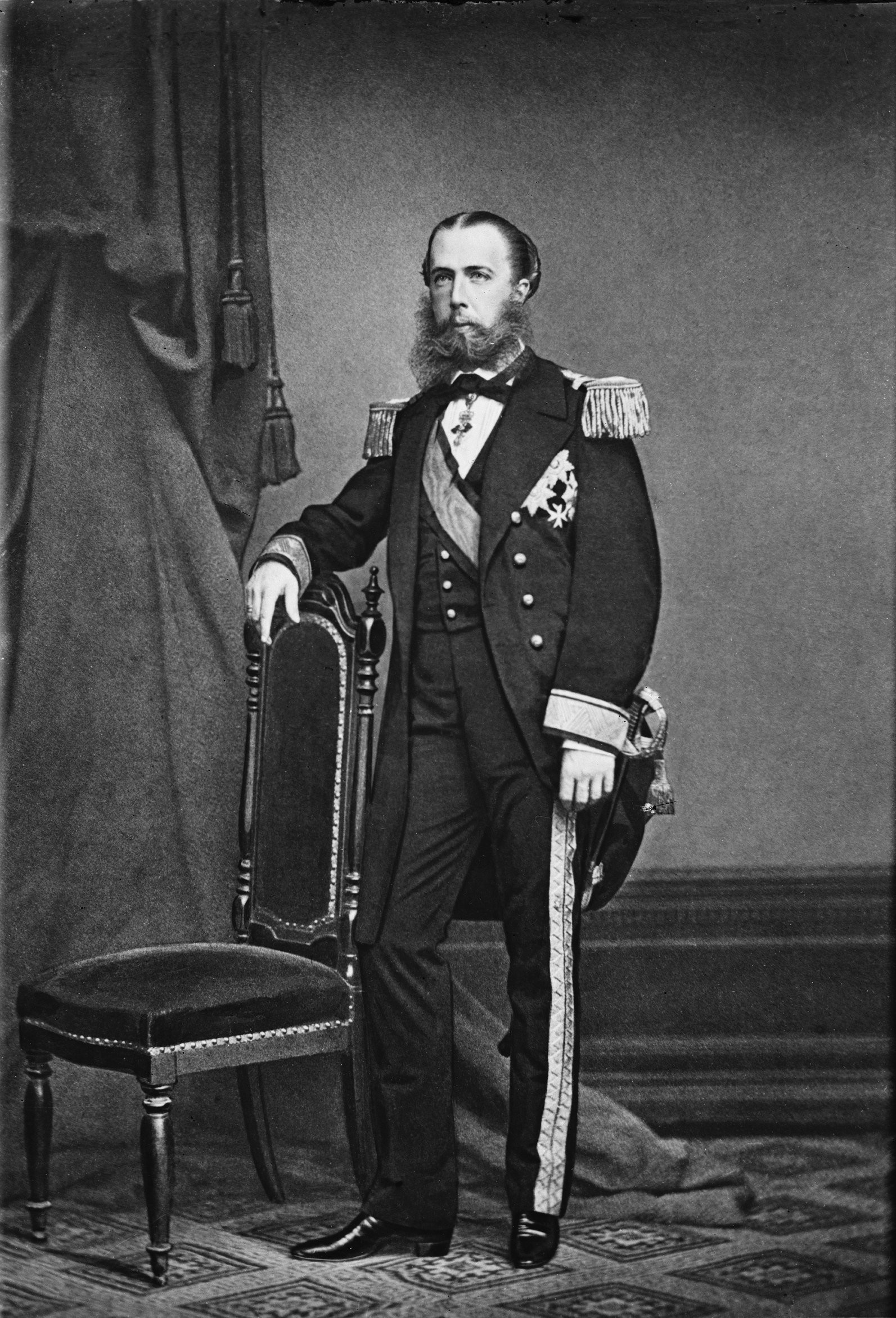
Maximilian I was emperor of Mexico from 1864 until his execution on 19 June 1867. Born Ferdinand Maximilian Josef Maria von Habsburg-Lothringen on 6 July 1832 at Schönbrunn Palace, he was the younger brother of Emperor Franz Joseph I of Austria. Installed with French military backing as a monarchist figurehead, he ruled a regime that lasted barely three years before Republican forces captured and shot him at Cerro de las Campanas outside Querétaro City.
Key facts
- Born: 6 July 1832
- Birthplace: Schönbrunn Palace
- Died: 19 June 1867
- Place of death: Santiago de Querétaro
- Country: Austrian Empire; Second Mexican Empire
- Occupation: politician; botanist
- Awards: Knight of the Order of the Golden Fleece; Order of Saint Anna, 1st class; Order of the White Eagle; Order of Saint Stanislaus, 1st class
Early career in Austria
Maximilian served as commander-in-chief of the small Imperial Austrian Navy before his election as Mexican emperor. In that role he authorized the Novara Expedition, sending the frigate SMS Novara on the first circumnavigation of the globe by an Austrian warship, a voyage that ran from 30 April 1857 to 30 August 1859.
From 6 September 1857 he served as Austrian viceroy of Lombardy-Venetia. Nationalist unrest in the region led Franz Joseph to remove him from the post in 1859. On 27 July 1857 he married Princess Charlotte of Belgium. He also commissioned Miramare Castle near Trieste, moving into the completed residence in 1860.
Becoming emperor of Mexico
Napoleon III of France backed a plan to install Maximilian as a monarchist figurehead to legitimize French influence in Mexico. On 10 April 1864 Maximilian proclaimed himself Emperor of Mexico, with backing from the French army and conservative Mexican monarchists opposed to Benito Juárez’s liberal government.
Despite being installed by conservatives, Maximilian pursued liberal reforms. He restricted working hours, abolished child labor, cancelled debts that bound laborers to haciendas, and restored communal lands to Indigenous villages. Out of his love for the arts, he also supported the development of museums, libraries, and theaters in Mexico.
The Black Decree and repression
Under the terms of the Black Decree, 623 people were executed in March 1866, and 470 more were executed in April 1866 alone.
Collapse, capture and execution
By February 1867 Maximilian was forced to retreat to Santiago de Querétaro, where Republican forces under General Mariano Escobedo besieged him. He was captured along with his generals Miguel Miramón and Tomás Mejía. A military tribunal tried him on 12 June 1867 under a 1862 law enacted under Juárez targeting collaborators with the French intervention.
On 19 June 1867, Maximilian, Miramón, and Mejía were executed by firing squad at Cerro de las Campanas, the Hill of the Bells, outside Querétaro City. His reported last words in Spanish were: “I forgive everyone, and I ask everyone to forgive me.”
Honors
Maximilian held the Order of the Golden Fleece as a Knight, the Order of Saint Anna First Class, the Order of the White Eagle, and the Order of Saint Stanislaus First Class. He was also active as a botanist alongside his political career.
Data sources
- Wikidata
- global.museum-digital.org
- royalty.miraheze.org
- thefamouspeople.com
- humansofhistory.com
- natalietaylor.org
- unofficialroyalty.com
- italia.it
Where it appears
- Emperor Maximilian of Mexico Dies Before a Firing Squad at Querétaro November 10, 2026
Data updated: 2026-11-05