
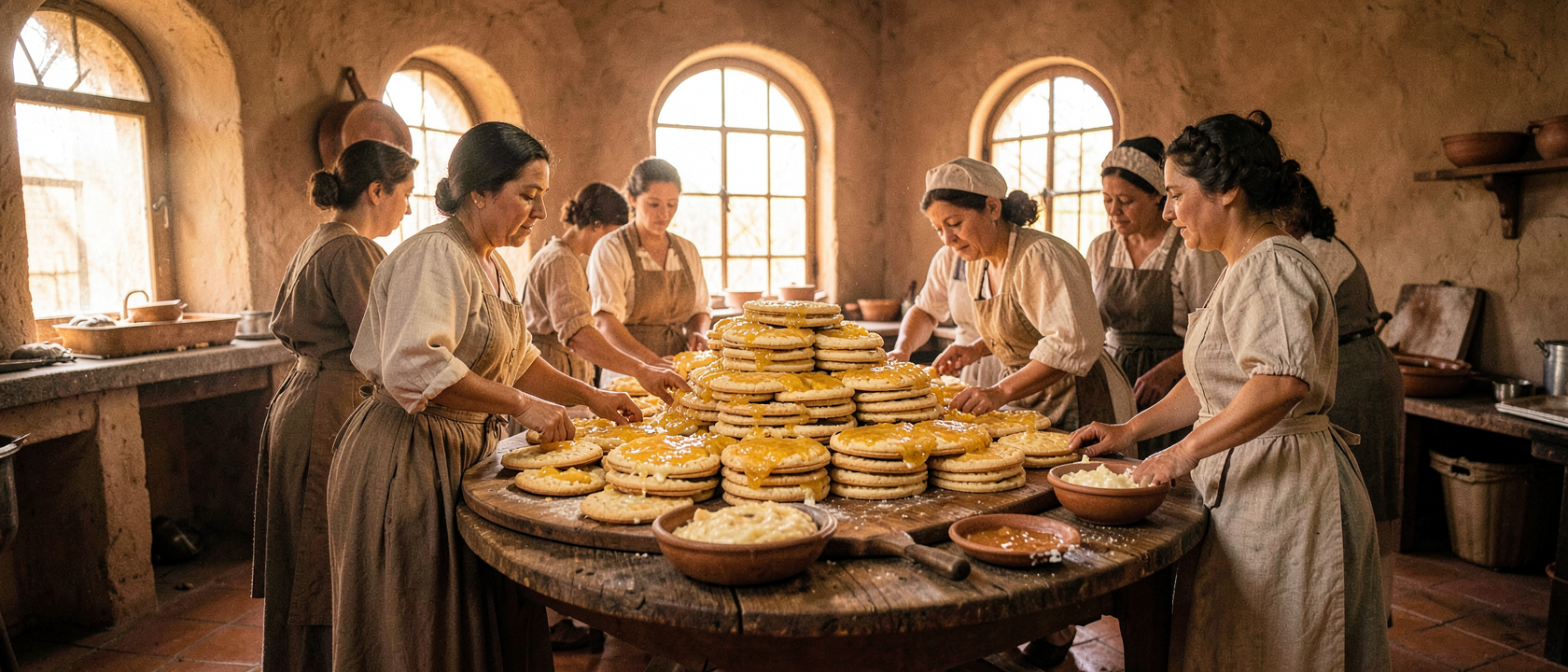
A Lambayeque Kitchen, the 1920s
By the 1920s, the alfajor was already old news on Peru‘s northern coast. The city of Lambayeque, next to Chiclayo, had inherited the dessert from across the regional border in Trujillo, in La Libertad, where the round alfajor was a two-cookie sandwich held together with manjar blanco, the thick, caramel-colored milk spread known elsewhere as dulce de leche. Sometime in that decade, no record says exactly when, a Lambayeque baker named Victoria Mejía de García, who lived on Calle San Roque, changed its shape for good.
Mejía built a rectangular mold and stacked not two cookie layers but seven, filling each gap with manjar blanco and, by one account, quince paste; a separate, less corroborated version instead describes pineapple or strawberry preserve. Accounts also differ on her motive: one calls it her own commercial idea, another says she led a group of women from Calle San Roque who baked it to help families in town with little money. Either way, what came out of her kitchen had no name of its own yet. Lambayeque simply called it alfajor de Lambayeque.
Why Bigger Wasn’t Automatically Better
Lambayeque did not need a new alfajor; it already had one, by way of Trujillo. A taller, heavier version of an old dessert had to earn its place at the counter rather than being waved off as a novelty. What set Mejía’s version apart was visible the moment it was cut open: a cross-section of stacked layers instead of one simple seam of filling. It came out of a mold instead of being shaped by hand, it weighed more, and it cost more per piece. None of this was written down at the time. No newspaper notice, advertisement, or sales record from the late 1920s or early 1930s survives to say how fast Lambayeque took to it. What spread, spread by word of mouth, bakery to bakery.
1933: The Name Arrives
In 1933, the film King Kong played in Lambayeque’s theaters. Audiences who had just watched a giant ape climb a building walked past bakery windows, saw the tall, mold-built alfajor sitting there, and made the obvious joke: something stacked too high not to look like the same thing. The comparison stuck. Local tradition holds that within that same year, people stopped asking for alfajor de Lambayeque and started asking for a King Kong instead. No clipping from the period records the joke in writing; it survives as oral history, told consistently enough that Lambayeque treats it as settled fact. The older name did not survive the decade. Some Peruvians simply Hispanicized the new one instead, and still call the sweet a kinkón.
How King Kong Became a Staple
The name outgrew the single bakery it started in. By the mid-twentieth century, multiple bakeries across Lambayeque and Chiclayo were making their own King Kongs, and the custom had reached the wider La Libertad region as well. In 1943, the García Mejía family’s company, San Roque, patented the original recipe under the name King Kong de Manjar Blanco, marketed as King Kong San Roque. The company reportedly did not open its first production plant until 1970, by which time the recipe it was built on had long since become common property across Lambayeque’s bakeries.
What reached the counter was never standardized. Commercial King Kongs typically weigh one to two pounds and come either rectangular, in the brick shape Mejía’s mold first produced, or circular. The layers are built from flour, butter or margarine, egg yolk, and milk; manjar blanco is the one constant filling, paired with pineapple sweet, peanut sweet, or other jams depending on the bakery. Because no two bakeries agree on a layer count or filling combination, buyers in Lambayeque still ask to see the cut cross-section before paying, the only reliable way to judge what is actually stacked inside. One travel-industry source credits King Kong with the title Heritage of the Lambayeque Region, though no official heritage registry confirms it. Bakeries export the dessert as far as the United States, Japan, and Spain.
Every July, Lambayeque Builds a Giant
Lambayeque holds a Semana Tradicional del King Kong, or Traditional King Kong Week, timed to Peru’s Fiestas Patrias holiday in late July, with a single giant King Kong built each year by the region’s producers working together. One earlier giant, its exact year not recorded, weighed 1,373 pounds (623 kg) and ran 20 feet (6 m) long. By 2024, sixteen producer brands, among them El Legendario, San Roque, and Miski, had built one weighing 2,756 pounds (1,250 kg) and stretching 33 feet (10 m) long, handed out free to more than 8,000 people on August 4 of that year. In 2026, fifteen local companies used 40 sacks of flour, 80 crates of eggs, 992 pounds (450 kg) of manjar blanco, and 882 pounds (400 kg) each of pineapple sweet and peanut sweet to build one weighing 2,866 pounds (1,300 kg) and running 39 feet (12 m), handed out in about 8,000 free portions in Lambayeque.
None of these giants are certified by any outside record-keeping body; the figures come from local press coverage, year by year, not from an international registry. What is certain is simpler. The film that gave the dessert its name ran in Lambayeque for a season in 1933 and then moved on, as films do. The joke it left behind did not. Victoria Mejía’s own story survives mainly as a name, a street address, and a trademark her family registered a decade after she built the first mold. The nickname a theater audience made up in passing has outlasted the picture that inspired it, built bigger again every July since.