
The Royal Opening That Swept Away London’s Ice
On August 1, 1831, King William IV and Queen Adelaide traveled up the Thames by royal barge to open a brand-new London Bridge. The ceremony marked an engineering triumph: five broad stone arches, built slightly upstream, replacing a medieval crossing that had carried London’s traffic for generations. It also marked the end of an older tradition. For centuries, whenever a hard winter froze the Thames solid, Londoners had built entire carnivals on top of the ice. After 1831, the river in London never froze over again.
The obvious explanation is that city authorities had finally lost patience with the ice fairs and built a new bridge partly to break them up, or that English winters had simply turned milder. Neither holds up once the record is checked. The real story runs through engineering, not policy.
No Council Ever Banned the Frost Fairs
The ice carnivals ran on unlicensed drinking, informal gambling, and unregulated markets. Surviving city records show that no ordinance ever outlawed the fairs, and no instruction about controlling ice crowds appears in the engineering plans for the new bridge. What changed the Thames sat underneath the water, in how fast the current was allowed to move.
Starvation, Watermen, and Survival on the Frozen Highway
The Thames through London served as the city’s main route for passengers and freight. Boatmen earned their living ferrying people and goods, and a hard freeze took that income away overnight. When the ice thickened, idle watermen built the first stalls and charged crossing tolls to survive. Working the frozen river was a hazardous gamble against shifting floes, freezing water, and weeks without regular wages.
From the Blanket Fair of 1684 to the Last Carnival of 1814
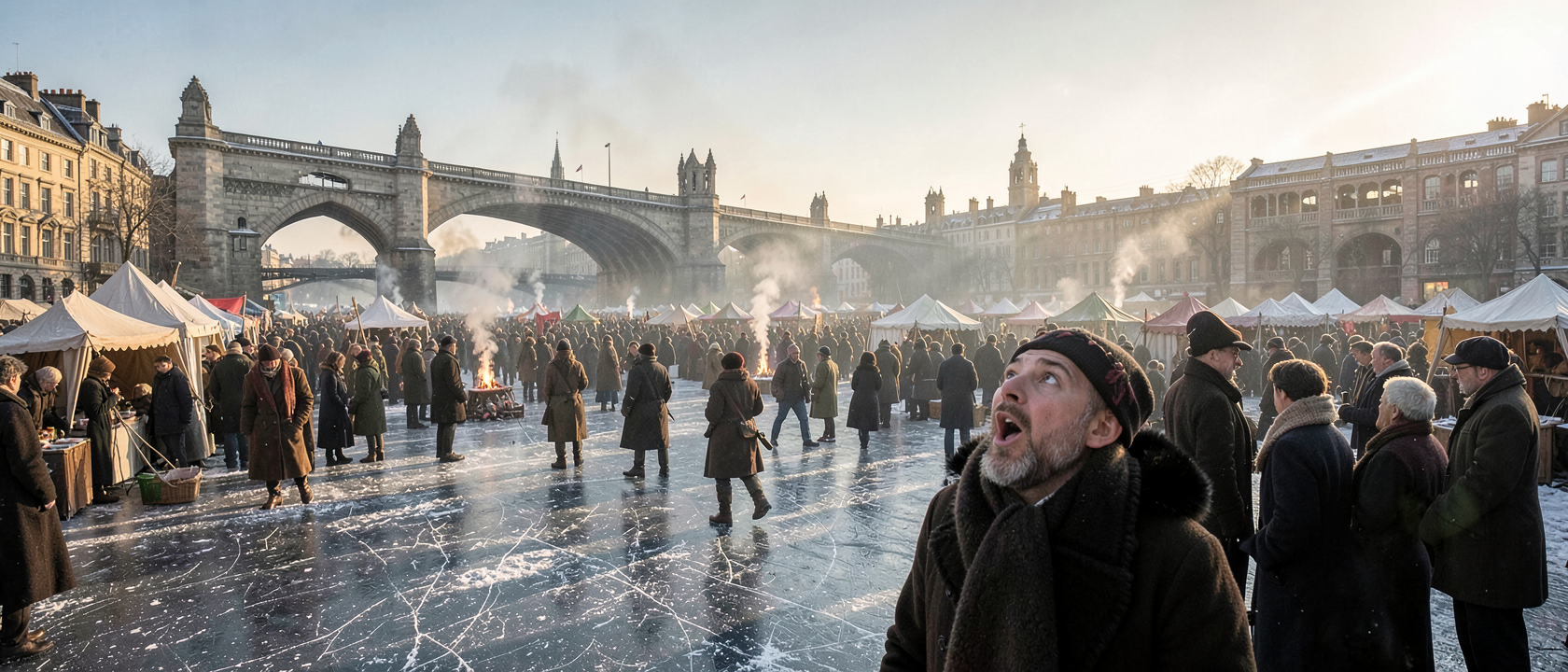
London saw traders pitch stalls on the ice in 1608, the first time the phrase “frost fair” was used. The winter of 1683 and 1684, remembered as the Great Frost, set the template for subsequent fairs. Diarists disagree on whether it began on December 15 or December 19, 1683. John Evelyn recorded frost beginning around December 20 and holding until February 6, freezing ponds 18 inches (45.7 cm) deep. Thames ice reached 11 inches (28 cm) to a foot (30.5 cm) thick, holding for about two months. Londoners built the Blanket Fair, selling provisions and printing souvenir cards. King Charles II visited, bought a keepsake, and reportedly ate roasted ox opposite Whitehall Palace on February 2, 1684, though no independent record confirms that date.
The river hosted fairs five more times: in 1715 and 1716, 1739 and 1740, 1789, and 1814. In 1789, melting ice pulled a moored ship against a riverside public house, collapsing the building and killing five people. The last fair opened on February 1, 1814, between Blackfriars Bridge and London Bridge, following sub-zero nightly temperatures since December 27, 1813. It ran for four days, featuring an elephant led below Blackfriars and printing presses producing souvenirs, including one stamped February 5, 1814.
Contested Dates, Tolls, and Folklore
No comprehensive death records survive from the 1683–1684 freeze. Unverified folklore claims Charles II joined a fox hunt on the ice across from Whitehall. Historical tallies also vary: one account counts nine gatherings starting in the winter of 1564 and 1565, while most independent sources count six proper fairs starting with 1608.
The Cost of Speed
Old London Bridge functioned as an accidental dam. By one unconfirmed historical account, it carried around twenty narrow arches supported by wide piers that slowed the tide enough for pack ice to knit together. Engineer John Rennie designed the replacement with five wide stone arches. Following his death, his sons Sir John and George Rennie oversaw construction 33 yards upstream while traffic continued across the old bridge. Lord Mayor John Garratt laid the first stone on June 15, 1825, leading to the royal opening on August 1, 1831. The bridge reportedly cost £506,000, and access roads cost four times that amount.
Crews demolished the old bridge down to the riverbed by 1832. Without the crowded piers, the Thames flowed faster, preventing the water from locking into solid ice. One engineering history describes the hydraulic change in opposite terms, but the river’s subsequent behavior demonstrates the effect of the swifter current.