
The Shimmer on the Horizon
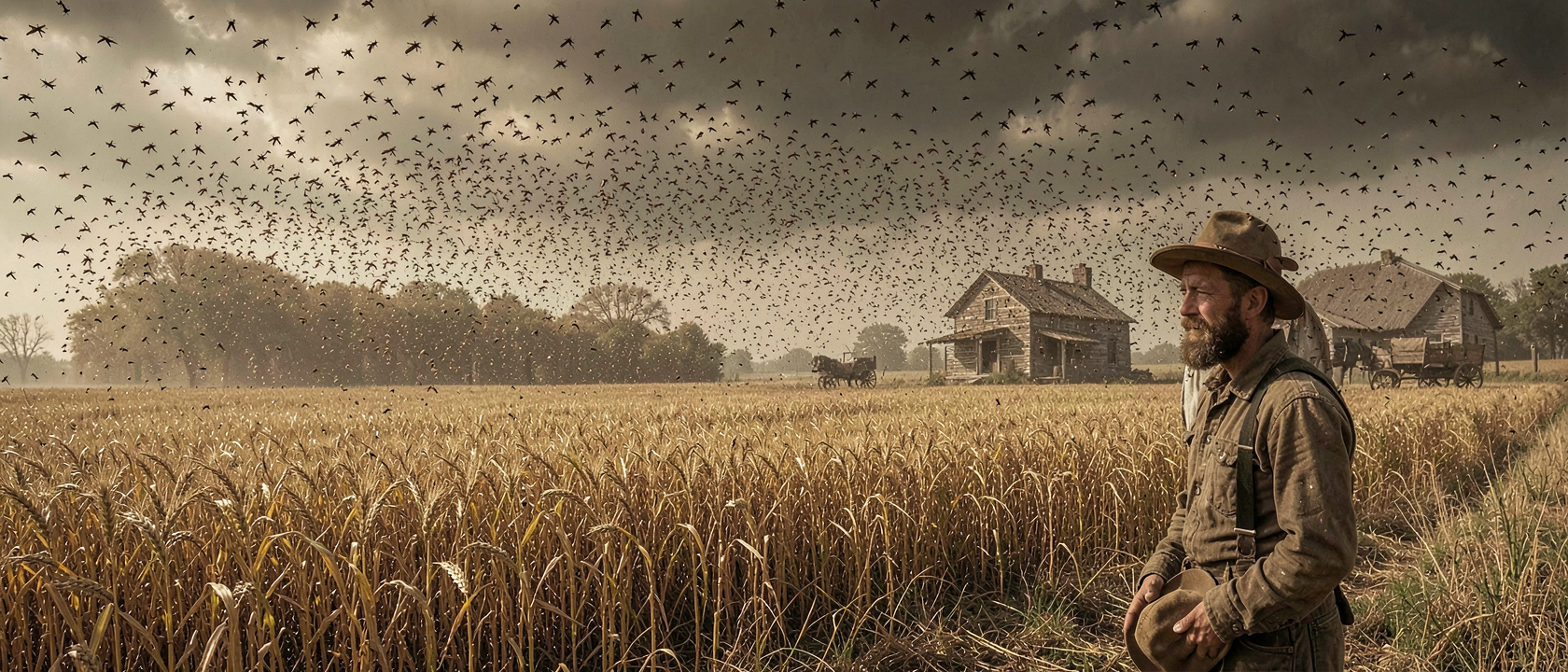
In the summer of 1874, farmers across Minnesota, Kansas, Nebraska, and the Dakota Territory watched something rise on the horizon that did not look like weather. It grew as it closed in, then blotted out the sun for as long as six hours. One farmer described it as “a great, white glistening cloud,” its wings catching the light like snow. The insect had a name beyond “grasshopper”: the Rocky Mountain locust, Melanoplus spretus, and in its swarming phase it behaved like nothing the same insect had done the year before.
Federal surveyors later put the outbreak at close to 2 million square miles (5.2 million square kilometers). In 1880 the U.S. Entomological Commission compared that footprint to New England and the mid-Atlantic states combined, eleven states from Maine to Maryland. The swarm stripped wheat and corn to the stalk, then took leather harness, wooden tool handles, wool still on sheep’s backs, and in extreme cases clothing off people’s backs. A field green that morning could be bare ground by evening.
The Weather Behind the Swarm
The insects did not appear out of nowhere. A wet spring in 1873 let locust eggs hatch in far larger numbers than usual, and swarms reached as far as Minnesota before winter closed out that year’s outbreak. In 1874 the pattern repeated with a second, larger hatching.
The plague came from the summer that followed. Hot, dry weather forced the swollen population to range farther for food, and under that crowding the insects underwent a gregarious-phase change: larger bodies, longer wings, and a shift from settled local grasshoppers into migratory locusts moving by the swarm. The same species could sit quietly in the same fields for years without this happening. In 1874 the conditions lined up exactly, on a farm economy with no cushion built in for losing an entire year’s crop.
Fire, Tar, and Ginseng
Farmers tried what was in front of them. They covered rows with quilts and sheeting, and the locusts ate through the cloth along with the plants beneath. They dug trenches to trap the advance and set fires along field edges, with little effect against numbers this large. Some built the “hopperdozer,” a metal pan coated in tar and dragged across a field by horse to trap locusts and eggs on its sticky surface. It worked on flat ground and nowhere else.
When the crops were gone, some ate the insects themselves. The entomologist Charles Valentine Riley urged it publicly and published recipes for cooking locusts. One account describes a farmer noticing that locusts left ginseng root alone, and digging it up to sell since little else in the ground still had value; the detail survives in a single retelling and cannot be checked further. For plenty of families none of it was enough, and they walked away from their land rather than farm through another season like it.
Bounty Laws, Not Relief
When state governments finally moved, they did not move with money. Minnesota and Kansas passed laws requiring residents to spend a set number of hours each week killing grasshoppers or their eggs, backed by fines and, by some accounts, jail for those who refused. The logic was plain: put the labor onto people already ruined rather than spend public funds on them. This came before any relief did, the first thing a farmer’s state asked of him was more of his own time, spent killing the insects that had eaten his living.
Fifty Million Dollars and a Refusal to Say So
The figure attached to 1874 alone is an estimated $50 million in crop and property damage, a number one historian called “a wild estimate,” though it remains the standard one. It comes out to roughly three-quarters of that year’s entire U.S. farm output; a related tally gives 74 percent, close enough to count as the same finding. Across the full run of the plague, 1873 to 1877, states counted about $200 million in combined losses, meaning 1874 alone accounted for roughly a quarter of that.
Behind the totals were letters like the one an elderly farmer sent Minnesota Governor Cushman Davis, warning that the grasshoppers had left him with nothing and that “we can see nothing but starvation in the future if relief does not come in time.” A county commissioner in Cottonwood County wrote that he had families “on the verge of starvation.”
State leaders had reasons to play the disaster down, admitting how bad it was risked frightening off settlers and investment the plains still needed. But letters like these kept arriving, and the pressure outran what officials could manage quietly. Congress eventually appropriated $180,000 for “persons living on the western frontier who have been rendered destitute and helpless by ravages of grasshoppers,” among the earliest large-scale disaster-relief efforts the federal government had mounted. It added $30,000 in seed for the next planting, eased the residency rules homesteaders had to meet, and between 1874 and 1875 the U.S. Army handed out clothing and rations to families who had lost the rest.
The Unanswered Questions
Some parts of this story do not have numbers attached, and it is worth saying so rather than filling the gap with a guess. No precise count of deaths from starvation survives; the letters and reports point to real hunger without adding up to a tally. No record counts how many farms were abandoned across the affected states. And whether the bounty laws in Minnesota and Kansas ever actually sent anyone to jail, rather than just threatening it, is not something the record settles either way.
What is clear is the shape of the whole episode: a disaster measured in tens of millions of dollars and hundreds of letters, met first with laws demanding more labor from people already ruined, and only later with money, seed, and rations from governments that had spent two seasons hoping the problem would pass on its own. It did not take a body count to force that change. It took enough farmers writing to enough governors, saying the same thing, for long enough.