
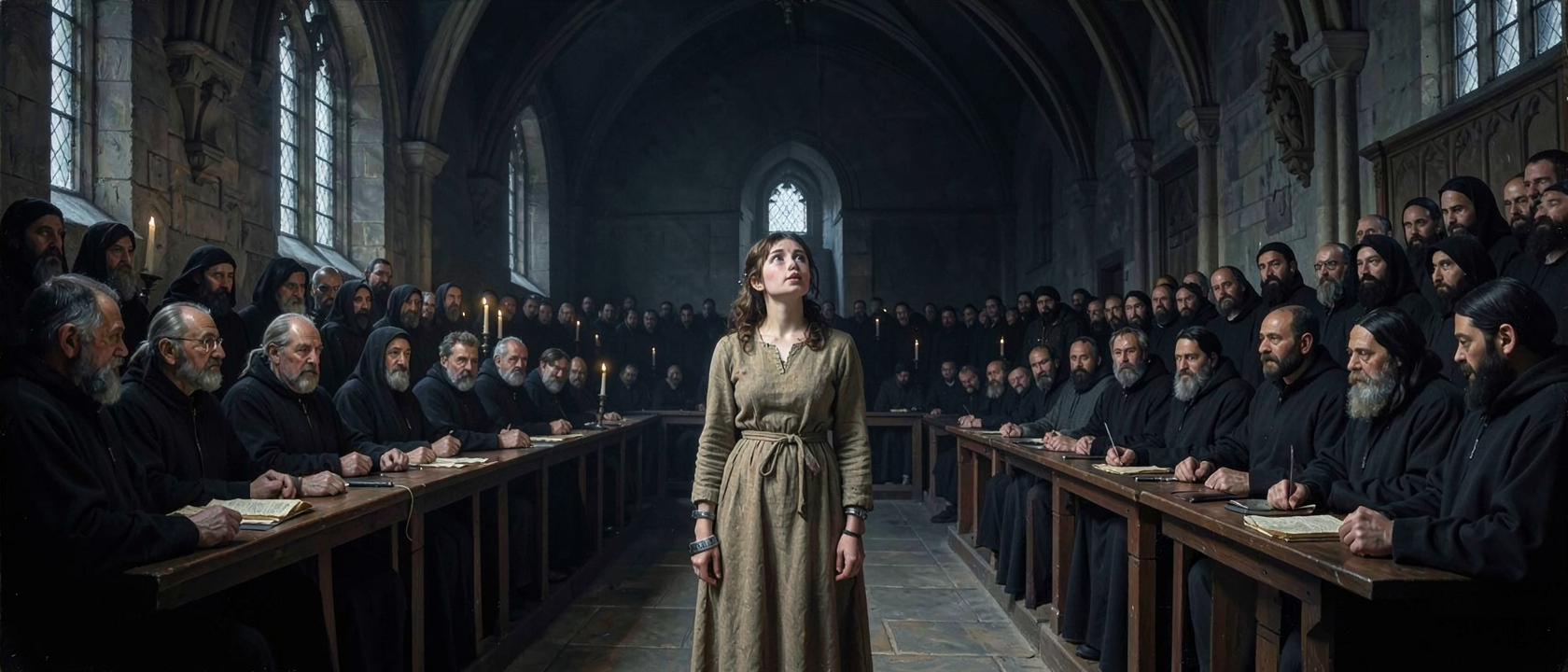
Rouen, January 9, 1431
On January 9, 1431, a tribunal convened in Rouen, seat of English power in occupied northern France. The men in the room were churchmen, university scholars, and doctors of canon law, and the case before them concerned a young woman then in her late teens: Jeanne, known to her neighbors in Domrémy as Jeannette, who signed her own name Jehanne and called herself Jeanne la Pucelle, Joan the Maid.
She needed no introduction. In April 1429 she had helped break the siege of Orléans, and three months later she had stood beside Charles VII at his coronation. By January 1431 she was one of the most talked-about figures in France, and the charge against her was heresy.
Rouen was not chosen at random. Bishop Pierre Cauchon of Beauvais, who oversaw the case, could no longer return to his own diocese, now under French control, and had an eye on an open post at the archbishop’s palace in Rouen. Some sources describe January 9 as the trial’s formal opening; others treat it as preliminary hearings ahead of the questioning that followed weeks later. Either way, a court built to decide whether her visions came from God or the Devil was now at work.
Captured, not ransomed
The path to that room began eight months earlier. On May 23, 1430, Burgundian troops led by John II, Count of Ligny, captured Joan while she tried to relieve Compiègne. She surrendered to one of Ligny’s officers, Lyonnel de Wandomme, and was passed to Philip the Good, Duke of Burgundy, who held her at the castle of Beaulieu-les-Fontaines.
Noble prisoners were usually ransomed. Joan was not. Cauchon opened talks with the Burgundians during summer 1430, and by November 21 she had been sold to the Kingdom of England for 10,000 livres tournois, worth roughly 1,783.1 pounds (808.8 kilograms) of silver; one account gives the sum in gold francs instead, though the transfer itself is not in question. On December 23 she was moved to the tower of Rouen Castle, and on January 3, 1431, an English edict ordered her delivered to Bishop Cauchon to face an ecclesiastical court.
The calculation on both sides was political as much as religious. A heresy conviction would stain the coronation she had made possible, tying it to a fraud worked by demons. Her survival without a conviction, meanwhile, left the English and their Burgundian allies holding a prisoner whose reputation kept growing the longer she went untried.
The voices, as she described them
What is known about the origin of Joan’s mission comes only from her own testimony, given under interrogation in 1431 about events she placed around 1425, when she was about 13. She said the first voice came from her right side at midday, with a strong light beside it, and that she took it for Saint Michael.
After that, she said, she most often heard two female saints, Catherine and Margaret, whose voices she described as gentle and quiet, speaking to her in French, especially at compline, the church’s last service, marked by evening bells. Their instructions, as she reported them, were direct: drive the English out of France and see Charles VII crowned.
None of this can be checked the way a date or a payment can. It is Joan’s account, given to a hostile court with every reason to make her description sound suspect, and it is reported here as testimony, not as settled fact.
Day after day: the interrogation
Formal questioning opened on February 21, 1431, under Cauchon’s direction. Six public examinations ran from that date through March 3, after which the court moved to private sessions in Joan’s cell. At points the panel weighing her answers numbered 60 or more men, churchmen, scholars, and legal doctors trained to find the seams in a claim of divine contact.
Their method was repetition, pressing Joan session after session for physical, bodily detail about how the saints appeared to her, since a concrete enough description could support an argument that she had met a demon rather than a messenger of God. Seventy articles of accusation were read against her at the opening of the formal proceedings; by April these had been condensed into twelve. On May 9, prosecutors threatened her with judicial torture to force a confession. Joan told them torture would change nothing, and the judges voted 11 to 3 not to use it.
The surviving record does not list every session in full. What is clear is the shape of it: questioning that continued, in effect, day after day for roughly three months, meant less to uncover new facts than to wear one answer down until it broke.
Recantation and retraction
By early May 1431, Cauchon’s court had concluded that Joan was not going to change her account. On May 2, she was publicly admonished in Rouen: one of Cauchon’s assistants laid out, point by point, how her testimony amounted to heresy. Later that month the court staged a formal reading of her condemnation at the cemetery of the abbey of Saint-Ouen. As Cauchon read the sentence, Joan agreed to abjure; the abjuration is recorded on May 24, 1431.
Recanting carried a procedural benefit: it opened the door to a lesser sentence, life imprisonment instead of death. Within days, though, Joan reversed herself, telling the court she had signed the abjuration only to save her life and that in doing so she had betrayed her true voices.
Under canon law, that reversal counted as a relapse into heresy. A first lapse could be forgiven with penance; a second could not. The retraction closed off the leniency the abjuration had briefly opened.
May 30, 1431
Six days after her retraction, on May 30, 1431, Joan was bound to a wooden stake in the market square of Rouen. Above the crowd, she was heard to cry “Jesus, Jesus, Jesus” as the flames took hold. She was about 19 years old.
The political purpose behind the trial had never been well hidden. Undermining Charles VII’s legitimacy, by showing that the woman who had crowned him served the Devil rather than God, ran through the case from the January hearings to the final sentence.
Her death did not undo what had already happened at Orléans and at Reims. The relief of the siege in April 1429 and the coronation that followed three months later stood as military and political facts, whatever a Rouen court concluded about the woman behind them. Twenty-five years later, in 1456, a rehabilitation trial overseen by the inquisitor general Jean Bréhal nullified the verdict and declared her a martyr. She was canonized as a saint in 1920, nearly five centuries after the fire in the market square.