
The Africains
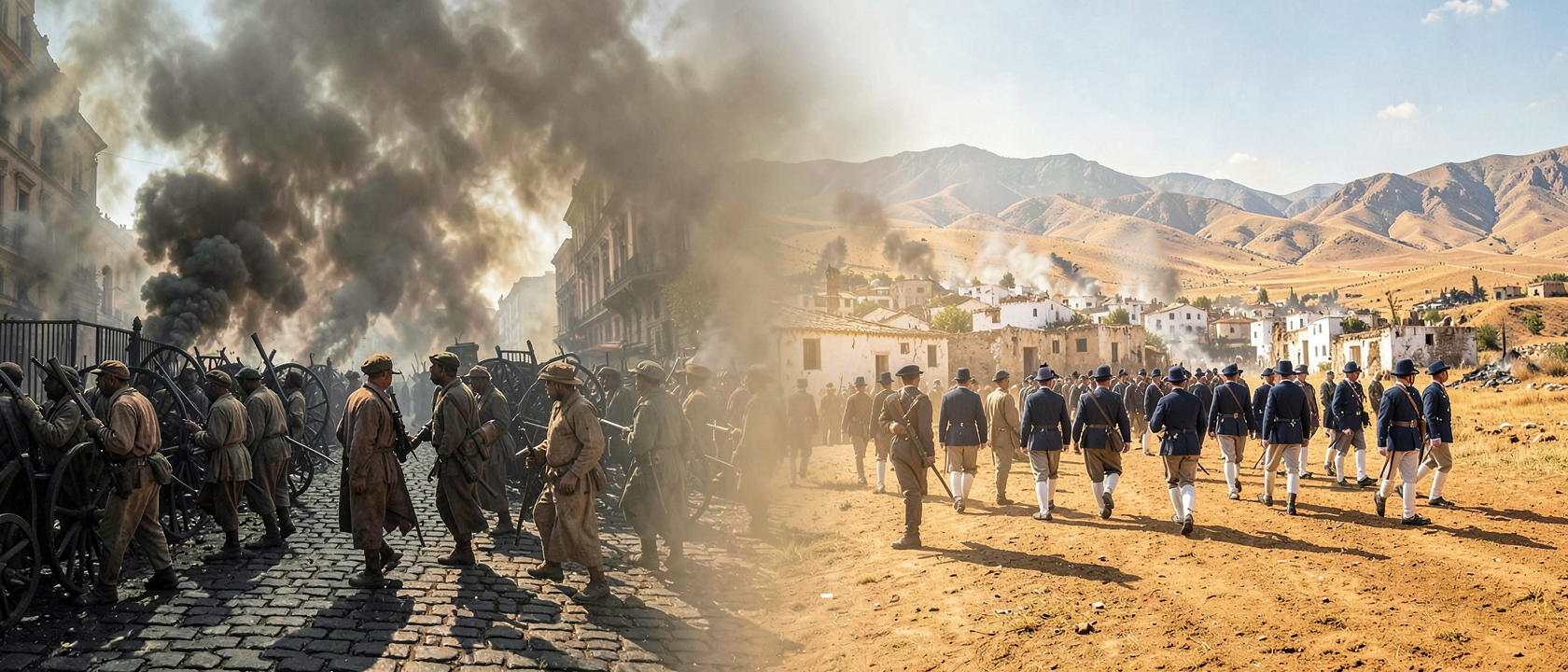
By February 1848, France had been fighting to conquer Algeria for eighteen years, since 1830. That war produced a particular kind of officer, men who had learned to break resistance not by meeting it in open ground but by sealing it in. One tactic they carried home was the enfumade: lighting fires at the mouths of caves where villagers had taken shelter and letting the smoke finish the job. General Louis-Eugène Cavaignac used it against the Sbeah people in 1844, four years before he would be asked to solve a different kind of unrest, in his own capital.
These men were known at home as the Africains. By early 1848 they were being pulled back from Algeria just as Paris grew restless. The war had no clean front and no fixed end date; it had simply trained a generation of soldiers to treat a civilian population as the enemy. The monarchy they served was about to find out what that training was worth turned on its own people.
A King’s Restraint, and Its Price
When the crowds came out in February 1848, King Louis-Philippe turned to Thomas-Robert Bugeaud, the former governor-general of Algeria, hoping his record there could save the throne. Bugeaud’s appointment went nowhere. The king stopped short of loosing the army on Paris the way it had been loosed on villages across the Mediterranean, and within days he abdicated and sailed for exile in England.
Measured against what came next, it was a small fight. The July Monarchy fell without the casualty count Algeria had made ordinary. What it left behind was a question nobody had answered yet: if a king would not use colonial methods on his own capital, would a republic?
The June Days
The answer came within months. In late June 1848, Paris rose again over the government’s plan to shut down the National Workshops, the public jobs program set up for the unemployed after February. The Constituent Assembly’s response was to declare a state of siege and hand total power to Cavaignac, the same general who had used enfumade against the Sbeah four years earlier. Sources differ on whether that happened on June 23 or 24, but the effect was the same: one man, one order.
Between June 22 and 26, his forces used artillery against insurgents holding the city’s working-class districts. The Archbishop of Paris, Denis Auguste Affre, was killed trying to negotiate a peace. When it stopped, at least 1,500 people were dead by the most commonly cited counts, with some estimates running higher, and roughly 4,000 insurgents were deported to French Algeria. Friedrich Engels, writing at the time, called it the colonial war coming home to Paris. That is his reading of it, not a settled verdict, but the man giving the orders made the comparison easy to reach for.
Fifty Million Francs and a Family Ship
The deportations were punishment. Within months the Second Republic turned the same destination into something it called relief. According to historian Jennifer E. Sessions’s account, the government set aside fifty million francs to send unemployed Parisian workers to Algeria as agricultural colonists, an idea that had started among workers themselves as a cooperative scheme and came out the other end reshaped by the government into something built around individual families and religious faith instead.
That same year the Republic abolished slavery across its colonies and formally made Algeria French national territory, divided into three départements. It also expanded voting rights for the European men settling there, a group that did not include the Algerians whose land they were taking. France’s unemployed could become French Algeria’s landholders, and French Algeria’s landholders would vote to keep it French.
Half Gone Within a Year
The plan did not survive contact with the place it was meant to solve. Sessions’s account describes cholera moving through the new settlements fast, and by late 1849, by her telling, barely half of the colonists sent out under the scheme were still there. The record gives no starting headcount, only that surviving fraction as reported in her research, so the raw number of dead and departed is lost. What that account leaves on record is enough: a scheme built to turn Parisian unemployment into Algerian settlement lost roughly half its people within about a year of landing, at least by this one telling of it.
What the Repression Bought
Cavaignac held the title Chief of the Executive Power for a few months after the June Days, the man who had crushed an uprising now running the government he had crushed it to protect. It did not last. In December 1848, voters elected Louis Napoleon Bonaparte president instead. Cannon fire against Paris workers, whatever else it bought Cavaignac, did not buy him the presidency. Bonaparte staged his own coup in 1852 and crowned himself Emperor Napoleon III, closing out the Republic the June Days had supposedly saved.
Algeria itself stayed French for well over a century past 1848. French rule there did not end until 1962, when Algeria won its independence and close to a million pieds-noirs, descendants of settlers like the ones shipped out under the fifty-million-franc scheme, left the country for France.
What the Numbers Don’t Say
This account leans on historian Jennifer E. Sessions, whose 2011 book “By Sword and Plow” argues that the domestic politics of 1848 and the colonial war in Algeria cannot be pulled apart. That is her reading of the connection, built from the record, and other historians may draw the line differently.
The record itself has real gaps. There is no total death count for Algerian civilians across the eighteen years of war from 1830 to 1848, only documented instances like the enfumade against the Sbeah. There is no independently confirmed figure for how many settlers France actually sent to Algeria in 1848, and the francs-and-cholera numbers above rest on Sessions’s account rather than a wider paper trail. Where the numbers stop, the argument about what connects these two stories has to stand on the evidence that remains.