
A Familiar Habit
By September 1781, Brighton was not a new experience for Thomas Hughes. He was 22 years old, a British officer who had returned from service in the American Revolutionary War, and he had made trips to this stretch of English coast before. Brighton in this period was a fashionable resort, drawing officers and gentry each season for its ballrooms and gaming tables, its rituals of dress and display. For Hughes it had become something closer to routine: a break between spells of soldiering, and one that had worked before. Everything known about what happened to him there comes from a single source, his own journal, and nothing in this account goes beyond what he wrote in it.
What Brighton Was Supposed to Do
A trip like this was not treated as an indulgence. For an officer coming off campaign, it functioned as maintenance, a near-automatic way of shaking off the strain of service, and it was the kind of thing that had simply worked for Hughes in the past. Judged by the standards of his own time, a young man who could not enjoy the gaming table or the ballroom had failed at something small and ordinary, no more than an off night in fashionable company. Looked at from further away, it reads differently. It does not look like bad luck or low stamina. It looks like a strain that a few weeks by the sea could not reach. That is the hinge of this episode. Brighton was supposed to distract him. Instead, it failed to touch him at all.
The Rooms He Used to Know
Hughes went to the places he had always gone: the gaming rooms, the ballrooms, the long private business of dress and preparation that Brighton society called the toilette. He described himself as “launched into a sea of gaiety and dissipation,” the same crowded world he had moved through before the war. And yet, in his own words, he felt “out of my element.” Hughes admitted to a naturally “reserved disposition,” but he was careful to note that this reserve had never before kept him from enjoying this kind of company. Something else was working on him now. He found, he wrote, “little pleasure in a concourse of people whose only amusement was the exhibition of their sweet persons and a laborious attendance on the toilette.” There is no single scene in the journal where something goes visibly wrong, no argument or humiliation recorded. Read as a whole, though, the entries describe an accumulation: room after room, evening after evening, in which a man who had once moved through this world without effort now records himself failing to feel any part of it. That reading is this writer’s own; the journal itself offers only the string of evenings, not a verdict on what they added up to.
The Bill
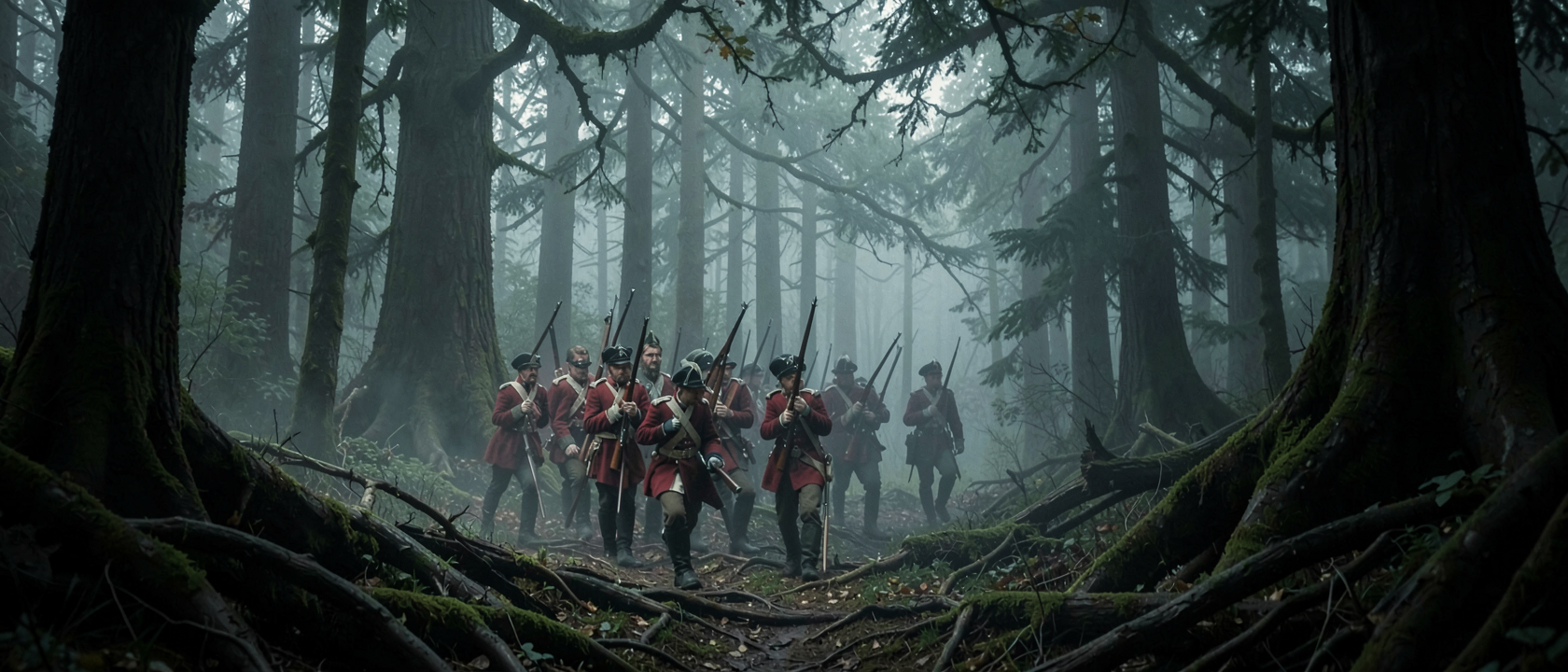
Nothing here shows up in a ledger. Hughes recorded no money lost at the tables, no wound, no incident that would have reached a regimental report. The cost was internal, a young officer’s distance from a pleasure that had once cost him no effort at all. The historian Vaughn Scribner, writing on British soldiers in the American war, has argued that this kind of change fits a wider pattern rather than something unique to Hughes. Tens of thousands of British and Hessian (German auxiliary) troops had been sent roughly 3,000 miles (4,828 km) across the Atlantic to fight a war many of them were unprepared for, and firsthand accounts from that campaign describe soldiers who came to feel that the American wilderness itself, and the war fought inside it, had turned against them. Some are described as feeling it had destroyed them outright. Hughes’s failed holiday fits inside that pattern rather than standing apart from it. He came home from Brighton a changed man, not a restored one.
What the Journal Doesn’t Say
The journal does not name Hughes’s unit, nor does it describe the terrain or the fighting that produced this change in him. It does not explain why this particular visit to Brighton, after what were presumably earlier ones during the war years, was the trip that finally failed to work. This is a common limit of sources like this one: they preserve the symptom exactly, in a man’s own words, and say nothing about the cause. That gap is not a flaw to write around. It is what the evidence allows, and it is more honest to leave it standing than to fill it with a plausible guess.