
The Accountant Who Bought a Record
In 1886, Frank Lenz, a young accountant in Pittsburgh, paid $100 for a high-wheeled bicycle: a 52-inch (132 cm) front wheel, 55 pounds (25 kg) of iron and rubber. It cost him a full month’s wages, and he did not treat it lightly.
He joined the Allegheny Cyclers, the largest of the city’s three cycling clubs with about 30 members, and quickly became its most reckless rider. He set a personal record of 162 miles (261 km) in a single 24-hour ride. He also carried a camera on his outings and documented them as he went, a habit that produced some of the only visual record of his ride.
His model was Thomas Stevens, who had already ridden a high-wheeler around the world between 1884 and 1886. Lenz wanted an attempt of his own.
Trading a High Wheel for a Sponsor
By 1890 the bicycle industry was moving on. A new design, the safety bicycle, replaced the single towering front wheel with two equal-sized wheels driven by chain and sprocket. It was lower, steadier, and safer to fall from, and it made the high-wheeler look outdated. Lenz was reluctant to give up his old machine, but a sponsor would pay for the new one, not for the bicycle that had cost him a month’s wages four years earlier.
He kept building his case. In 1890 he rode from Pittsburgh to St. Louis; the next summer he covered the 1,200 miles (1,931 km) to New Orleans. Then he pitched Outing Magazine, which had once employed Stevens, on an idea that would make him, if he finished, the first person to circle the globe solo on a chain-driven safety bicycle: about 20,000 miles (32,200 km) across the United States, Asia, and Europe, in roughly two years. The magazine reportedly agreed to cover $2,000 in expenses, twice Lenz’s yearly pay as an accountant, and Lenz asked for a $3,000 life insurance policy before he left. The deal was as much about Outing’s circulation as about Lenz’s ambition; a serialized adventure, filed chapter by chapter, sold copies.
Out of Pittsburgh, Toward the World
On May 15, 1892, Lenz pushed off from the Smithfield Street Bridge in Pittsburgh on a Victor safety bicycle fitted with pneumatic tires, watched by a crowd of about 800 people. He rode east first, through Washington, D.C., and New York, then turned west across the United States and parts of Canada, reaching San Francisco on October 20, 1892.
Along the way he detoured through Yellowstone National Park instead of taking the stagecoach road, riding over ground most travelers would not have attempted on two wheels, and his dispatches to Outing praised how well the new tires handled it. From San Francisco he sailed to Japan, then rode through China, Burma (present-day Myanmar), and India, filing reports and photographs, though sources differ on whether his camera was a light Kodak model or a heavier wooden one. From there he entered Persia (present-day Iran).
The Caravan Road to Constantinople
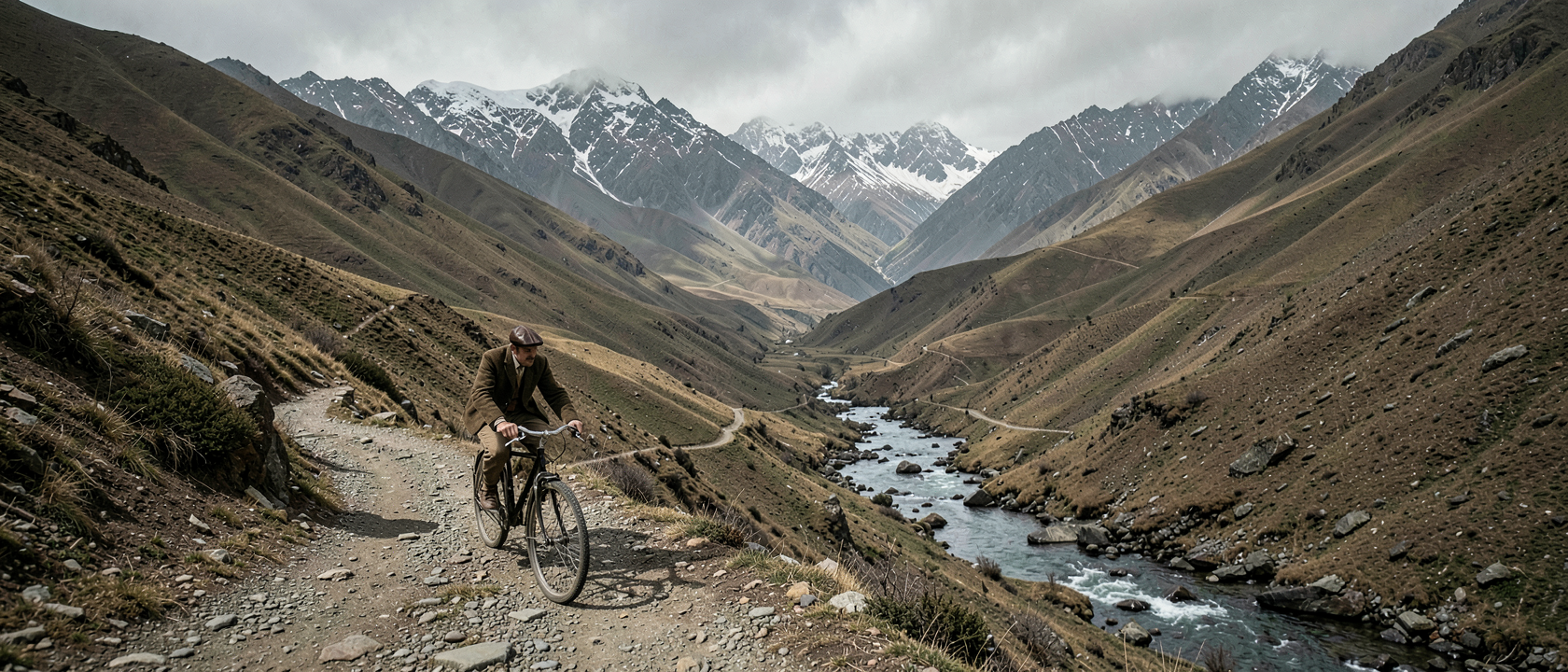
Once in Persia, Lenz followed the caravan roads west toward Constantinople (present-day Istanbul). The last confirmed photograph of him was taken in Tabriz in the spring of 1894. On May 2, 1894, he sent what turned out to be his final dispatch from that same city, writing that he was setting out for Constantinople with roughly 900 miles (1,448 km) left to cover.
That stretch carried him into the plains of Alasgird, in what is now eastern Turkey, and toward the Delibaba Pass (also spelled Deli Baba Pass). Almost everything up to this point had gone close to plan: two years on the road, close to 14,000 miles (22,530 km) covered by ship and bicycle, with only the crossing into Europe still ahead. It was in these mountains, not the open roads he had already crossed, that the trip ended.
Last Seen Near Chilgani
Lenz was last confirmed seen near the village of Chilgani, in the Alasgird plains just outside the Delibaba Pass. Beyond that point he disappeared somewhere in the mountains near Erzurum, then Ottoman territory and now eastern Turkey. His presumed date of death is given as May 4, 1894, though that figure is an estimate; no body was ever found to confirm it.
Roughly a month after he went silent, a separate report reached Outing claiming Lenz had been killed near the village of Kourdali (also recorded as Koord Ali), a different account from the sighting near Chilgani. The two stories were never reconciled. Outing itself was slow to act on either one. Limited communication in the region played a part, but the historian Duncan Jamieson has suggested the delay may also have suited the magazine’s own purposes: a missing cyclist, unexplained, was good for sales as long as the mystery lasted.
Sachtleben’s Investigation and the Unpaid Bill
Outing eventually paid for a search. William Sachtleben, who with Thomas Allen had already circled the globe by bicycle in the opposite direction, sailed for Europe in March 1895 and forged papers to enter Ottoman Turkey. In Erzurum a witness told him Lenz had entered the Delibaba Pass and stopped at the village of Kourdali. From there the accounts diverge: one holds that six Kurdish men helped him across a river and then shot him and took his belongings; another, also gathered by Sachtleben, describes a local chief ordering the robbery after an unintended insult, an ambush the next morning at the same river, a sword cut to Lenz’s hand, and an offer to convert to Islam before he was killed and buried on the bank. Neither version produced a body.
Ottoman authorities charged and convicted a Kurdish man believed responsible, though he later escaped custody. Some of the Armenian residents who had helped Sachtleben were themselves imprisoned, and at least two died there. The search unfolded against the Hamidian massacres then under way in the region, and contemporaries compared Sachtleben’s effort to the earlier search for the missionary David Livingstone in Africa.
What the investigation never settled was which account of the killing was true, whether the convicted man was actually guilty, or what became of Lenz’s bicycle, his camera, or his remains. In 2010 the historian David Herlihy gathered the conflicting reports into a book, “The Lost Cyclist,” more than a century after Sachtleben closed his file with the same open question he had started with. The bicycle Lenz had traded up for, bought to make the trip worth sponsoring, was never recovered either.