
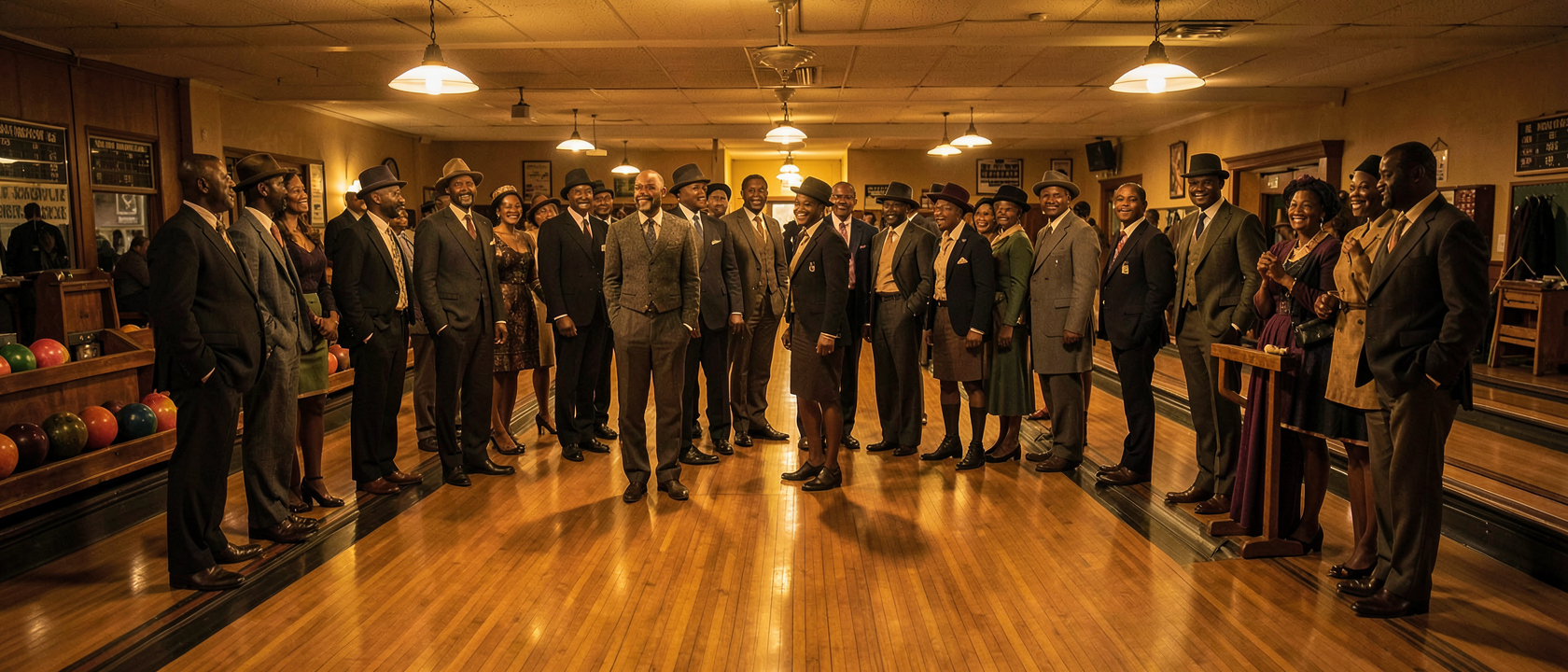
A League of Their Own
On August 20, 1939, 22 Black bowlers gathered at Paradise Valley’s Frogs Club in Detroit, Michigan, and founded the National Negro Bowling Association. The American Bowling Congress, the sport’s governing body since 1895, kept a whites-only clause in its constitution, and so did the Women’s International Bowling Congress. The new association answered that exclusion by building something of its own, open from the start to bowlers of any race and to women.
The NNBA held its first tournament that same year, in Cleveland, Ohio. The group grew quickly in its early years, drawing members from across the country into local leagues and regional tournaments. In 1944 it renamed itself the National Bowling Association, formally widening its reach to bowlers of any race even as its membership stayed mostly Black. The ABC and the WIBC did not drop their own whites-only language until 1950, eleven years after the Frogs Club meeting.
A Game for Some Americans
By the mid-1940s, bowling was one of the most popular pastimes in the country, drawing in millions of Americans every year across tens of thousands of lanes nationwide. This was not a niche hobby. It was close to a national habit, one that cut across class and region.
Scale did not translate into access. Many of those lanes, in the North as much as the South, turned away Black customers. Efforts to desegregate alleys had already begun during the war years, pressed quietly by local organizing rather than national headlines. Mainstream newspapers mostly ignored those efforts, leaving the record of them to the Black press. That gap in coverage is itself part of the documented history, not a guess about what reporters might have missed.
Trying the Door
On the night of Monday, January 29, 1968, six students from South Carolina State College (today South Carolina State University) walked into the All Star Bowling Lanes in Orangeburg, South Carolina, hoping to bowl. The alley, owned by Harry Floyd, was one of the few entertainment spots left in town still closed to Black patrons. What began that night would escalate over the following days into violence that defined the city for decades after.
Police closed the alley for the night rather than let the students stay. Students returned to find the door locked and guarded; when officers opened it, the students pushed their way inside, and several were arrested. The exact sequence of arrests in the days that followed is not pinned down precisely in the surviving accounts.
Three Hundred Outside
Word spread fast. About 300 students gathered outside the bowling alley, and city police were joined by troopers from the South Carolina Highway Patrol. Officers released those who had been arrested, hoping that would break up the crowd. It didn’t.
A firetruck arrived at the scene, and students, fearing officers meant to turn hoses on them, grew agitated. What followed was not a hosing but a beating: police went after the crowd with clubs, and some of the women present were held to the ground and struck along with the men.
Three Days Later
No officer was disciplined for what happened that night. Students gathered again on campus to protest. After dark on February 8, 1968, with a fire burning nearby, officers moved in to put it out. Someone threw debris at them, among it a piece of broken banister that struck an officer, identified afterward as David Shealy. Minutes later, at least nine troopers and one city officer opened fire into the crowd.
Three students were killed: Samuel Hammond, Delano Middleton, and Henry Smith. Counts of the wounded differ by source, between 27 and 28. Nearly all of them were hit in the back, the side, or the soles of their feet, shot, in other words, while running away. The students were unarmed, whatever some news reports claimed at the time.
Federal prosecutors charged nine of the troopers with depriving the students of their civil rights under color of law. All nine were acquitted. The shootings came more than two years before National Guardsmen killed four students at Kent State; Orangeburg was the first time police gunfire killed students on an American campus.
The Open Questions
Parts of this story are not settled. Accounts differ on what exactly set off the gunfire that night. One version ties it to the officer struck by debris, but that doesn’t explain why most of the wounded were hit from behind, running rather than advancing.
The record is thin on dates, too. The initial attempt to integrate the bowling alley is fixed to January 29, and the shooting to February 8. The days in between, including the exact order of arrests, the gathering crowd, and the firetruck and beatings, are not pinned down with precision in the surviving accounts.
No source explains why all nine officers were acquitted, and none records a reform that followed inside the police department or the Highway Patrol.
What the record does show is what became of the bowling alley itself. After the killings, it was desegregated, along with most of the other whites-only establishments still standing in Orangeburg.