
Forty Thousand People, One Morning
In 1851, the English sculptor Benjamin Waterhouse Hawkins unveiled life-sized models of dinosaurs and other prehistoric animals in a park in South London. He built them in concrete and brick, posed as if alive, and later accounts put opening-day attendance at an estimated 40,000 people.
Nobody else in the world was doing this kind of work at that scale. The display made Hawkins the leading name in giving extinct animals a physical, public form, a reputation that would cross the Atlantic with him within two decades.
Proof of Appetite
New York hired Hawkins in 1868 to design the centerpiece of a planned Paleozoic Museum for Central Park, the country’s first dinosaur museum. The commission rested on what he had already proven in London.
That same year, Hawkins traveled to the Academy of Natural Sciences in Philadelphia and mounted the skeleton of Hadrosaurus foulkii standing upright, the first time any dinosaur skeleton had been displayed in a lifelike pose. The posture, based on what scientists then believed about the animal’s stance, is now considered anatomically implausible. Accounts differ on the crowd it drew: some put the surge at more than 100,000 visitors, others describe a rise closer to 50 percent over the museum’s normal turnout. Either way, the demand for dinosaurs was no longer a guess. It had been measured.
The New Treasurer
William Magear Tweed, who ran New York City through the Tammany Hall political machine, reorganized Central Park’s governing board in May 1870. Among the men he installed was a lawyer named Henry Hilton, who became treasurer and vice president of the park’s Board of Commissioners.
Commissioners under the new leadership voted in December 1870 against moving the Paleozoic Museum forward, citing cost. Hawkins went unpaid for the models he had already finished, with no further commission to continue the work. He pressed his case anyway, addressing the New York Lyceum of Natural History on March 6, 1871, still hoping to get the project restored.
The Order
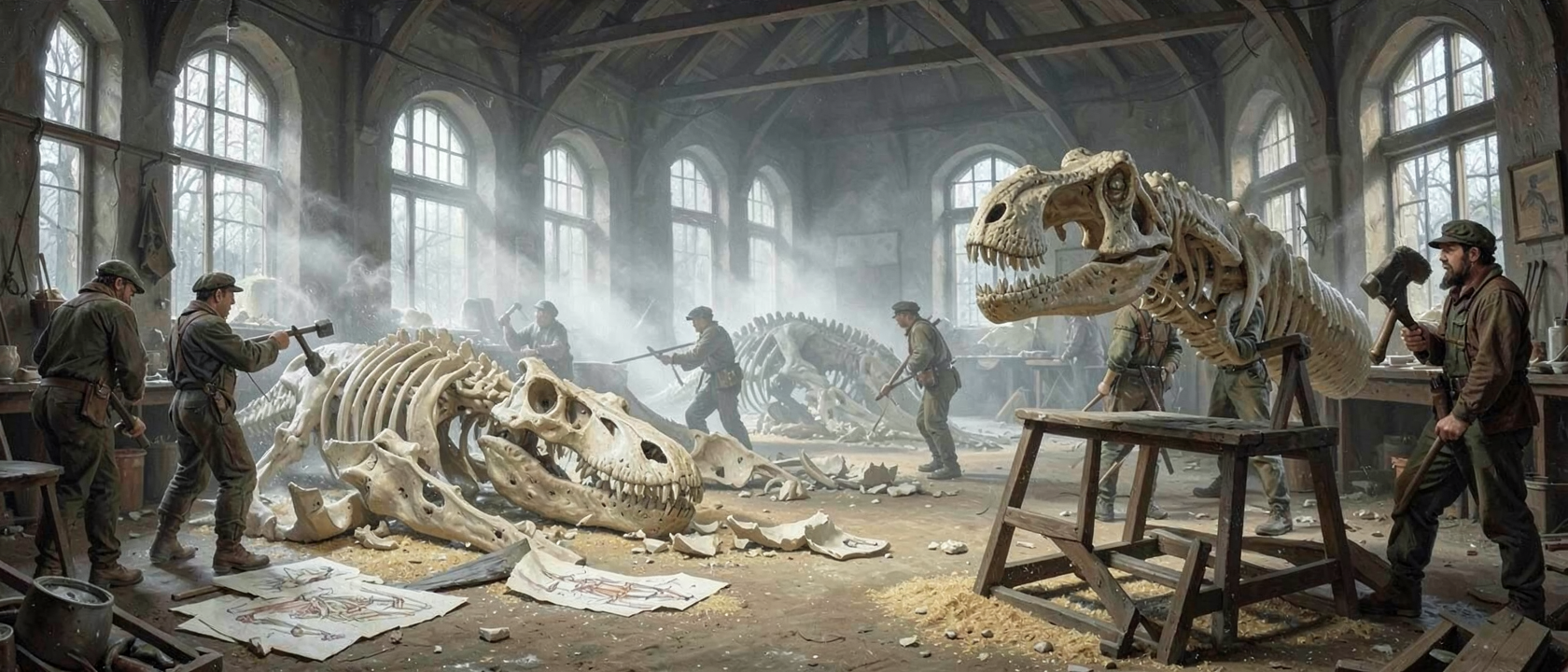
On May 2, 1871, the park board’s minutes recorded a resolution, passed under the direction of the treasurer, Henry Hilton: the shed near Sixty-second Street and Eighth Avenue was to be moved, and “the old barn, shed, and structures” at the site removed.
The next day, a crew arrived with sledgehammers. They smashed Hawkins’s seven finished models and their molds, destroyed his plans and drawings, and carried the wreckage off to be buried somewhere in the park. Nothing in the written order mentioned a museum, or models, or Hawkins. On paper, it was cleanup.
What New York Lost
Hawkins never attempted another large-scale exhibit. He died in England in 1894, his museum unbuilt and his finished work in pieces underground.
The United States lost a museum that would have been the first of its kind in the country, along with models that captured how the first generation of paleontologists and sculptors actually pictured these animals. There’s a complication worth stating plainly: fossil discoveries from the Bone Wars of the 1870s and 1880s would likely have made several of Hawkins’s reconstructions outdated anyway, museum or no museum. So the loss runs two ways. One is the objects themselves. The other is the record of how early science saw these animals, before later digs rewrote the picture.
Blaming the Wrong Man
For more than a century, popular accounts handed the blame to Tweed. Some versions added that he found the dinosaurs blasphemous, a claim no source actually supports. Tweed made an easy villain; he was already the face of the era’s corruption, and his ring had spent years hollowing out the city’s institutions for its own benefit. Other tellings pointed to ethnic tension, since Tammany Hall’s base was largely Irish and Hawkins was English, but the surviving records don’t support that theory either.
Historian Vicky Coules, working with Michael Benton at the University of Bristol, went back through the park board’s own meeting minutes and traced the order to Hilton, not Tweed. Why Hilton did it is less certain. One theory holds that he saw the planned museum as a rival to the newly forming American Museum of Natural History, though that motive is not proven. The pattern fits a man with other documented habits, though: Hilton ordered a bronze statue in the park painted white, and when the sculptor refused, he had it taken down and painted anyway. He also whitewashed a whale skeleton given to the American Museum of Natural History, ruining it beyond repair. Tweed’s own ring, for its part, had kept Hawkins employed on other work even after the museum stalled, which is not what you would expect of men bent on destroying him.
Still Buried
What happened to the wreckage afterward is still unsettled. One account places it near a pond in the park’s southeastern corner; another points to the southwestern corner. Dredging has turned up nothing in either spot. The paperwork behind the Paleozoic Museum’s destruction has finally been read correctly, more than a century on. The models themselves have never been found.