
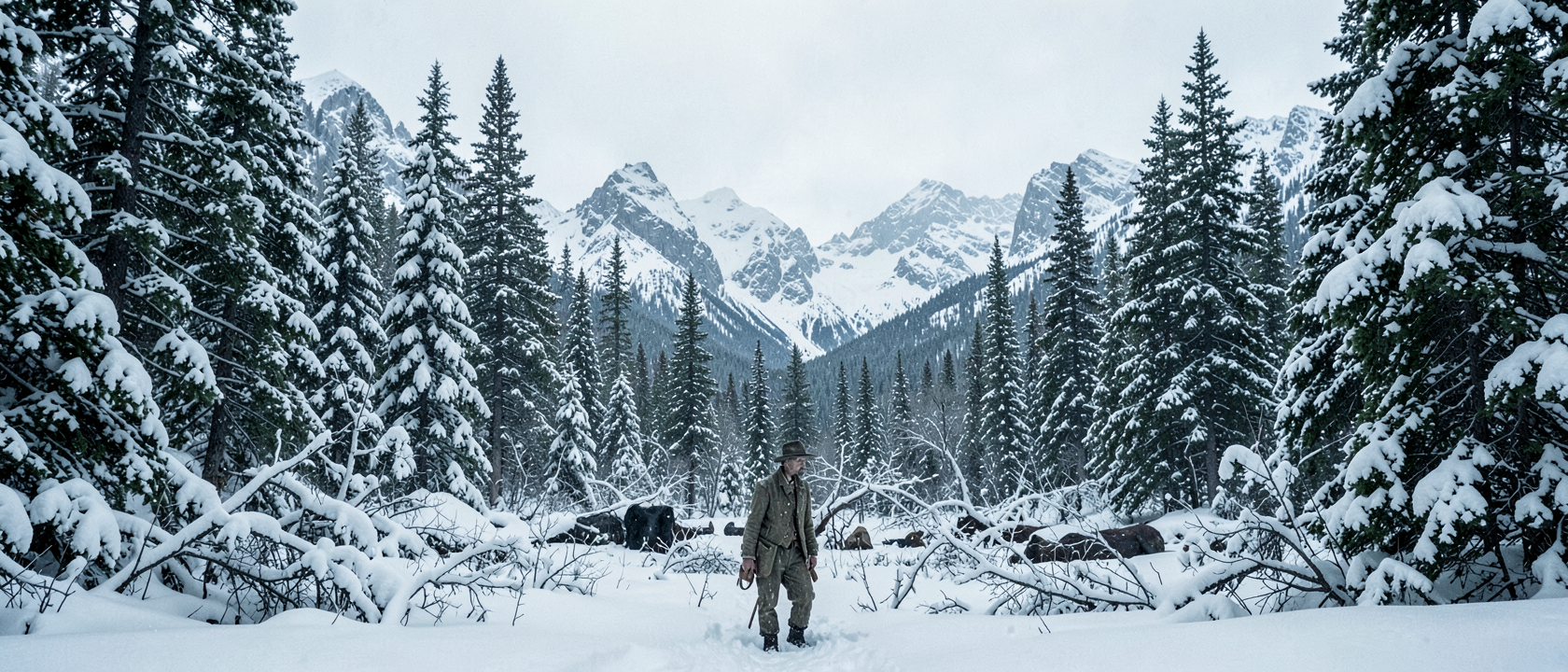
A man who said he had nearly starved alone in the San Juan Mountains of Colorado walked out of them in the spring of 1874 looking neither thin nor poor. He had more cash on him than anyone could account for. That contradiction unraveled into one of the most notorious killings of the American West, a case historians still argue over.
A Guide Who Wasn’t
In the fall of 1873, Alfred Griner Packer, who went by Alferd, joined an expedition of an estimated twenty prospectors setting out from Provo, Utah, bound for the gold and silver reported in Colorado’s San Juan Mountains. Packer claimed to know the mountains, to have guided parties through them before, and to have money and supplies of his own to contribute. Little of that held up. As the trek wore on into winter, the company splintered, and Packer ended up traveling with five other men: Shannon Wilson Bell, James Humphrey, Frank “Reddy” Miller, George “California” Noon, and Israel Swan.
Nine Months of Snow
Winter in the San Juans was the real danger, long before any man raised a hand against another. According to historian Diana Di Stefano, who studies the region’s mining frontier, snow in the high San Juans could linger for as long as nine months of the year, burying trails and cutting supply routes. Parties that stayed too long in that country risked freezing or starving, a hazard well understood by anyone chasing San Juan gold. Six men moving deeper into that terrain with limited provisions as the snows set in were already a bad bet against the weather, before anything else went wrong.
The Parting at Ouray’s Camp
On February 9, 1874, Packer and his five companions set out from Chief Ouray’s winter camp, near where Montrose, Colorado, stands today, resuming a trek that had begun months earlier in Provo. From that point, the six men went on alone into the mountains. None of the five who traveled with Packer was ever seen alive again.
The Story Packer Told
What happened over the following weeks is known only through Packer’s own telling, first given in a confession he signed on May 8, 1874, after questioning by Charles Adams, the Indian agent at Los Pinos. By his account, Israel Swan, the oldest of the group, died first of exhaustion and was eaten by the others. Four or five days later, Humphrey died and was eaten in turn; Packer said he took $133 from Humphrey’s pocketbook. Later, while Packer was out gathering firewood, Miller was killed and eaten as well. Packer said Bell then shot Noon, leaving the two of them alone, and that Bell turned on him next.
As journalist Andrew Curry later rendered Packer’s account, Bell “wanted to kill me, struck at me with his rifle, struck a tree, and broke his gun.” Packer said he killed Bell in self-defense and used part of his body for food. That is Packer’s version. He would tell it differently twice more, in a second confession in March 1883 and in a letter to the Rocky Mountain News in August 1897, and the details of who killed whom shifted each time.
Out of the Mountains
On April 16, 1874, Packer walked alone into the Los Pinos Indian Agency near Gunnison, Colorado, saying he had spent 57 days alone in the wilderness after his companions died. But he did not look like a man who had gone nearly two months without reliable food: he was well-fed and carried more cash than a half-starved survivor should have had. That contradiction drew suspicion and led, three weeks later, to Adams sitting him down for the confession that became the public record of the case.
What the Thaw Revealed
A search that spring found nothing under the remaining snow. It was not until August 1874 that John A. Randolph, an Illinois illustrator working for Harper’s Weekly, came across the five bodies near Lake City, lying under a grove of spruce trees, partly wrapped in blankets. He sketched them where they lay. Packer, already held on suspicion since his confession, was committed to the jail in Saguache, Colorado. The condition of the remains convinced investigators this had not been a simple case of men succumbing to cold and hunger, and Packer was charged with murder.
Two Decades, Paid in Pieces
Packer escaped from the Saguache jail within days of being locked up, by some accounts on August 8, 1874, and was not seen again for nearly nine years. He was found living in Cheyenne, Wyoming, under the name John Schwartze, and arrested there on March 11, 1883. A trial opened in Lake City on April 6, 1883; on the 13th he was convicted and sentenced to hang. The execution, set for May 19, 1883, never happened: Packer won a new trial, and in October 1885 the Colorado Supreme Court threw out the conviction, ruling it rested on a law passed after the fact.
A second trial, held in Gunnison in 1886, convicted him on five counts of voluntary manslaughter and sentenced him to 40 years. The Colorado Supreme Court upheld that sentence on June 19, 1899. Packer was paroled on February 8, 1901, and moved to Deer Creek, in Jefferson County, Colorado. Depending on how the years are counted, he had served somewhere between fifteen and eighteen years behind bars. Five men who went into the mountains with him never came out at all.
What Still Isn’t Settled
Whether Packer killed out of hunger and fear or for gain is still argued. His story changed in 1874, 1883, and 1897, and the details of who died first and who killed whom were never the same twice. A forensic review in the 1950s added its own complication: a rusted 1862 Colt Police Model revolver, a five-shot .32 missing two rounds, turned up on what is now called Cannibal Plateau, and analysts at Mesa State College’s Electron Microscopy Facility matched bullet fragments from the burial site to lead from that gun, a result consistent with Packer’s claim that he shot Bell in self-defense. But another reading of the same evidence holds that none of the five bodies showed gunshot wounds at all, only signs that the men had struggled before they died.
Even the geography of the case has needed correcting. One widely read modern account originally placed the events in California’s Sierra Nevada before the error was fixed to read the San Juan Mountains. No investigation since has settled whether Bell died by Packer’s hand alone, or whether all five men were murdered outright.