
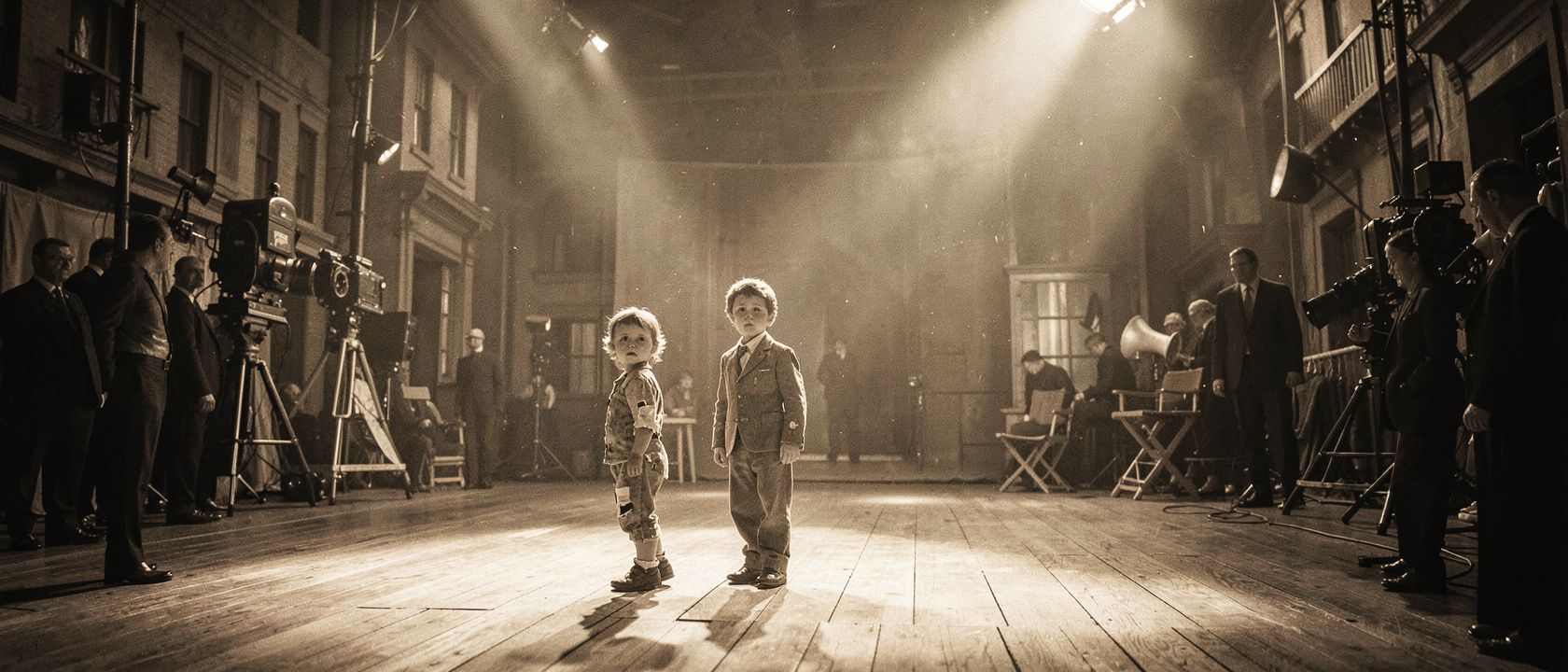
A Comedian Takes a Gamble
In 1920, Charlie Chaplin began work on his first full-length feature, built around a tramp, an abandoned infant, and the boy who would play him. The boy was Jackie Coogan, born October 26, 1914, in Los Angeles. Chaplin had spotted him in a vaudeville act with his father, John Henry Coogan Jr., known in the business as Big Jack. Audiences responded to the boy’s bits so strongly that the tour’s promoter began paying the family extra to keep him in the act. When the show reached Los Angeles, Chaplin, who was looking to cast a child for a new picture, decided Coogan was the one.
Chaplin was already one of the most recognized performers alive, famous worldwide for short comedies built on pratfalls and timing. The Kid asked for something different: a story that moved between slapstick and real hardship, a sick and poor child nearly taken from the only parent he knew. Industry skeptics said as much at the time: comedy and pathos, in their view, did not sit well together at feature length, and one was likely to undercut the other.
What Chaplin Had on the Table
Chaplin was not working inside a studio system that could absorb the loss if the picture failed. He was financing and controlling the production himself, which meant the money at risk, and the reputation at risk, were both his own. A flop would not have read as a small stumble. It would have been taken as proof of two things: that Chaplin, for all his success in two-reel comedies, could not sustain a full-length film, and that his instinct to reach for sentiment alongside comedy had been a misjudgment. In 1921, neither claim would have sounded far-fetched.
The Kid Opens, and Then Oliver Twist
The Kid opened in 1921 and became a hit worldwide, praised by critics and embraced by audiences. The gamble on pairing comedy with real hardship had paid off, and Coogan’s performance was a large part of why. The following year, in 1922, he took the title role in Oliver Twist, opposite Lon Chaney as Fagin, and critics singled him out again for a performance that held its own against an established star. He was still a small child, and already one of the most famous people in the world.
The Boy as a Brand
Fame on that scale did not stay inside movie theaters. Coogan’s face and name began turning up on consumer goods built around nothing but his identity: dolls shaped in his likeness, stationery, whistles, phonograph records, figurines. Exact lists vary by source, but the pattern does not. This was not simply a child actor growing wealthy from his pictures. It was a specific five-year-old’s image turned into a commercial product in its own right, years before that kind of merchandising was ordinary business in Hollywood. Between his film work and these endorsements, Coogan’s childhood earnings are estimated at $3 million to $4 million, worth an estimated $44 million to $59 million in 2021 dollars.
He was not the only child of the era whose image and labor were converted into money on this scale. Diana Serra Cary, known on screen as Baby Peggy, began performing in front of a camera at 19 months old in 1921, the same year The Kid opened. Between 1921 and 1924 she made more than 150 short films, received over 1.2 million pieces of fan mail in a single year, and was eventually billed as “The Million Dollar Baby” for a reported annual salary of $1.5 million. Both children were, by the standards of their moment, among the highest-earning performers alive, and both were still years away from being old enough to manage a bank account on their own.
What This Doesn’t Tell You Yet
None of this says what became of the money, and none of it should be read as the end of the story. Left out here is the part where the earnings did not stay protected for the child who made them: a lawsuit Coogan eventually brought against his own mother and stepfather, and a change in California law that grew out of it. Cary lived through a parallel version of the same arrangement, with her own family’s handling of her earnings running alongside his, and her own story of what was and was not recovered. Those threads belong to what came after 1921 and 1922, and they are not settled here.