
The Bear He Didn’t Catch
In spring 1852, Augustus T. Dowd was hunting meat for a crew building an irrigation ditch for the Union Water Company near Murphys, in Calaveras County, California. He wounded a grizzly bear and followed its trail into the forest, but the bear got away. What he found instead was a stand of trees unlike anything recorded in American botany: trunks around 25 feet (7.6 m) across at the base, rising somewhere between 250 and 300 feet (76 to 91 m), depending on which period account you trust.
The largest of them would later be called the Discovery Tree. A handful of unpublicized sightings of giant sequoias went back as far as 1833, but Dowd’s was the first to reach other people’s ears. When he returned to camp and described the tree, no one believed him; the size didn’t fit anyone’s experience, so secondhand it sounded invented. It took a walk out to the grove, now part of Calaveras Big Trees State Park near Arnold, California, to settle the argument.
A Dead Tree Sells Better Than a Living One
By 1853, a plan had formed to turn the tree into money. Accounts differ on whose plan it was: one names William H. Hanford, a promoter, as organizer; a marker at the site instead credits several stockholders of the Union Water Company, Dowd’s old employer. Both versions agree on the logic. A sequoia standing in a forest earned nobody a dollar; felled, stripped, and shipped, it could be toured and charged for. No one had tried anything like this before, nothing built to cut timber in California had ever gone through a trunk this wide.
Twenty-Two Days to Fell a Tree
Workers stripped the bark away first, though accounts disagree on exactly how: one describes panels roughly 40 feet (12 m) long, another says only the lowest 10 feet (3 m) of the trunk was stripped. No saw in the region was long enough for what came next, so the crew used long-handled pump augers and wedges instead. Five men spent about 22 days boring through the base.
Even fully bored through, the tree held. It stood for several more days until a windstorm finally brought it down on June 27, 1853, according to a report at the time in the San Joaquin Republican. The fall gave botanists a clean cross-section to count for the first time. Ring counts put the tree’s age at 1,244 years when it was felled.
The Bark Goes on Tour
Hanford shipped the stripped bark and sections of the trunk to San Francisco, then on to New York City, where they went on public display. From there, organizers planned to send the exhibit across the Atlantic to Paris. A tree that had stood in one place for more than a thousand years was now traveling the country as a show.
What Was Left
The Paris leg never happened. The bark burned instead, reportedly in a New York warehouse in 1855, before it could be shipped overseas.
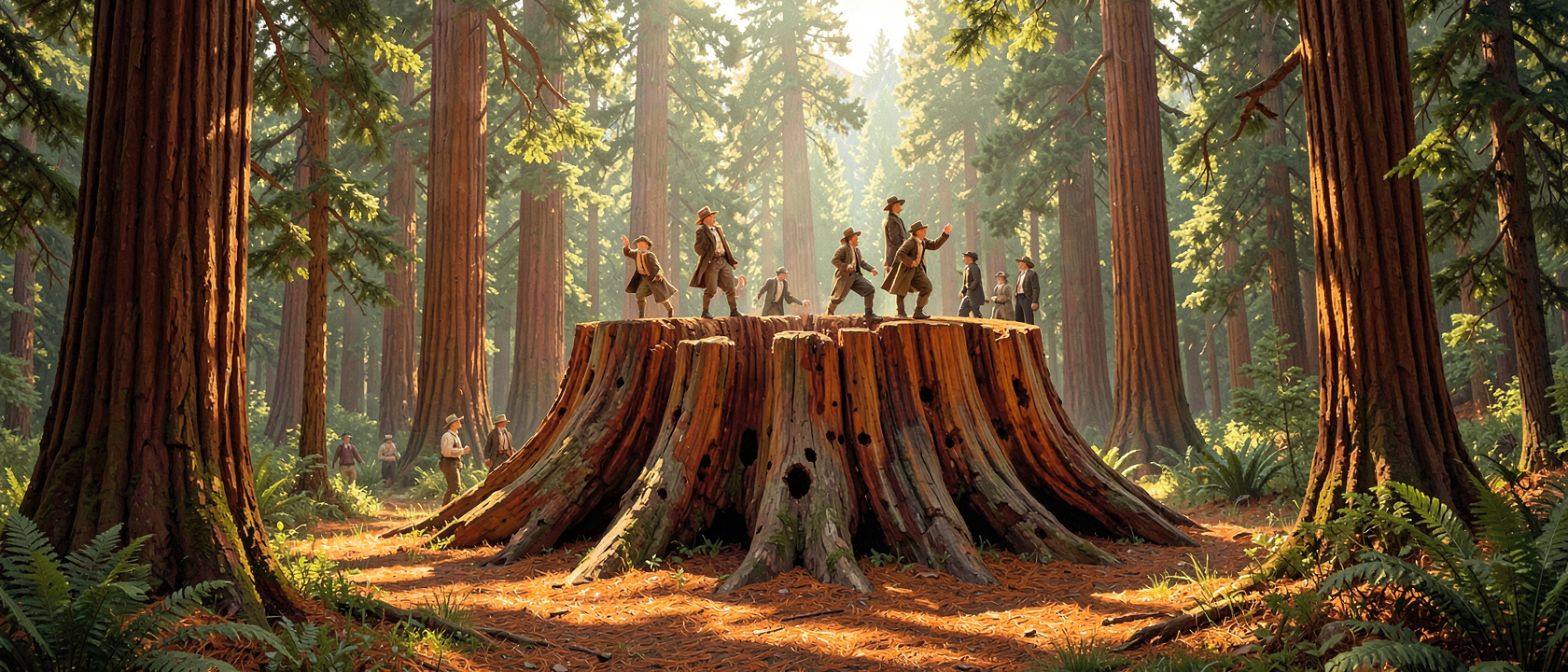
In California, what remained was the stump: cut down to about 19 feet (5.8 m) and leveled flat on top. The site went on to host dances, theatrical performances, concerts, lectures, church services, weddings, and, at different times, a schoolroom and a bowling alley. A tree more than a thousand years old became, within months, a stage for an afternoon’s entertainment.
Desecration, in Print
The felling drew criticism almost at once. Newspapers of the period wrote it up as a loss, not an achievement, and most of the blame landed on the men who had cut the tree down. The naturalist John Muir later captured his verdict in the title of an essay: “The Vandals Then Danced Upon the Stump!”
In 1864, California Senator John Conness introduced a bill in Congress to protect Yosemite Valley. It passed, and the grant that followed is often described as an early step toward the state and national park systems that came later. Historians connect the public reaction to the Discovery Tree’s destruction with that growing conservation sentiment, but no documented record draws a straight line from outrage over one stump to a bill signed eleven years later. The link is a matter of interpretation, not proven cause and effect.
What the Record Doesn’t Settle
Some claims here outrun what the record can confirm. The 1864 Yosemite grant is sometimes called the first state park in the country, a claim not independently verified here, and whether outrage over the Discovery Tree actually moved Conness to act remains an open question rather than a documented fact.
The grove itself gained formal protection later. Calaveras Big Trees became a California state park in 1931, preserving the North Grove and its roughly 100 mature giant sequoias. A larger South Grove, with about 1,000 more, was added afterward, bringing the park to about 6,400 acres (2,590 hectares) as of the park’s current boundaries.
In 2013, the artist Josh Winkler began a project telling the grove’s history through prints and drawings, and later made graphite rubbings taken directly off the surface of the Discovery Tree’s stump. By his own account, those rubbings have been exhibited in Minnesota, Nebraska, and the Yukon Territory, though that detail has not been independently confirmed elsewhere. The stump is still there, in Calaveras Big Trees State Park, for anyone who wants to measure the distance between what the tree had been and what was made of it.