
The Square, the Cold, the Wait
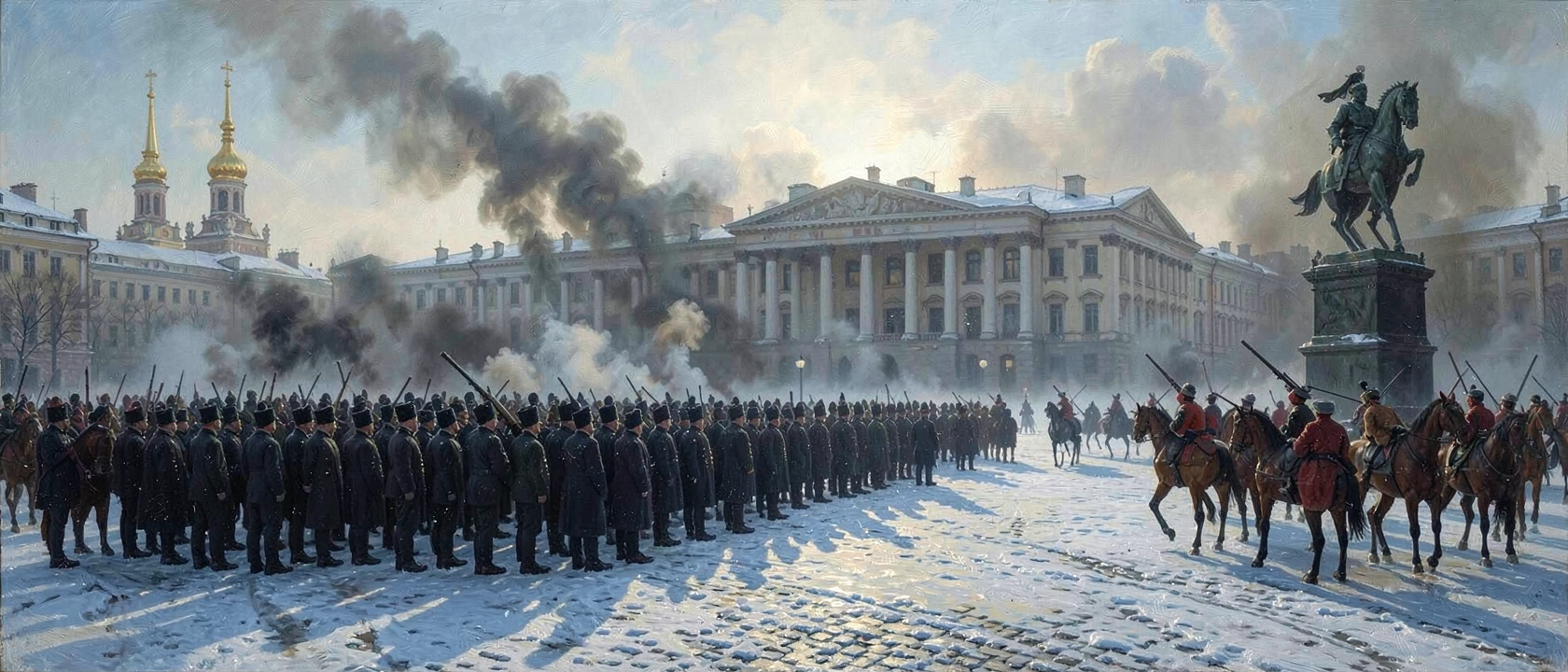
On December 14, 1825, close to 3,000 soldiers formed up in Senate Square in St. Petersburg. They were not a crowd pulled in off the street. They were regular army units, marched there before dawn by officers who had spent years preparing for this exact morning.
They had been told that the Senate, the empire’s highest legislative body, would soon read out a manifesto declaring the old government finished. So they stood in formation through hours of winter cold, waiting not for a fight but for a political signal that kept failing to arrive.
The man the conspirators had named “dictator” of the uprising, Colonel Prince Sergei Trubetskoy, never showed up at the square at all. No one explained to the waiting soldiers why their own commander was missing.
A Throne, a Lie, and a List of Demands
Alexander I had died on December 1, 1825, with no son to take the crown. His brother Konstantin, next in line, had secretly renounced his claim two years earlier, a fact almost nobody in St. Petersburg knew. The army had already sworn loyalty to Konstantin by mistake. On December 14, officials made the troops swear a second oath, this time to Nicholas, Alexander’s younger brother. It was that oath the rebel officers meant to block.
Their manifesto did not ask anyone to overthrow a government. It claimed the government had already fallen, a fiction built to make the mutiny look like a restoration rather than a revolt. Underneath the lie sat a real program: a written constitution, the end of serfdom, civil rights for ordinary subjects.
This was not peasants rising against landlords. These were nobles and army officers, men who belonged to the system that fed them, organizing against it from the inside.
Cannon Fire
Nicholas tried persuasion first. Mikhail Miloradovich, St. Petersburg’s military governor-general and a decorated veteran of the war against Napoleon, rode up to the rebel line and urged the soldiers to lay down their arms. One of the conspirators, Pyotr Kakhovsky, shot him. The wound was fatal.
By then Nicholas had roughly 9,000 loyal troops ringed around the square, outnumbering the rebels three to one. After four in the afternoon, with the standoff still unresolved, he gave the order to fire. Seven rounds of grapeshot, cannon charges packed with small iron balls, went off: one over the rebels’ heads as a warning, the other six point-blank. The formation broke apart within minutes.
One officer, Mikhail Bestuzhev, tried to rally retreating soldiers into a column across the frozen Neva River to seize the Peter and Paul Fortress. The attempt failed. Within hours, most of the rebels were under guard inside that same fortress, this time as prisoners.
How many died on the square that evening is genuinely disputed. One account from the era puts the toll at 1,271, including 9 women and 19 children caught in the crush. A lower estimate used in more recent popular histories puts it closer to 80 soldiers and bystanders. The gap between those two numbers, over a thousand people, has never been closed.
The Second Rising
Senate Square was not the end of it. Roughly two weeks later, far to the south, officers of Russia’s Second Army, stationed in what is now Ukraine, raised the Chernigov Regiment in a separate revolt built on the same demands. Sergei Muravyov-Apostol and Mikhail Bestuzhev-Ryumin led it.
Government troops caught up with them within days, and by early January 1826 the regiment had been dispersed in the field. The fighting did not end there, though. Days later, in a final stand against pursuing forces, Muravyov-Apostol was struck by canister shot and captured. The revolt was finished almost before it reached the capital’s attention.
Six Months, 121 Names, Five Deaths
The government did not move quickly. Investigators spent six months working through almost 600 men, clearing roughly half of them. On June 1, 1826, Nicholas convened a Supreme Criminal Court and personally oversaw the sentencing of every man who remained.
A total of 121 were found guilty of serious crimes against the state. Most lost their rank and their property and were sent to Siberia for hard labor and exile, later joined there by soldiers who had followed them into the square. Thirty-one had originally been condemned to beheading; Nicholas commuted that to life at hard labor instead. History now remembers all 121 together as the Decembrists, after the month their plot came apart.
Five men were shown no such mercy: Pavel Pestel, Kondraty Ryleyev, Sergey Muravyov-Apostol, Mikhail Bestuzhev-Ryumin, and Pyotr Kakhovsky, the officer who had shot Miloradovich. They were hanged at the Peter and Paul Fortress on July 25, 1826. Three of the five fell when the ropes broke and had to be hanged a second time. Bestuzhev-Ryumin, the youngest of the five, was twenty-five years old.
Idealists or Reformers?
Historians still disagree on what to call the men who stood in that square. One reading treats them as privileged dreamers: aristocrats who had absorbed constitutional ideas abroad and staged a mutiny with no real plan once their own appointed leader failed to appear. Their founding manifesto, after all, rested on a claim that was simply untrue.
The other reading takes their program at face value. Ending serfdom, writing a constitution, granting civil rights, these put them well ahead of the government they served. Pestel, one of the five hanged, had spent years drafting a detailed political plan before the revolt ever happened. That argument has not been settled and is unlikely to be.
What both readings agree on is the shape of the thing itself. It was not a peasant uprising and not a palace struggle over who wore the crown. It was officers and nobles, insiders of Russian autocracy, trying to take it apart from within, decades before any comparable movement came close again. In 1975, a monument to the five hanged men went up inside the walls of the Peter and Paul Fortress, the same fortress Bestuzhev had failed to seize and where all five had been put to death.