
The Gallows at Oxford Castle
On December 14, 1650, in the yard of Oxford Castle, England, a 22-year-old servant named Anne Greene was led up a ladder and hanged. She hung by the neck for close to half an hour. Friends in the crowd reportedly hastened her death, a recognized mercy at hangings of the period: they thumped her chest, hung their own weight from her legs, and hauled her down before letting her drop again. After about half an hour she was cut down and pronounced dead, then placed in a coffin. From there her body went to a house at the university, where Dr. William Petty, professor of anatomy, was due to lecture over her corpse before it was dissected.
A Servant at Duns Tew
Earlier that year, in the summer of 1650, Anne Greene had been working as a scullery maid in the household of Sir Thomas Read, a justice of the peace who lived at the manor house in Duns Tew, Oxfordshire. That summer, Read’s teenage grandson seduced her. She became pregnant without realizing it, and weeks later delivered a stillborn infant, reportedly born at only 17 weeks and measuring 9 inches (23 cm) long, small enough that she concealed both the birth and the death rather than report them.
The law that decided her fate was the 1624 Act to Prevent the Destroying and Murthering of Bastard Children. It made the concealment of an illegitimate child’s death a capital offense on its own terms: a woman could hang for hiding the body, whether or not there was any proof the child had ever drawn breath.
Arrest, Trial, Conviction
A fellow servant told Sir Thomas Read what had happened, and he pursued the prosecution himself. Anne spent roughly three weeks in the county jail at Oxford before trial, held, by one account, in constant fear. She was convicted in December 1650, though no record survives of the exact day of the trial, only its outcome. A midwife testified that the infant had been too underdeveloped to have lived outside the womb, but the 1624 Act allowed no such distinction. Anne was sentenced to hang. That sentence was carried out on December 14, in the scene already described.
The Night in Petty’s Rooms
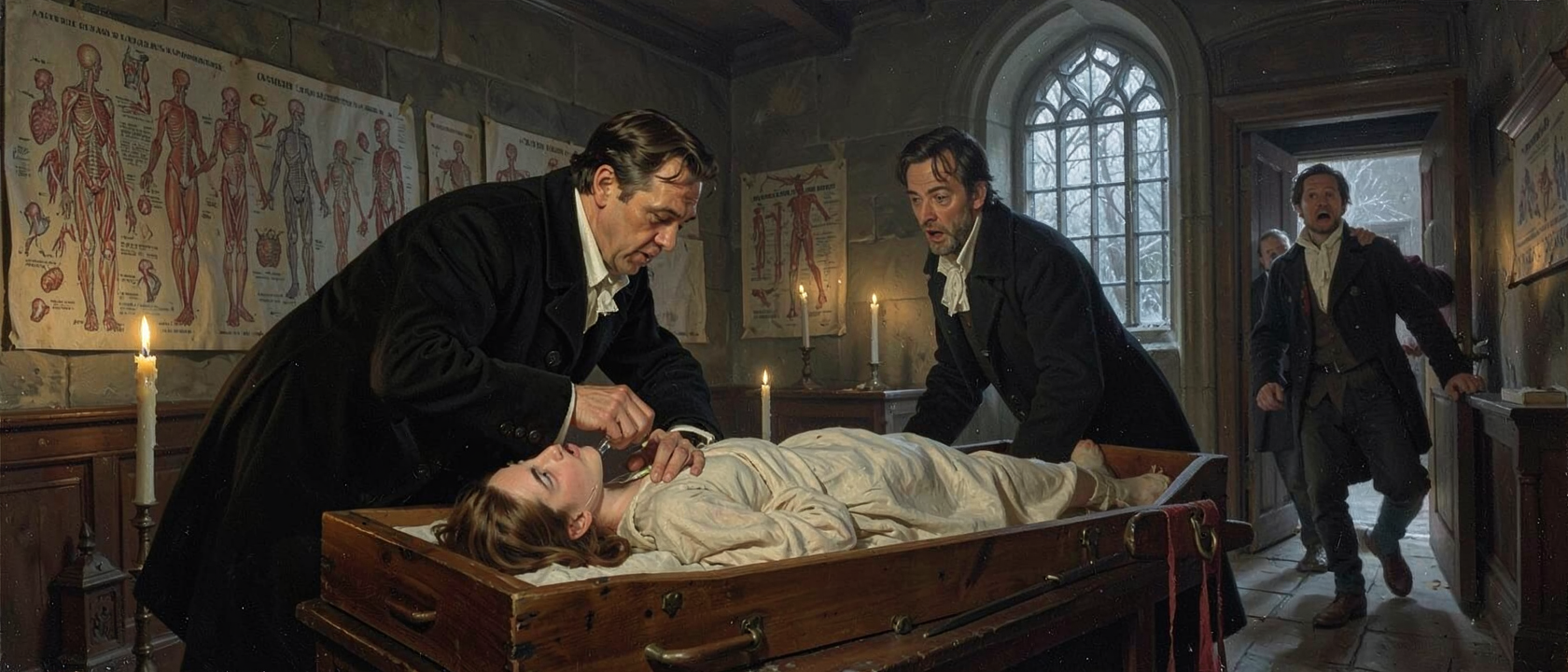
At the dissection house, the coffin was opened, by some accounts within hours of the hanging, by others the next morning, and the physicians found Anne Greene still breathing. There was a faint pulse, and what one witness described as an audible rattle in her throat. Petty and his colleague Thomas Willis, joined by Ralph Bathurst and Henry Clerke, abandoned the lecture and turned instead to reviving her. They forced open her clenched teeth and poured in a hot cordial, which brought on coughing, then they rubbed her fingers, hands, arms, and feet. They drew blood, massaged her with scented oils, and applied enemas (then called clysters) and poultices (cataplasms), the standard treatments of the day. A woman was laid in bed beside her for warmth. After 14 hours, Anne spoke again. Her full recovery took about a month.
Who Paid
The costs here were not shared evenly. Anne had spent three weeks in jail under threat of execution, survived a hanging meant to kill her, and carried the public shame of a capital charge for killing her own child. Sir Thomas Read’s teenage grandson, who had fathered that child, faced no recorded punishment at all. Read himself, who had pushed for her prosecution, died three days after the hanging, around December 17, 1650. Many at the time read his death as a judgment on the man who had sent her to the gallows. No medical connection between the two events has ever been established; only the timing is on record.
After
Because a midwife had testified the infant could never have survived outside the womb, the case against Anne unraveled. The undersheriff sought a reprieve so that, if she lived, she would not be sent back to finish the sentence. She was declared innocent again in the eyes of the law. Anne recovered fully, moved to Steeple Barton, and brought her coffin with her as a keepsake. She later married and had three more children.
What the Pamphlet Denies
A different story took hold of what had happened to her: that while she lay presumed dead, she had seen a green meadow with a river running around it. Richard Watkins, who published a sober account of the case the following year titled Newes from the Dead (1651), denied this directly, writing that such stories belonged to ballad-makers, not to the facts of the matter. By his account, Anne remembered nothing between her last hours in jail and the moment she woke, except a brief, fleeting glimpse of the hangman.
Two things about the case were never settled. No one at the time, or since, has offered a medical explanation for how she survived half an hour on the rope. And no surviving record names the day she was tried, only the day she was hanged.