
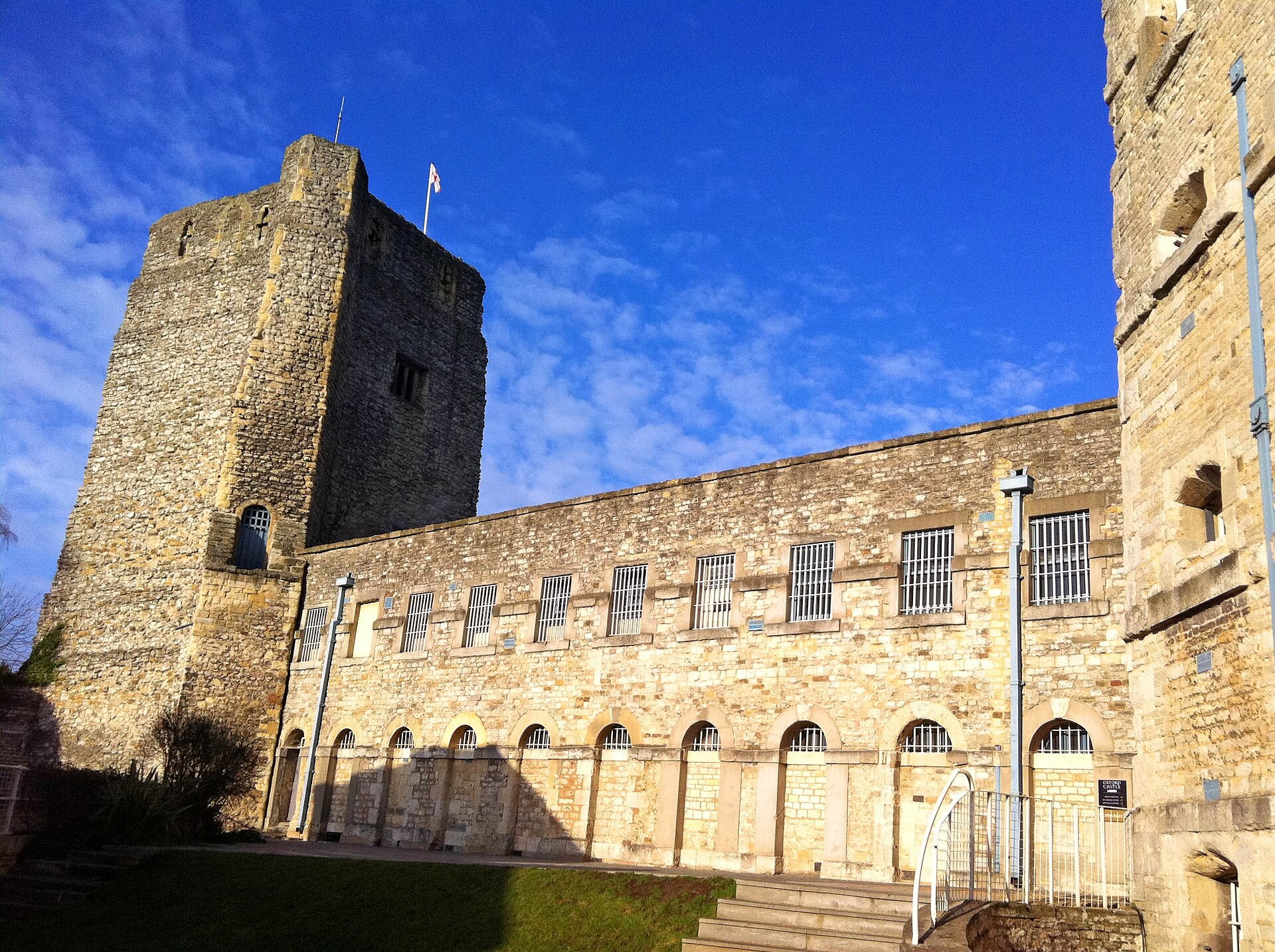
Oxford Castle is a Norman fortification built on the western edge of Oxford in the eleventh century, later absorbed into a county prison that operated until 1996. Its oldest surviving fabric, St George’s Tower, predates the castle proper and is thought to have begun as a Saxon watch tower around 1020. Few English urban sites carry as compressed a record of Norman conquest, civil war, scholarship, and penal history within such a small footprint.
Key facts
- Country: United Kingdom
- Type: castle
- Located in: Oxford
- Coordinates: 51.7518, -1.2625
Construction and Layout
Robert D’Oyly raised the castle in the years following the Norman Conquest, placing it on the western edge of the town and diverting a stream of the River Thames — now called Castle Mill Stream — to cut a protective moat around the site. The initial design was a motte-and-bailey arrangement. The motte was originally about 60 feet (18 m) high and 40 feet (12 m) wide, built from layers of gravel strengthened with clay facing.
In the thirteenth century the earlier timber keep on the mound was replaced by a ten-sided stone shell keep enclosing an inner courtyard only 7 metres (22 ft) across. St George’s Tower, standing separately, is now believed to pre-date the rest of the castle entirely. Scholars consider it to have been a Saxon watch tower associated with the original west gate of the city, built around 1020, which D’Oyly’s builders then incorporated into the new fortification.
St George’s Chapel and its Collegiate Foundation
In 1074, Robert D’Oyly and Roger d’Ivry jointly founded St George’s Chapel within the castle walls and endowed it as a collegiate church for secular canons. This made it the first collegiate church to be established inside an English castle. Its canons included scholars from early Norman times onward, and the chapel is widely regarded as a precursor to Oxford University, predating the developing university by a century or more.
The chapel’s connection to medieval learning was direct. In 1136, Welsh scholar Geoffrey of Monmouth was a serving canon at St George’s Chapel. It was there that he wrote Historia Regum Britanniae, one of the earliest narratives to set out the legend of King Arthur. The crypt chapel beneath St George’s Tower survives from this period and, together with the tower, has been Grade I listed since 1954.
The Anarchy and Empress Matilda’s Escape
Oxford Castle’s most dramatic episode occurred during the civil war between King Stephen and Empress Matilda. In December 1142, after a prolonged siege had left the castle’s garrison near collapse, Matilda escaped by descending the castle walls on a rope with three knights. All four were cloaked in white to blend with the snow on the ground. They crossed the frozen River Thames on foot and walked six miles to Abingdon, reaching safety.
Prison, Executions, and Judicial Use
The castle’s function shifted toward justice and confinement over the medieval and early modern centuries. By 1236 the gaol was being used to house the University of Oxford’s own ‘rebellious scholars,’ a detail that captures how tightly the castle’s administration was bound up with the life of the town around it.
Capital punishment was carried out at the site until well into the nineteenth and twentieth centuries. The last public execution at Oxford Castle took place in 1863. Executions continued privately within the prison walls until 1952. The prison closed in 1996, by which point it was so overcrowded that three prisoners were held to a cell.
The judicial infrastructure of the site also left a mark on Oxford University’s own vocabulary. A tunnel ran directly from the County courtroom into the prison — one of only two such tunnels in England — and the phrase ‘to be sent down,’ meaning to be expelled from the university, has its origins here.
The Domesday Omission
Oxford Castle is absent from the Domesday Book of 1086, despite having been standing for at least fifteen years by the time the survey was compiled. Its omission is not evidence that the castle was unknown or unimportant; the survey simply did not record every castle in existence.
Regeneration and Current Status
After the prison closed in 1996, Oxfordshire County Council, which holds the freehold of the site, partnered with the Oxford Preservation Trust and private developer Trevor Osborne on a regeneration scheme carried out between 2004 and 2006. Malmaison, one of the few hotel companies willing to take on the conversion, transformed the prison into a hotel while keeping the A Wing virtually intact.
Did you know
- Geoffrey of Monmouth, the Welsh scholar who wrote Historia Regum Britanniae in 1136 — one of the earliest texts to narrate the legend of King Arthur — was a serving canon at St George’s Chapel inside Oxford Castle when he composed the work. (oxfordcastleandprison.co.uk)
- St George’s Chapel, founded within the castle in 1074, is widely regarded as the seed from which Oxford University grew. Its canons included scholars from early Norman times, predating the developing university by a century or more. (historyhit.com)
- The phrase ‘to be sent down,’ meaning to be expelled from Oxford University, traces back to a tunnel connecting the County courtroom directly to Oxford Prison. It is one of only two such tunnels in England. (historyhit.com)
- When the prison closed in 1996 it was so overcrowded that prisoners were held three to a cell. Malmaison was one of the few companies willing to take on the hotel conversion, and it kept the A Wing of the former prison virtually intact. (blog.quintinlake.com)
- Oxford Castle does not appear among the 48 castles recorded in the Domesday Book of 1086, even though it had been standing for at least fifteen years by that date. The survey did not capture every castle then in existence. (wikishire.co.uk)
- In 1236 the castle’s gaol was recorded as holding the University of Oxford’s own ‘rebellious scholars,’ a detail that shows how closely the castle-prison and the university were entangled from an early date. (oxfordhistory.org.uk)
Data sources
- Wikidata
- wikishire.co.uk
- oxfordvisit.com
- patrickcomerford.com
- british-history.ac.uk
- historiesandcastles.com
- oxfordshirehistory.org.uk
- oxfordpreservation.org.uk
Data updated: 2026-10-29