
In the spring of 1786, a Paris courtroom closed a case that had nothing to do with the queen of France, and everything to do with her name. Marie Antoinette never signed a document connected to the Affair of the Diamond Necklace, never met the men who ran the scheme, and never saw the necklace itself. The person punished hardest was the one who did nothing.
A Necklace No One Would Buy
By the early 1780s, court jewelers Charles Auguste Boehmer and Paul Bassenge had assembled, on speculation, the most expensive diamond necklace made in France to that point. It held 647 diamonds in triple rows that gave it the nickname “en esclavage,” the slave necklace, for the way the strands hung like chains. The price came to an estimated two million francs, though one account puts it closer to 1.6 million livres. Either way, only a king or queen could afford it.
Louis XVI reportedly offered it to his wife, who is said to have turned it down, telling him the crown needed warships more than diamonds. The necklace stayed unsold. Boehmer and Bassenge were left holding a piece too large, too costly, and too specific to sell to anyone else, a necklace built for a queen, with no queen willing to buy it.
The Broker Nobody Checked
In 1784, a woman named Jeanne de Valois-Saint-Rémy, who called herself the Comtesse de la Motte, worked her way into both men’s confidence. She claimed descent from an illegitimate son of King Henry II of France, and had married Nicolas de la Motte, a gendarme officer who styled himself a count, a claim to royal blood that left her with a title and almost no money.
Jeanne told Boehmer she had the queen’s ear and could finally arrange the sale he had been chasing for years. She told Cardinal Louis de Rohan, the Grand Almoner of France and a former ambassador to Vienna who had fallen out of royal favor, that she could broker his reconciliation with Marie Antoinette. Each man had a reason not to look too closely: Boehmer wanted the sale that would save his business, Rohan wanted back into the queen’s circle, and Jeanne wanted access to both their money and their standing. None of it required the queen to know any of this was happening.
Midnight in the Grove of Venus
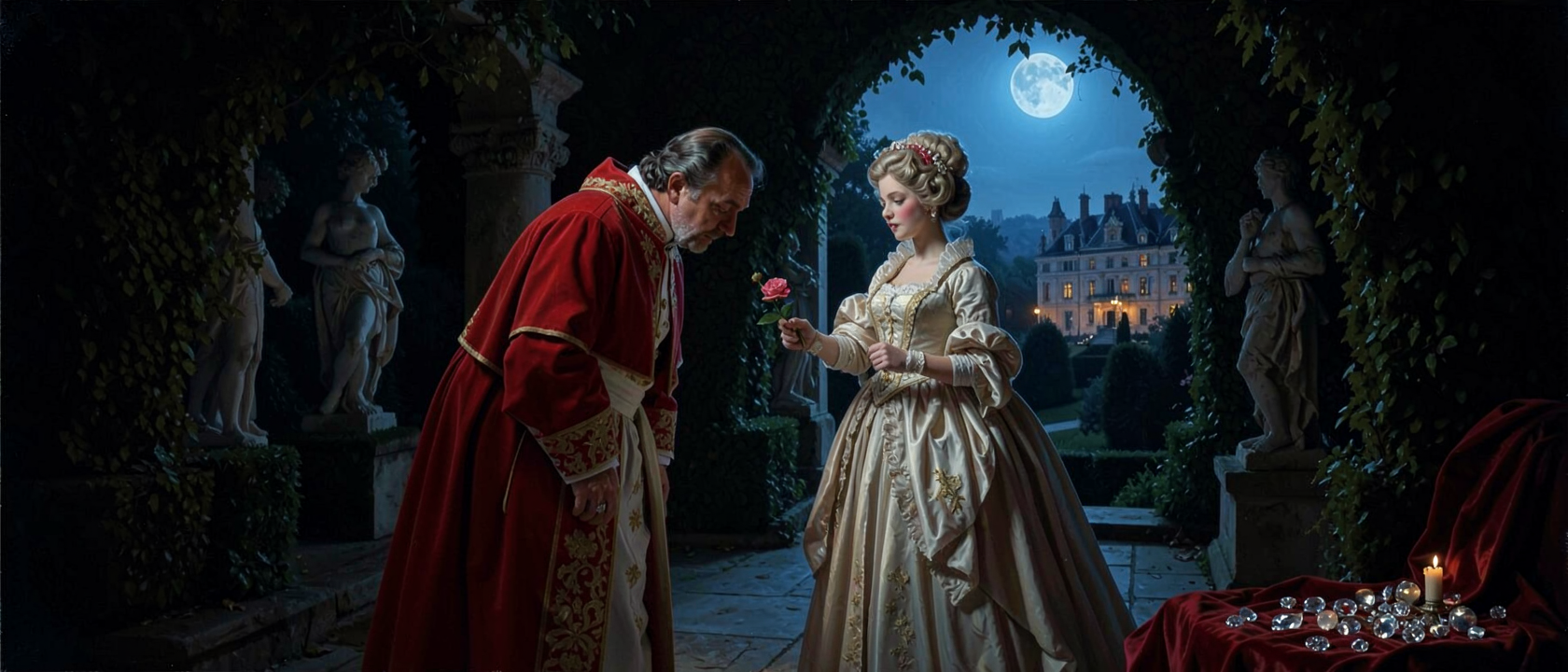
In August 1784, Jeanne staged the meeting Rohan had been begging for: a brief, secret meeting with the queen at night in the Bosquet de Vénus, the Grove of Venus, at Versailles. The woman who met him there was not the queen but Nicole Le Guay d’Oliva, a milliner turned prostitute, hired because she resembled Marie Antoinette closely enough in the dark. Rohan, convinced, handed her a rose.
Forged letters followed, supposedly written by the queen and asking Rohan to buy the necklace for her in secret. A man named Rétaux de Villette produced them, signing one “Marie Antoinette de France,” a signature no real French queen would have used, since custom called for her given name alone. Rohan missed the error. On February 1, 1785, he bought the necklace from Boehmer on credit and delivered it that evening to Jeanne’s husband, believing it was bound for Versailles.
It never got there. Jeanne pried the diamonds loose from their settings, by one account with a kitchen knife, and split the stones between two buyers. Her husband carried most of them to London and sold them there; a lover of hers sold others in Paris. The necklace no longer existed as a single object.
The Bill Comes Due
The scheme depended on Rohan continuing to pay on credit, and that is where it failed. The first installment came due in July 1785, and no one paid it. Boehmer, running out of patience, went around the cardinal and asked Marie Antoinette directly about the debt. By her own account she felt as if inside a labyrinth, with no idea what the jeweler meant, she had never ordered the necklace and had never discussed it with Rohan.
Louis XVI had Rohan arrested at Versailles on August 15, 1785, in the Hall of Mirrors, while the cardinal stood in full clerical dress ahead of a religious ceremony. Guards took him straight to the Bastille. Jeanne, Nicole Le Guay d’Oliva, forger Rétaux de Villette, and the self-styled occultist Cagliostro were arrested soon after. Jeanne’s husband, still in London, was tried without being present.
Rohan chose to be tried by the Parlement of Paris, the court with jurisdiction over nobles and senior clergy, rather than face a private hearing arranged by the king. What happened inside that courtroom over the following nine months is thinly documented; what survives is the outcome. On May 31, 1786, the Parlement voted, narrowly, to acquit him. Crowds gathered outside the Bastille to celebrate, not his innocence exactly, but what the verdict implied: that a queen suspected of secret garden meetings and jewelry bought behind her husband’s back deserved whatever she got.
Who Paid, and What It Cost
Rohan walked free of the charge but not of the consequences. Louis XVI exiled him to a remote abbey in the Auvergne and ordered him to repay Boehmer and Bassenge for the necklace. Jeanne was convicted of theft and sentenced to public flogging, branding with a V for voleuse, thief, and life imprisonment in the Salpêtrière. The sentence was carried out in June 1786, reportedly about a month before her thirtieth birthday. She later escaped prison disguised as a boy, reached London, and published memoirs in 1789 that laid the blame on Marie Antoinette. Her husband, never caught, was sentenced in absentia to flogging, branding, and a life on the galleys. Nicole Le Guay d’Oliva was acquitted; what became of her afterward is not recorded. Boehmer’s business had already collapsed under the unpaid debt before any repayment could reach him, and he was left bankrupt.
Marie Antoinette never bought the necklace, never touched it, never saw it. She lost no money and faced no charge. What she lost was harder to measure: a reputation already thought extravagant was now, in the public mind, confirmed. That gap, between who did the damage and who carried the cost, is the whole story. Years before the French Revolution began, the one person proven innocent in the Affair of the Diamond Necklace was the one the public had already decided to blame.