
The Garment and the World It Announced
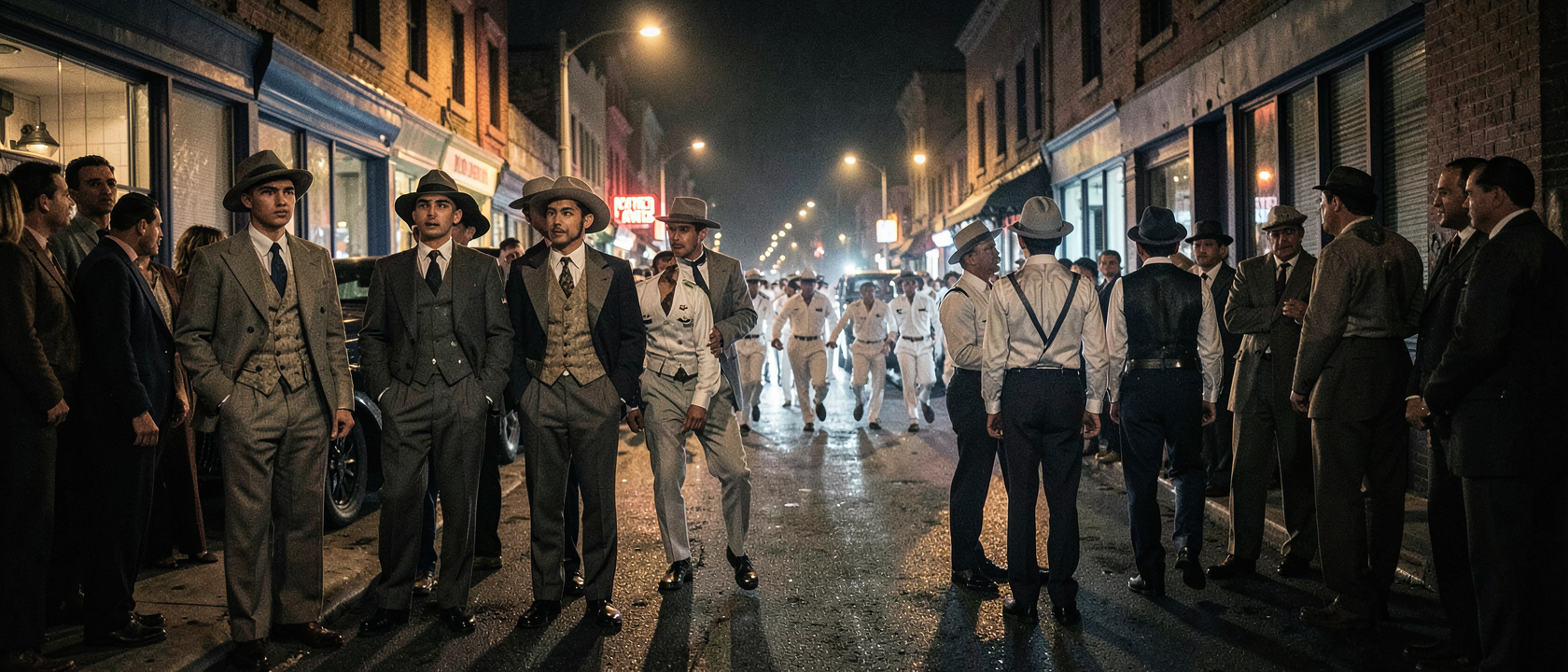
The suit was hard to miss. High-waisted trousers ballooned at the thigh and tapered sharply to the cuff. The jacket fell to mid-thigh, with padded shoulders, sprawling lapels, and enough fabric to trouble any tailor’s ledger. A wide-brimmed, fedora-style hat and a long watch chain completed the silhouette.
Historian Kathy Peiss traces the zoot suit’s origins to Harlem in the mid- to late 1930s, where tailors were producing the style for young Black men, a finding Britannica corroborates. The precise first tailor and exact year remain unknown, and Peiss notes the term likely derived from African American rhyming slang. The style spread through jazz venues and dance halls, and by the early 1940s had been adopted across ethnic lines.
Malcolm Little, not yet Malcolm X, bought his first zoot suit at fifteen, in 1940, and described the experience in his autobiography. César Chávez wore one as a deliberate act of defiance. Cab Calloway wore one on stage regularly, and on July 21, 1943, appeared in a white zoot suit in the 20th Century Fox film Stormy Weather, bringing the look to a national audience.
The pachuco subculture, young Mexican American men who built a distinct identity around language, music, and dress, carried its own separate history. Research from EBSCO indicates the pachuco lifestyle had developed in El Paso, Texas, before moving west to California. The zoot suit, when worn by a pachuco in Los Angeles, was a statement that required courage long before June 1943.
The Official Assault on the Suit, 1942–Early 1943
Before any serviceman raised a fist, Los Angeles authorities had done considerable work. On August 2, 1942, a young Mexican American man named José Gallardo Díaz was found dying near a reservoir in Commerce, California. Police rounded up approximately 600 Mexican Americans; 24 were indicted and 17 convicted in People v. Zammora, the largest mass trial in California history to that point. An appellate court eventually overturned all 17 convictions, citing lack of evidence, coerced testimony, denial of counsel, and judicial misconduct.
Also in 1942, the Los Angeles City Council passed a resolution formally outlawing the zoot suit, framing the garment as a marker of criminality. A roundup of zoot-suit wearers in early 1943 put an estimated hundreds more in jail. By the time servicemen took to the streets in June, the suit had been condemned by officials, amplified as a symbol of deviance by newspapers, and used as a pretext for mass arrest.
The Attacks Themselves
A clash between servicemen and Mexican American youths on May 31, 1943, left a sailor beaten. On the evening of June 3, approximately 50 sailors marched through the streets. Starting June 4, servicemen moved into Mexican American neighborhoods, assaulting young men in zoot suits and stripping the clothing from their bodies. The worst night was June 7, when thousands of servicemen and civilians spread across the city, into East Los Angeles and into Watts. Military authorities declared Los Angeles off-limits to servicemen on June 8, ending the main wave. Estimated casualties: 150 or more injured, 500 or more arrested. No one was killed. Local police, by multiple accounts, watched from the sidelines and then arrested the victims.
The primary targets were Mexican American pachucos, but Filipino American and African American young men were also attacked. Comparable incidents broke out in San Diego, Detroit, New York, Toronto, Mobile, and Beaumont during the same summer. Detroit’s violence was far deadlier: 34 killed, 433 wounded, and an estimated $2 million in property destroyed.
The most forensically significant fact about Los Angeles is the simplest: white individuals wearing identical zoot suits on the same streets were not attacked. The argument that the violence was directed at the clothing cannot survive that observation.
The Victims, Their Record, and the Charges Against Them
Two accusations circulated widely: that zoot-suit wearers avoided military service and wasted rationed fabric. Neither held up. Mexican Americans served at rates proportional to their population share; many of the young men attacked were simply too young to be drafted. The rationed-fabric argument was applied selectively, the same volume of cloth on a white wearer drew no comment.
No serviceman is recorded as having faced formal discipline for the attacks. The Citizens’ Committee appointed by Governor Earl Warren concluded that race prejudice had been a factor, a finding city officials flatly rejected. The day after the June 8 end of hostilities, the city passed a formal ban on zoot suits: the ordinance arrived after the beatings, not before them.
The Naming Problem, and What Remains Unresolved
The phrase “Zoot Suit Riots” implies mutual combat. Historian Douglas Henry Daniels has argued that the term obscures the one-sided, racially organized character of what happened: servicemen attacked; the reported injured were overwhelmingly their targets, not them.
Several things remain genuinely uncertain: no precise casualty count was established at the time, the exact origins of the style are contested, and no formal disciplinary record for any serviceman has surfaced. What is not in dispute: the people beaten and stripped were young men of color. The people left alone were white.
The Zoot Subculture’s Long Reach
Daniels argues that the phenomenon, its fusion of Black style, jazz sensibility, and deliberate outsiderness, contributed to bebop, Beat culture, and the broader redefinition of American social “hipness” during the 1950s. That cultural diffusion unfolded alongside documented, officially tolerated violence. In 1979, playwright Luis Valdez’s Zoot Suit, starring a young Edward James Olmos, became the first play by a Chicano writer to reach Broadway, and was released as a film in 1981. The events of June 1943 had not faded; they had been carried forward and put on a stage.