
A Company on the Road
The Queen’s Men, formally Queen Elizabeth’s Men, had existed for barely four years when the killing happened. Founded on March 10, 1583, by order directed to Edmund Tilney, Master of the Revels, the company was assembled under the direction of Sir Francis Walsingham by recruiting the best performers from several established troupes: Leicester’s Men, Sussex’s Men, and Oxford’s Men among them. Twelve founding members made it the first large acting company in English Renaissance theatre, twice the size of its predecessors.
Their touring pattern followed the calendar. Court appearances came in the winter season; the summer belonged to the provinces. Thame, a market town in Oxfordshire, was the company’s first stop on its 1587 provincial tour. On the evening of June 13, between nine and ten o’clock, two members of the company were in White Hound Close, an enclosed field on the edge of town. No surviving document records what passed between them before that evening, or what word or action set off the confrontation.
What the Company Name Was Worth
Carrying the Queen’s name on the road was a practical advantage, not just a title. Elizabethan vagrancy statutes gave local magistrates authority to treat unlicensed performers as vagabonds; the royal licence the Queen’s Men held insulated them against that risk. Municipal account books from towns along their touring routes recorded formal payments to the company of between 20 and 40 shillings per stop, figures that reflect institutional respect rather than casual hospitality.
That respect was contingent. Civic goodwill could be withdrawn, and an arrest or a violent death mid-tour was not something a company could absorb quietly. William Knell, described in period accounts as an “Absolute Actor,” played leading parts, including King Henry V in the pre-Shakespearean chronicle play The Famous Victories of Henry V. When he joined the company is a matter of some dispute: one source places him among the founding members in 1583, while another notes he may not have joined until around 1585. Either way, by the summer of 1587 he was a recognized performer in the company’s ranks.
John Towne, a founding member from 1583, was another. The coroner’s inquest that would follow his confrontation with Knell described him as “John Towne late of Shoreditch, yeoman.” Towne had appeared before a coroner before: on June 15, 1583, he was involved in an affray at The Red Lion inn in Norwich in which an audience member died, a case that resolved without recorded punishment. Four years later, he was in Thame.
Opposition to stage performance added its own pressure. Puritan reformers had been attacking the theatre as a morally corrupt institution for years, Stephen Gosson had published The Schoole of Abuse as early as 1579. The Queen’s Men operated on the tolerance of individual communities, and that tolerance had limits.
The Mound in White Hound Close
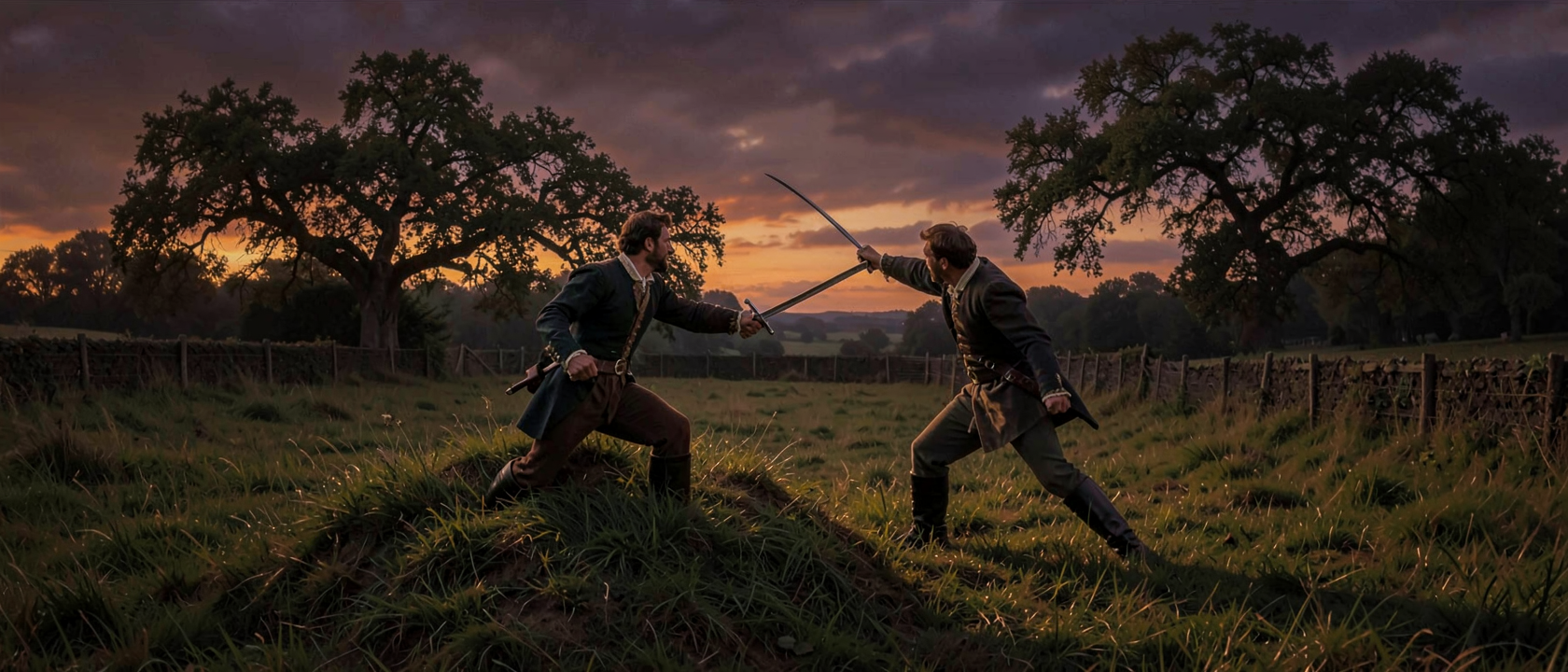
The coroner’s inquest is the primary document for what happened that evening, and it is specific where it can be. Knell drew his sword first and attacked Towne. Towne retreated to the raised ground of a mound within White Hound Close. There, cornered on the high point, he drew his own weapon, a sword of iron the inquest valued at five shillings, and thrust it into Knell’s neck.
The wound is recorded with the precision a coroner’s document requires: 3 inches (about 7.6 cm) deep and 1 inch (about 2.5 cm) wide. Knell did not die at once. He survived for approximately thirty minutes after the wound was inflicted. The inquest records the physical facts of those minutes; it records nothing of who else stood in White Hound Close that evening, or what was said before the swords came out.
What Towne Said, and What the Record Made of It
Towne’s account, as the inquest recorded it, was that he had acted to preserve his own life. Knell had been the aggressor; Towne had retreated; the sword had come out only when retreat was no longer possible. Under Elizabethan law, that framing corresponded to a claim of self-defence, and the inquest placed the initiation of violence on Knell.
Whether that finding would translate into a legal resolution in Towne’s favor was not settled at the inquest itself. He was held on a charge of murder. The cause of the original quarrel sits entirely outside the record; whatever the two men were arguing about, it mattered enough that one of them drew a sword, and the inquest had no obligation to explain why.
The Bill
William Knell was dead before ten o’clock on the night of June 13, 1587. His wife, Rebecca, née Edwards, had been married to him since January 30, 1586, when she was fifteen years old. The inquest that recorded her husband’s death left her a widow at fifteen.
John Towne remained imprisoned on a murder charge until August 15, 1587, when Queen Elizabeth I pardoned him, the formal determination being that he had acted in self-defence. He lived until 1617. The Queen’s Men continued their provincial tour, short one performer, with no surviving account of how the remaining stops were managed.
Rebecca Edwards remarried on March 10, 1588, when John Heminges received a licence to marry her; she was sixteen. Heminges, baptized November 25, 1566, became an actor and eventually the business manager of the King’s Men, and in 1623 he co-edited the First Folio of Shakespeare’s collected plays with Henry Condell, a project through which a large portion of Shakespeare’s work reached posterity. That editorial undertaking was carried out in part by a man whose connection to the Queen’s Men ran through a June night in an Oxfordshire field.
One further claim attaches itself to the episode: that Knell’s death left a vacancy the Queen’s Men filled by recruiting William Shakespeare during their 1587 Warwickshire tour. No firm documentary evidence supports it. It remains speculation. What the coroner’s inquest preserved was narrower and more durable: the name of a man who killed a colleague on a mound in a closed field, the name of the colleague who died, and the dimensions of the wound that killed him. Without the legal obligation that required a coroner to convene and record the facts of a violent death, none of those names would be recoverable at all.