
The Arrangements That Held
Mikhayil Mishaqa was born in 1800 in Rechmaya, in the emirate of Mount Lebanon. By his mid-thirties he had served as financial comptroller to the Shihab emirs of Hasbayya, taught himself medicine, and by 1859 held the post of United States Vice-Consul in Damascus. That combination was the product of arrangements several centuries in the making. Sultan Suleiman I established a legal order that suppressed inter-communal violence across Ottoman domains. Alongside it, the Capitulations treaties gave foreign merchants extraterritorial rights inside the empire, drawing Ottoman Christians and Jews into European commercial networks as intermediaries. Men like Mishaqa were the result: Ottoman subjects with one foot in the empire’s traditional hierarchy and another in European commercial culture. That equilibrium held for a long time. That is what makes 1860 legible.
Five Shocks to the System
The pressures accumulated in sequence. Napoleon’s forces invaded Egypt in 1798, were defeated at Acre in 1799 and withdrew, but the campaign announced a westward shift in global power that neither departure nor victory undid. A Second Serbian Uprising in 1815 and the Greek War of Independence beginning in 1821 eroded Ottoman authority in the Balkans. France seized Algeria in 1830. By 1831, Mehmed Ali Pasha had pushed his forces into Syria.
The Ottoman government’s answer was the Tanzimat, formally launched with an imperial edict on November 3, 1839. Part of the price for European support against Mehmed Ali, driven from Syria by 1840, was a commitment to equal treatment of all subjects regardless of religion. That commitment became law with a second imperial decree on February 18, 1856, declaring Muslims, Christians, and Jews legally equal before the Ottoman state.
Reform as Provocation
In Damascus, the 1856 decree landed badly. According to Eugene Rogan’s The Damascus Events, Shaykh Muhammad Said al-Ustuwani publicly condemned it as an attack on divinely ordered hierarchy, reportedly describing it as “ashes upon all Muslims.” That quotation has not been verified against independent scholarly sources. A separate economic grievance ran alongside it: a conspiracy theory that prosperous Christian notables like Mishaqa were agents of European displacement rather than loyal Ottoman subjects. One grievance concerned religious hierarchy; the other, economic competition. Both Rogan and Ian Rutledge, in his Sea of Troubles, treat them as compounding rather than identical forces.
July 1860
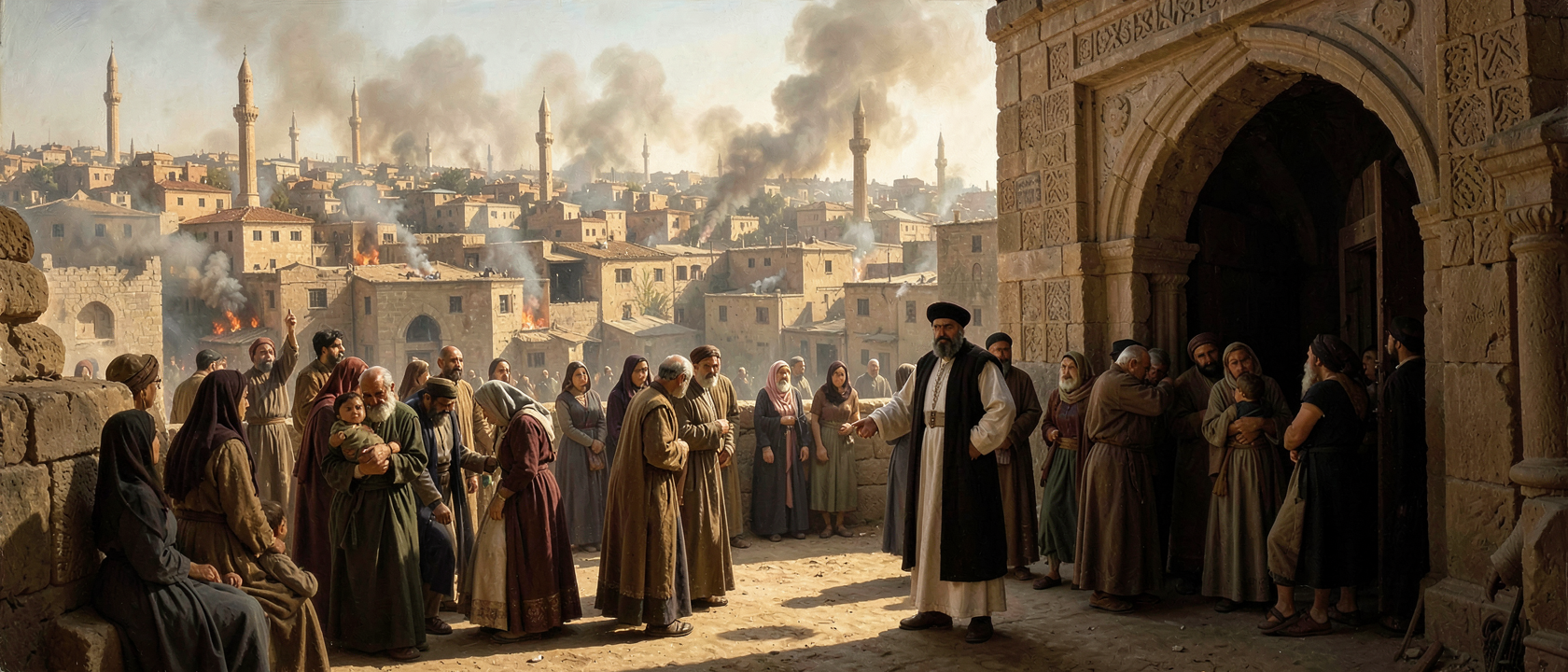
Violence broke out across Mount Lebanon in late May 1860. Rogan estimates roughly 10,000 to 11,000 Christians were killed there; other sources put the figure higher or lower. The Damascus massacre began July 9 and lasted eight days. Rogan’s publisher gives a figure of over 5,000 Christians killed in the city; other scholars have offered counts ranging from around 2,500 to 12,000. The material record is less disputed: 1,500 homes burned, 270 more destroyed by looters, 200 shops wrecked.
Mishaqa’s home was ransacked and his family attacked. He survived and later wrote what is considered the only eyewitness memoir of the Damascus killings by a survivor. The sources do not say how he came through it. Given equal weight in both books: Amir ʿAbd al-Qādir al-Jazāʾirī, an Algerian notable who had led armed resistance against French colonization in the 1830s and 1840s before settling in Damascus in 1855, organized the sheltering of Christians in his compound and escorted thousands more to the Damascus Citadel. French consular reports estimated he protected between 11,000 and 15,000 people.
The Porte Moves
The Sublime Porte recognized the political stakes immediately. France had already begun positioning roughly 6,000 troops for intervention. Mehmed Fuad Pasha arrived in Beirut on July 17 and reached Damascus on July 28 with approximately 4,000 troops. Within three weeks he had executed 167 men, court-martialled the Damascus governor Ahmad Pasha, and imposed a tax to fund reparations. He remained for approximately sixteen months. Damascus did not see a comparable outbreak of communal violence for decades afterward. Rogan reads this as evidence that the empire in 1860 was more capable than the “sick man of Europe” label suggested; that reading is contested.
The Longer Bill
Rutledge’s Sea of Troubles places the 1860 events inside a longer argument: that European competition for Ottoman territory, driven by industrial capitalism from roughly 1750 to 1918, was the most politically consequential sphere of imperialism in that period, and that it produced the First World War. The argument builds on and modifies Lenin’s characterization of the war as an imperialist, capitalist conflict. Italy invaded Libya in 1911. The genocide of Armenians and Assyrians occurred during World War One. The Treaty of Versailles in 1919 confirmed the empire’s dissolution. Between the Damascus killings and Versailles lay fifty-nine years.
What the Sources Leave Open
Four things remain uncertain. The death-toll figures for both Mount Lebanon and Damascus are estimates, and the range between scholars’ counts is wide enough to matter. Rutledge’s Mediterranean-rivalry thesis is an argued position, not an established consensus. Rogan’s reading of Ottoman capability in 1860 does not resolve the broader historical debate. And how Mishaqa survived July 1860 is simply not in the record: his memoir exists, the attack on his household is documented, and what happened between those two facts is not. He was born in 1800 in a Lebanese mountain village, made himself a physician and a diplomat, and died in Beirut in 1888. His papers ended up misfiled in the United States National Archives, where Rogan found them roughly a century later.