
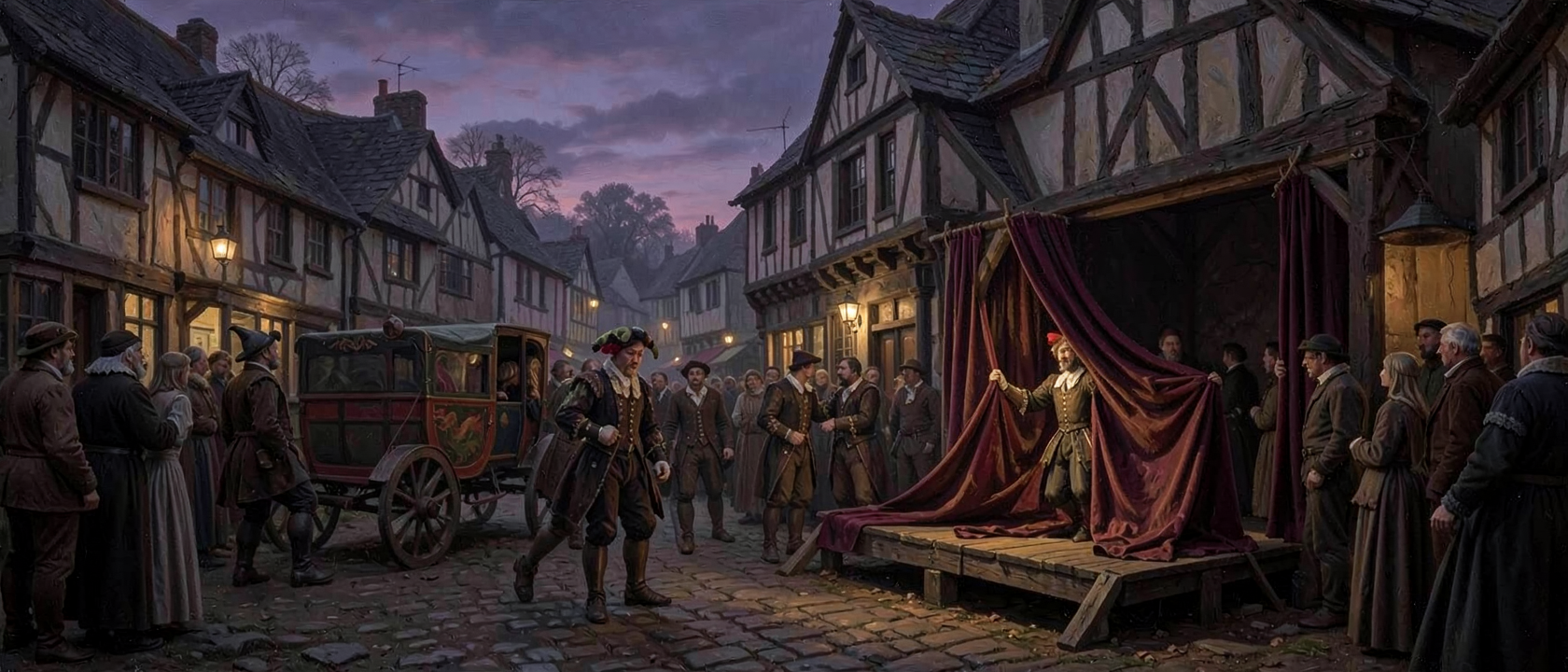
A Working Stop on a Working Tour
On the evening of June 13, 1587, between nine and ten o’clock, two members of the Queen’s Men met in an enclosure in Thame, a market town in Oxfordshire, and one of them did not walk away. The location the coroner recorded was White Hound Close. The company was on its summer tour of provincial England; Thame was a scheduled stop along the route.
What a Touring Company Ran On
The Queen’s Men were the most prominent theatrical company in England at that moment. Founded on March 10, 1583, when Edmund Tilney, the Master of the Revels, received the order to assemble it, the company was built by pulling performers from existing troupes. Sir Francis Walsingham organized the recruitment: Robert Wilson, John Laneham, and William Johnson came from Leicester’s Men; Richard Tarlton and John Adams from Sussex’s Men. The founding roster ran to twelve players.
The company held a royal patent, which gave it unusual standing with local officials, but standing was not a guarantee. In each town, a civic license had to be effectively granted, an audience had to pay, and the company had to leave an impression that earned an invitation back. A company that arrived trailing a public scandal handed hesitant authorities the grounds they needed to refuse entry or revoke a license.
What the Inquest Records
The coroner’s inquest is the primary document for that evening, and it renders the violence in measurements. William Knell drew his sword first and attacked. John Towne, identified as a Shoreditch yeoman and company member, retreated to a mound of earth and, pressed there, drew his own sword. The wound he delivered to Knell’s neck was 3 inches deep and 1 inch wide (about 7.6 cm by 2.5 cm). Knell survived approximately half an hour before dying. The inquest also logged the value of Towne’s sword at five shillings, standard procedure for the instrument of a killing.
The Immediate Cost
Towne was jailed and charged with murder. The Queen’s Men lost a performing member in the middle of a working tour. Knell had been with the company since its founding in 1583 and had played lead roles, including King Henry V in The Famous Victories of Henry V. His wife, Rebecca, had married him on January 30, 1586, when she was approximately fifteen. She was widowed before her sixteenth birthday. The inquest record, once written, named the company and the facts of the killing; any civic authority looking for grounds to turn the Queen’s Men away now had a document to point to.
What the Record Does Not Say, and What It Does
The inquest does not record what provoked the argument, but it establishes the sequence plainly: Knell drew first. Under the legal doctrine of se defendendo, that sequence bore directly on Towne’s situation, and the coroner’s framing appears to have held. A royal pardon was granted to John Towne on August 15, 1587, roughly two months after the killing.
One claim circulates widely and deserves a clear label: the suggestion that Knell’s death opened a vacancy that William Shakespeare filled when the Queen’s Men toured Warwickshire. Scholars have treated this as speculation, not evidence. No documented connection links Shakespeare to the company at that moment.
Rebecca Knell did not remain a widow long. John Heminges, later Shakespeare’s fellow in the King’s Men and co-editor of the First Folio of 1623, received a marriage license on March 10, 1588, to marry her. She was sixteen.
The Longer Reckoning
The Queen’s Men did not regain their footing easily. Richard Tarlton, the company’s star clown, died on September 3, 1588, removing its most recognizable performer. Meanwhile the Admiral’s Men were rising, performing Christopher Marlowe’s plays with Edward Alleyn. The Queen’s Men’s dominance, unchallenged since 1583, gave way across the following years; their last recorded performance fell between Christmas 1602 and the death of Queen Elizabeth I.
Across the late sixteenth and early seventeenth centuries, towns that had once licensed companies without friction began paying them to leave without performing, or turned them away outright. The Thame killing did not cause that drift, but it illustrates the structural fragility the whole practice rested on: a company’s reputation depended on every one of its members at every stop. Parliament’s ordinance of September 2, 1642 closed the theaters entirely for eighteen years, until 1660.
The coroner’s inquest from White Hound Close, with its five-shilling sword and its three-inch wound, records what touring theater actually rested on: the conduct of working actors under pressure, in a field in Oxfordshire, on a June evening. When that conduct failed, the cost fell first on William Knell, then on John Towne through the two months he spent jailed, and then in slower increments on the company that had to keep performing after both of them.