The Ground Before the Fire
On August 1, 1838, full emancipation took effect across the British Caribbean, ending compulsory apprenticeship in Jamaica. The British government distributed roughly £20 million in compensation to former slaveholders across the Caribbean. The people who had been enslaved received nothing.
In the parish of St. Thomas-in-the-East, the years after 1838 settled into a documented pattern. Vagrancy laws and tied-labor arrangements constrained where freedpeople could work and live. The magistracy was drawn almost entirely from the planter class. By 1864, when Edward Eyre arrived as governor, Jamaica’s population exceeded 436,000, with Black Jamaicans outnumbering white residents by roughly 32 to 1; fewer than 2,000 Black men qualified to vote. The sugar industry was failing, floods had damaged the 1864 harvest, cholera and smallpox epidemics were only ending around 1865, and a two-year drought had preceded the season. These conditions were recorded in petitions sent to the Colonial Office and in public meetings organized by George William Gordon, an elected assemblyman representing St. Thomas-in-the-East.
The Stakes Before the First Shot
Gordon, son of an enslaved woman and a white planter, had made himself a merchant and assemblyman, spending years pressing the Colonial Office on court corruption, land policy, and Eyre’s governance. In 1864, Eyre had Gordon ejected from the local vestry. Paul Bogle, a Baptist deacon in Stony Gut about 4 miles (6.4 km) north of Morant Bay, ran the social network connecting Gordon’s political arguments to the parish population. Gordon had been instrumental in Bogle’s appointment as deacon in 1864. What was riding on the autumn of 1865 was not only parish grievances, but Gordon’s life, the legal limits of martial law, and whatever formal political representation Black and mixed-race Jamaicans held.
What Actually Happened
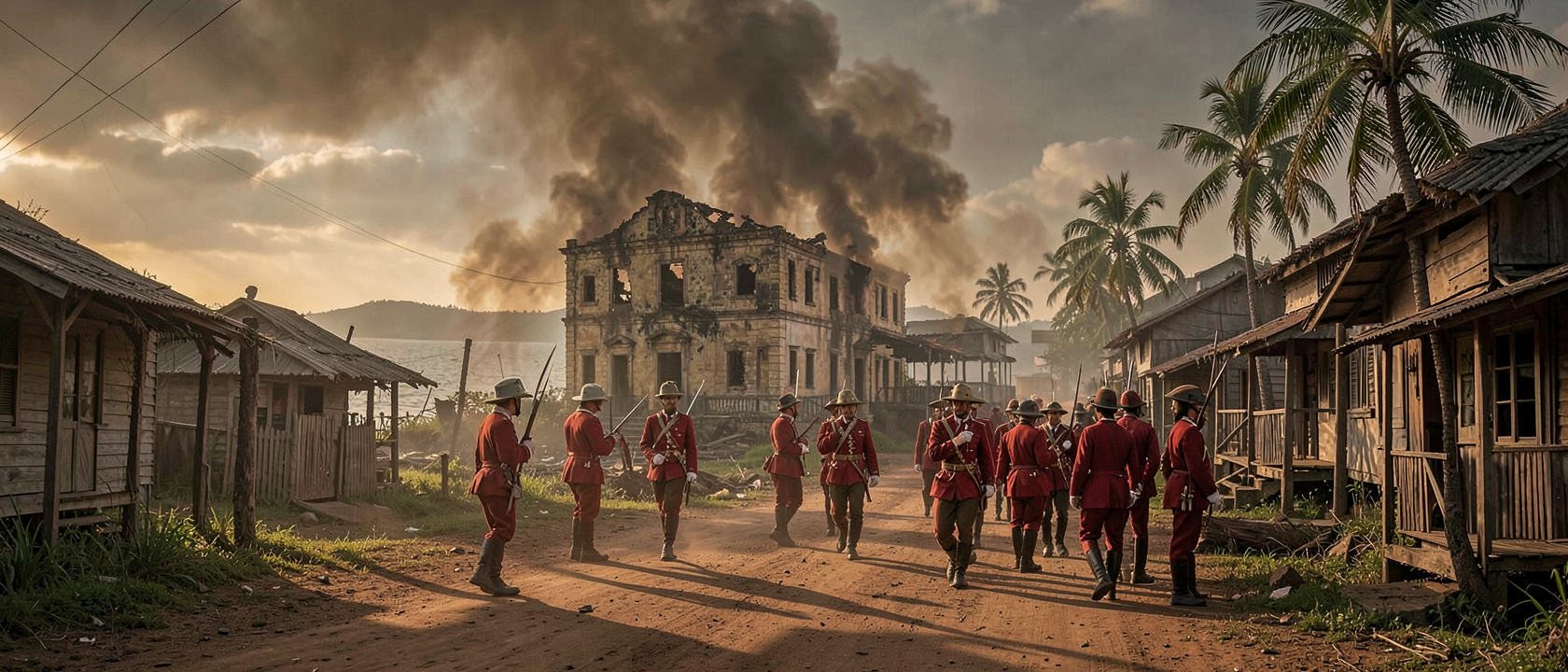
The sequence began on October 7, 1865, when a Black man was tried in Morant Bay for trespassing on an abandoned sugar plantation. The verdict produced protests and a confrontation between police and demonstrators. On October 9, colonial authorities attempted to arrest Bogle; the attempt was resisted. On October 11, several hundred Black Jamaicans marched to the Morant Bay courthouse. The volunteer militia opened fire, killing seven protesters; eighteen officials were killed in the fighting that followed and thirty-one wounded. The courthouse burned. Governor Eyre declared martial law on October 13. British regular troops and Maroon auxiliaries were deployed across St. Thomas-in-the-East. The operation killed at least 439 people by the most commonly cited count, with other estimates reaching nearly 500 or higher. More than 300 people were arrested, at least 600 flogged, and more than 1,000 homes destroyed. Multiple contemporary accounts reported that people who had surrendered, and others with no connection to the courthouse events, were killed in the sweep. Martial law remained in force until November 13, 1865.
The Engineered Execution of George William Gordon
Gordon was arrested in Kingston, explicitly outside the zone to which martial law applied. Eyre ordered him transported by warship to Morant Bay, where martial law was in force. In Kingston, Gordon would have faced a civilian jury including men sympathetic to him; in Morant Bay, he faced a court martial with none of a civilian trial’s procedural protections. The charges were high treason and sedition. The evidence consisted of his participation in political meetings and his correspondence with Bogle; no evidence placed him at the courthouse on October 11 or at the police station. He was convicted and hanged on October 23, 1865. Bogle was hanged the following day. Legal scholars have characterized the transfer from Kingston to Morant Bay as a deliberate mechanism to obtain a specific judicial outcome. The record supports that characterization.
The Transatlantic Battle Over Accountability, 1866–1868
A Royal Commission established in December 1865 interviewed more than 700 witnesses and reported in June 1866 that the punishments had been “excessive” and “far greater than the necessity required.” Its practical result was Eyre’s removal from office. In August 1866, Thomas Carlyle, whose 1849 essay had argued Black people were suited to coerced labor, organized the Eyre Defence and Aid Committee; Charles Dickens, Alfred Lord Tennyson, and John Ruskin lent support. The Jamaica Committee, formed in December 1865 in Britain, pressed for criminal prosecution. John Stuart Mill, who joined the committee in January 1866 and became its dominant figure, led the campaign for prosecution as the sitting MP for Westminster, with Charles Darwin, Thomas Huxley, and Frederic Harrison among the membership. Multiple prosecution attempts between 1866 and 1868 produced no indictment. In 1868, Alexander Phillips, a Black Jamaican whose property had been destroyed, brought a private prosecution against Eyre in England; it failed, in part because the Jamaican legislature had passed legislation barring compensation claims arising from the suppression.
Who Paid and What It Cost
On January 17, 1866, the House of Assembly voted itself out of existence; Jamaica became a Crown Colony, ending the constrained formal political participation Black and mixed-race Jamaicans had held. No freedperson received compensation for death, injury, or destroyed property. A Jamaican act of indemnity exempted Eyre and colonial officials from legal liability. Eyre was recalled without a pension and never appointed to another colonial post, and was never criminally charged. The failed prosecutions did, however, establish a precedent that subsequent colonial governors took seriously: the record shows measurable caution in the invoking of martial law after 1868, a restraint that legal historians have traced directly to those proceedings.
The Disputed Ground
The figure of at least 439 killed is a documented floor, not a confirmed ceiling. The records do not reliably distinguish active combatants from people with no involvement in the courthouse confrontation. Historians continue to disagree on whether the hardening of pseudo-scientific racial hierarchy visible in the Anthropological Society’s alignment with Eyre’s cause represented a rupture with earlier British ideology or its restatement in new institutional language.
What is not in dispute is the direction of each outcome. The dead were overwhelmingly Black Jamaicans. The uncompensated were Jamaican. The disenfranchised were Jamaican. Gordon was executed on charges assembled from speeches and letters, through a process that physically moved him across a legal boundary to keep a jury out of the room. The man who ordered that transfer left England with his legal record clean.